










By Cybersecurity Desk & Special Analysis
Published: April 2025
Some of the most devastating cyber-attacks against major global organizations in recent years did not begin with a zero-day exploit, a sophisticated supply-chain compromise, or a malicious email attachment loaded with advanced malware. They started with something far more mundane, routine, and fundamentally human: a phone call or chat message to the internal IT service desk.
In the modern enterprise landscape, cybersecurity defenses have grown exponentially more robust. Endpoint Detection and Response (EDR) platforms, Zero Trust architectures, hardware-backed multi-factor authentication (MFA), and advanced threat intelligence have made perimeter and device infiltration exceedingly difficult for cybercriminals. Consequently, sophisticated threat actors have pivoted away from attacking software vulnerabilities. Instead, they are targeting the soft underbelly of corporate security: the help desk technician whose primary directive is to be helpful, efficient, and responsive.
This methodology has become the signature tactic of Scattered Spider—a notoriously agile, financially motivated cybercrime collective that has systematically dismantled the security perimeters of major retailers, hospitality giants, and critical service providers. By conducting exhaustive reconnaissance on employees, constructing highly convincing digital personas, and leveraging psychological manipulation, these attackers persuade support staff to reset passwords or bypass authentication factors. In doing so, they turn legitimate, everyday account-recovery processes into a frictionless highway past an organization’s most rigorous security controls.
The 2025 cyber-attacks targeting prominent UK retailers have starkly illuminated the terrifying effectiveness of this approach. Furthermore, they expose a profound strategic flaw for enterprise defenders: investing heavily in strong authentication at login is virtually meaningless if the administrative process for recovering an account relies on rudimentary identity checks that an adversary can effortlessly satisfy.
1. Main Facts: The Service Desk as an Attack Vector
To understand the mechanics of a modern Scattered Spider attack, security leaders must fundamentally rethink what constitutes an enterprise perimeter. The service desk does not sit behind the firewall; rather, it sits upstream of many of the identity controls organizations depend upon. A password reset or an MFA device change may appear to be a routine administrative support ticket, but both are fundamentally high-privilege, security-sensitive actions. They dictate who the organization trusts as a legitimate, authenticated user.
The Anatomy of Help Desk Social Engineering
When threat actors target an IT service desk, they exploit a systemic vulnerability in how corporate identities are verified remotely. Traditional help desks are structurally optimized for speed and customer satisfaction. Technicians are rewarded for resolving tickets quickly, minimizing user downtime, and displaying empathy to frustrated employees who claim they are locked out of critical systems.
Scattered Spider operatives weaponize these operational priorities against the organization. By exploiting common human traits—such as a desire to be helpful, respect for authority, and the pressure of urgency—attackers bypass technical controls without writing a single line of malicious code.
The attack unfolds across a distinct operational framework:
- Target Identification & OSINT (Open-Source Intelligence): Attackers meticulously research corporate hierarchies, organizational charts, and employee personal details using professional networking platforms, public corporate registries, and historical data leaks.
- Persona Crafting: The attacker equips themselves with enough biographical data to comfortably impersonate the target employee during a high-pressure phone call or live chat session.
- Manufactured Urgency: Contacting the help desk under the guise of an emergency (e.g., an impending board meeting, an urgent client presentation, or a broken smartphone), the attacker convinces the technician to bypass standard verification protocols or accept weak answers to security questions.
- Privilege Escalation & Persistence: Once the service desk issues a temporary password or registers a new MFA token controlled by the attacker, the adversary gains unmitigated access to Single Sign-On (SSO) environments, email systems, and internal corporate directories.
2. Chronology: The Evolution of Scattered Spider Operations
Over the past several years, Scattered Spider (also tracked by various threat intelligence groups under designations such as UNC3944, Octo Tempest, and StarFraud) has evolved from a loose collective of digital extortionists into a highly organized, syndicate-like enterprise. Their operational history provides a clear roadmap of how help desk social engineering has been refined into a fine art.
2022–2023: The Rise of SIM-Swapping and Help Desk Exploitation
Initially gaining notoriety through aggressive SIM-swapping campaigns targeting telecommunications providers and cryptocurrency holders, Scattered Spider quickly expanded their operational scope to large enterprises.
- Late 2022 / Early 2023: Security researchers began tracking a surge in sophisticated social engineering attacks where threat actors routinely bypassed MFA protections not by exploiting technical flaws in protocols like FIDO2 or push notifications, but by directly manipulating human intermediaries at corporate help desks.
- September 2023: The collective executed high-profile breaches against American hospitality and entertainment giants MGM Resorts International and Caesars Entertainment. In the case of MGM, attackers leveraged information gathered from LinkedIn to identify an employee, called the help desk, and successfully convinced support staff to execute a password and MFA reset. The resulting operational disruption cost MGM tens of millions of dollars, shutting down hotel room key cards, slot machines, and internal reservation systems.
2024: Expanding into Telecommunications and Critical Infrastructure
As enterprises scrambled to harden their external defenses following the MGM and Caesars incidents, Scattered Spider adapted by shifting their focus internationally and targeting diverse industry verticals, including financial institutions, business process outsourcers, and telecommunication providers.
During this period, intelligence agencies globally—including the US Cybersecurity and Infrastructure Security Agency (CISA) and the UK’s National Cyber Security Centre (NCSC)—began issuing urgent joint advisories highlighting the group’s reliance on help desk social engineering as a primary vector for initial access.
2025: The UK Retail and Co-op Attacks
The threat matured further into 2025, marked by sophisticated campaigns targeting major British retail organizations and consumer cooperatives. These incidents demonstrated that no sector is immune to identity-based social engineering.
A landmark moment in understanding these tactics came during official parliamentary proceedings investigating a high-profile attack on the UK’s Co-op group. During the hearings, Chief Digital and Information Officer (CDIO) Rob Elsey provided transparent testimony detailing how the attackers breached corporate defenses. According to Elsey, the threat actors systematically impersonated a legitimate colleague, successfully answered a battery of standard security verification questions posed by the help desk, and induced support personnel to execute a full account reset.
Remarkably, within roughly one hour of the fraudulent password and credential reset, internal monitoring tools detected malicious lateral movement and anomalous behavior originating from the compromised account—underscoring just how rapidly adversaries transition from initial access to full-scale domain reconnaissance.
3. Supporting Data and Intelligence Agency Warnings
The empirical data gathered by cybersecurity researchers and government bodies paints a sobering picture of the scale and efficacy of service desk attacks. Identity-focused social engineering is no longer an isolated phenomenon; it represents a primary vector for enterprise compromise.
CISA and FBI Joint Advisories
In official advisories (such as CISA Advisory AA23-320A), federal authorities have explicitly warned that Scattered Spider operatives routinely leverage vishing (voice phishing) and SMS-based social engineering to target IT help desks. Key methodologies highlighted by CISA include:
- MFA Token Interception: Persuading service desk agents to transfer or rebind Multi-Factor Authentication tokens (such as hardware tokens or authenticator app registrations) to devices directly controlled by the threat actor.
- SSO Exploitation: Utilizing the newly provisioned credentials to infiltrate cloud-hosted Single Sign-On (SSO) environments, allowing seamless lateral movement across Software-as-a-Service (SaaS) applications, enterprise resource planning (ERP) systems, and collaboration tools.
- Credential Resets via Live Chat and Phone: Capitalizing on help desk channels that lack visual confirmation or out-of-band cryptographic verification, making it trivial for an actor using a spoofed caller ID or email address to pass as a stressed executive or distracted employee.
The Information Gap in Identity Verification
According to industry studies on enterprise identity management, a staggering percentage of organizations still rely on easily accessible personal data—such as employee ID numbers, office locations, manager names, date of birth, or home addresses—as secondary validation factors during service desk recovery calls.
Because virtually all of this information can be harvested from public social media profiles, data broker sites, or previous corporate data breaches, it fails to provide cryptographic certainty. When a help desk technician treats these static, easily researched data points as authoritative proof of identity, the security architecture collapses entirely.

4. Official Responses and Industry Accountability
The escalating frequency of service desk compromises has forced a profound re-evaluation of how IT support operations interface with corporate security teams. For decades, IT service desks operated under a service-level agreement (SLA) model centered on speed, convenience, and user satisfaction. Today, industry leaders argue that the help desk must be re-engineered as a high-security operational gatekeeper.
Corporate Transparency and Parliamentary Scrutiny
The willingness of executives—such as Co-op CDIO Rob Elsey—to testify openly before legislative bodies marks a cultural shift in how major organizations respond to cyber incidents. By publicly detailing how attackers bypassed routine verification questions, corporate leaders are helping to strip away the stigma associated with social engineering breaches.
These transparent disclosures have catalyzed cross-industry collaboration, compelling CISOs to share telemetry, caller-ID indicators, and behavioral scripts used by groups like Scattered Spider with information sharing and analysis centers (ISACs).
The Mandate for Policy Overhaul
Regulatory bodies and industry standards organizations are responding by tightening compliance frameworks. Security frameworks are increasingly requiring organizations to decouple help desk password resets from manual, conversational verification.
Organizations are being urged to implement strict out-of-band verification policies, such as mandating that any password reset or MFA token re-enrollment request must be authorized via a pre-registered physical security key, a hardware biometric check, or a secure push notification sent to a verified, enterprise-managed mobile device—never via verbal confirmation over an unencrypted phone line.
5. Enterprise Implications: Securing the Service Desk
The overarching lesson from the campaign of attacks waged by Scattered Spider is clear: Security is only as strong as its weakest administrative link. An organization can deploy cutting-edge endpoint protection and zero-trust network access, but if an attacker can manipulate a Tier-1 support technician into handing over the keys to the kingdom via a five-minute phone call, those technical investments are bypassed entirely.
To effectively immunize the enterprise against service desk social engineering, security architects must implement a multi-layered defense strategy spanning policy, human training, and automated technological controls.
Strategic Recommendations for Enterprise Defense
- Eliminate Static Security Questions: Completely phase out knowledge-based verification questions (e.g., "What was the name of your first pet?" or "What city were you born in?"). These details are trivial for advanced adversaries to harvest from social media or breach archives.
- Implement Out-of-Band Verification: Ensure that any sensitive account recovery request triggers an automated, secure out-of-band notification to the user’s primary, verified hardware device or trusted mobile app, requiring direct user authorization before an agent can proceed.
- Enforce Role-Based Privileged Access for Support Staff: Limit the ability of help desk agents to perform broad credential resets or MFA re-registrations without secondary supervisory approval or automated risk-scoring checks.
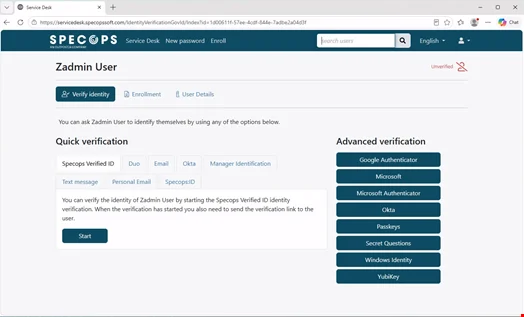
- Deploy Advanced Identity Verification Solutions: Integrate specialized technologies designed to harden the service desk against impersonation attempts. Solutions such as Specops Secure Service Desk introduce robust, automated identity verification steps directly into password reset and account unlock workflows. By requiring users to authenticate via secure MFA factors, directory attributes, or dynamic cryptographic challenge questions before a request can be processed, these tools remove the guesswork—and the vulnerability—from human-led verification.
- Continuous Behavioral Training and Simulation: Regularly train help desk personnel not just on general phishing awareness, but specifically on vishing techniques, social engineering indicators of urgency, and the specific playbooks utilized by threat groups like Scattered Spider. Emphasize to support teams that it is acceptable—and encouraged—to challenge callers, pause interactions, and verify requests through secondary internal communication channels.
- Robust Auditing and Telemetry: Maintain comprehensive, immutable audit trails for every service desk-initiated password change, account unlock, and MFA token modification. Integrating these logs with SIEM (Security Information and Event Management) platforms enables security operations centers (SOCs) to instantly flag anomalous administrative actions occurring shortly after an account recovery event.
Conclusion
The evolution of Scattered Spider and their relentless focus on the enterprise service desk serves as an urgent wake-up call for the global cybersecurity community. Attackers will always follow the path of least resistance. As technical perimeters harden, the human element—specifically the personnel tasked with keeping business operations running smoothly—will remain a primary target for sophisticated syndicates.
Securing the modern enterprise requires looking beyond traditional software vulnerabilities to secure the administrative processes that govern access. By pairing rigorous operational policies with advanced identity verification technologies like Specops Secure Service Desk, organizations can slam shut the back door that threat actors have exploited for far too long, ensuring that a call to the help desk remains a tool for legitimate support rather than an invitation to a breach.



