Landmark Court Ruling Slices Through Radaris Data Empire, Seizing Core Domains Under Daniel’s Law
In what privacy advocates are hailing as a watershed moment in the battle against unchecked online data brokering, a New Jersey court has ordered the transfer of Radaris.com and more than a dozen associated people-search domains to a private data privacy firm. The unprecedented ruling comes after years of systematic evasion, procedural stonewalling, and shell games played by the operators of one of the internet’s largest consumer data-scraping empires.
Driven by relentless litigation from Atlas Data Privacy Corp and supported by extensive investigative reporting, the takedown pierces the veil of offshore entities and fictitious executives that shielded the true masterminds behind Radaris: Massachusetts-based Russian-born brothers Igor and Dmitry Lubarsky.
While the domain names now display notices of transfer rather than searchable personal dossiers, the legal shockwaves are already reverberating through the data broker industry, setting up a high-stakes constitutional showdown over state-level privacy protections and the future of American data governance.
The Main Facts: Dismantling the Radaris Empire
At the center of the dispute is Radaris.com, a notorious consumer data broker that built an empire on harvesting, aggregating, and monetizing public records and personal profiles. For over a decade, Radaris earned a reputation for flatly ignoring consumer requests to remove sensitive information—a business model that ultimately collided with New Jersey’s strict Daniel’s Law.
Enacted to protect vulnerable public servants, Daniel’s Law prohibits commercial data brokers and people-search services from publishing the personal information of state law enforcement officers, judges, prosecutors, and their immediate families. The statute carries severe penalties, including fines of up to $1,000 per violation for companies that ignore compliance and removal requests.
In February 2024, Atlas Data Privacy Corp—a company dedicated to enforcing Daniel’s Law—filed a sweeping lawsuit against Radaris. The refusal of Radaris’s legal representation to engage in good-faith defense, compounded by an escalating series of jurisdictional shell games, ultimately exhausted the patience of the New Jersey court. On August 26, the presiding judge ordered that fourteen domain names belonging to the Radaris network be transferred directly to Atlas.
Today, visitors attempting to access Radaris.com are met not with a directory of personal backgrounds, phone numbers, and addresses, but with a stark administrative notice informing them of the court-ordered domain transfer.
Chronology of Evasion: A Decade of Shell Games
The collapse of Radaris did not happen overnight; it is the culmination of a ten-year cat-and-mouse game characterized by corporate restructuring, shifting offshore jurisdictions, and fictitious executives.
The 2017 Precedent
The playbook utilized by the Radaris operators was first tested during a 2017 class-action lawsuit. When the company failed to contest the claims in court, plaintiffs secured a $7.5 million default judgment. Unable to collect, the court ordered domain registry Verisign to transfer Radaris.com to the plaintiffs.
Attorneys for Radaris swiftly intervened, appealing the verdict on the grounds that the lawsuit had failed to name the true owner of the domain: a Cyprus-incorporated entity known as Bitseller Expert Limited. The judge ruled in Radaris’s favor, halting the transfer and forcing plaintiffs back to square one. Shortly thereafter, operational control shifted from Cyprus to Andtop Company, a shell entity formed in the Marshall Islands in October 2020. Exhausted by the procedural labyrinth, the plaintiffs never refiled.
The Lubarsky Brothers and "Gary Norden"
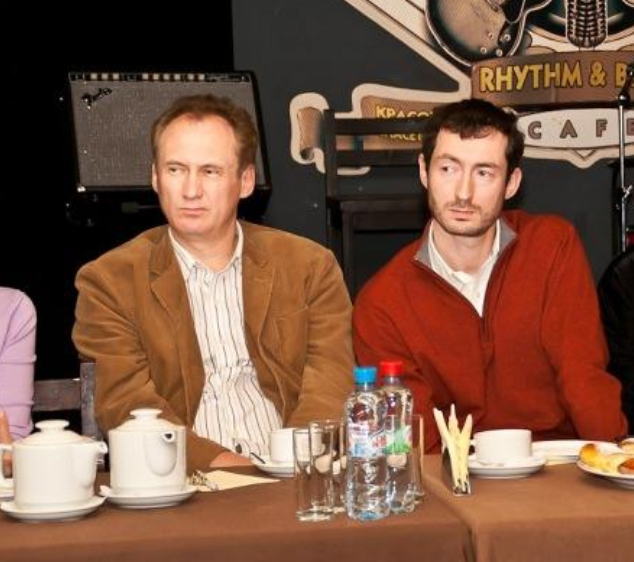
In February 2024, Atlas launched its Daniel’s Law campaign against Radaris. Roughly a month later, investigative journalist Brian Krebs published a deep dive identifying the true architects behind the enterprise: Igor and Dmitry Lubarsky, Russian-born brothers residing in Massachusetts who operate a sprawling network of people-search engines, affiliate programs, and Russian-language dating services.
Confronted with these findings, attorneys for the Lubarsky brothers threatened defamation litigation, claiming the report was wildly inaccurate and insisting the true owners were Ukrainians residing in Ukraine. However, follow-up reporting dismantled this narrative, revealing that the brothers had operated Radaris under the pseudonym of a fictitious CEO named Gary Norden—a fabricated executive whose name was used in investor pitches and press releases, a fact later admitted by Radaris attorney Val Gurvits of the Boston Law Group.
The Island-Hopping Phase
When Atlas refiled and expanded its lawsuit in June 2025 to include an array of sister companies, CEO Matt Adkisson noted that the defense reverted to its tried-and-true delay tactics.
"We refer to this period as their island-hopping phase," Adkisson explained. "Privacy policies changed constantly, and new entities kept appearing from places like the Marshall Islands, the British Virgin Islands, and Seychelles. Behind the scenes, it felt like a shell game."
When defense counsel pointed to a newly designated Marshall Islands entity as the true manager of Radaris, Atlas investigators discovered that the entity did not even legally exist yet. By August 2025, the New Jersey court ruled that the defendants had been granted ample opportunity to mount a defense and failed to do so, clearing the path for the landmark domain seizures.
Supporting Data: Uncovering the Corporate Web
During the extensive litigation, Atlas secured more than 10,000 internal emails, financial records, and operational documents. This paper trail independently corroborated investigative findings regarding how the Radaris ecosystem functions behind a smokescreen of corporate aliases.
The Unified Infrastructure
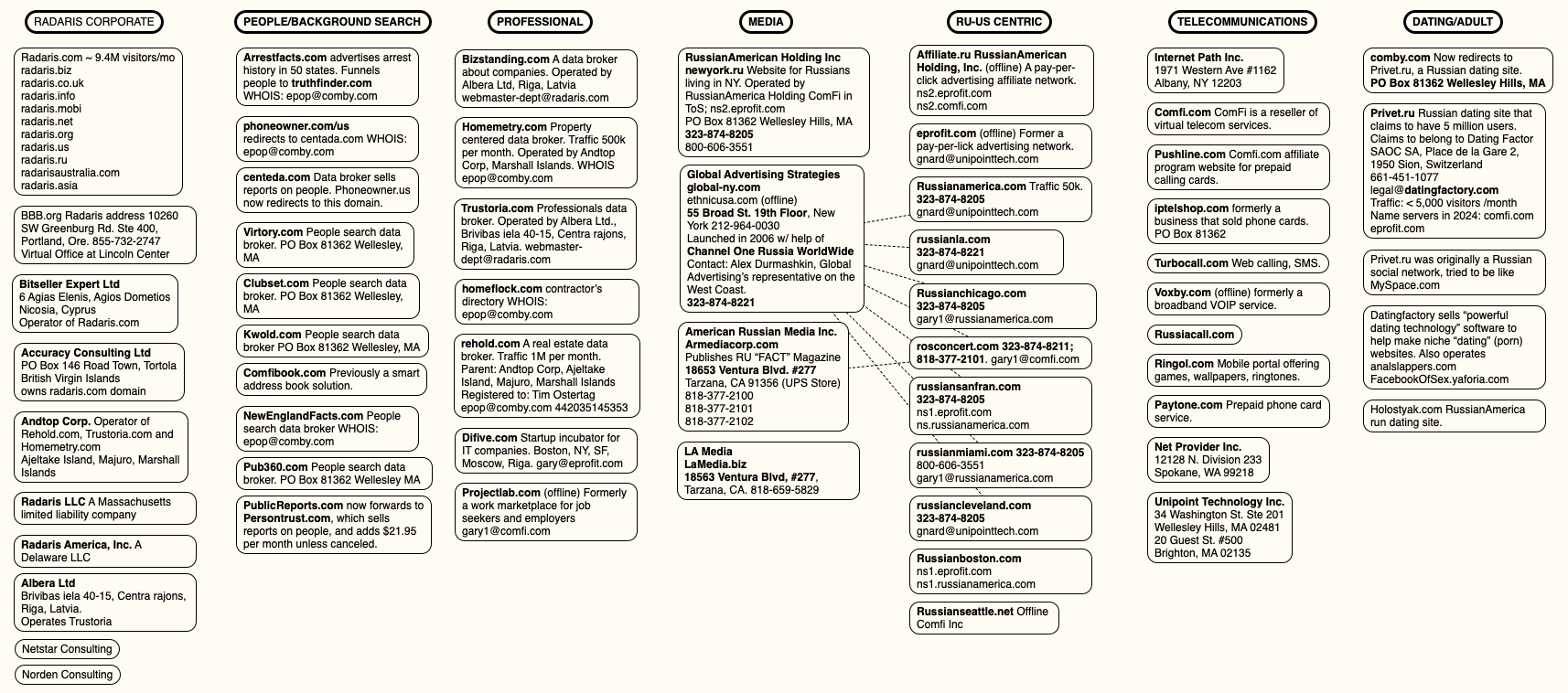
The documents confirm that nominal legal vehicles—including Radaris America, Inc., Bitseller Expert Limited, Digital Orbit Corp, Core Solutions Group Inc, Lucky Solutions Inc, Virtura Corp, Veripages Inc., Nuform Solutions Inc., Growth Data Advisors Inc., and Property Experts, Inc.—are in reality a single unified enterprise.
Administered by just three or four individuals operating out of a single virtual office address, the entire network shares banking channels, payment card sets, and technical infrastructure centered around the difive.com mail domain and its successors (centerex.com, scienteco.com, eprofit.com, realmo.com, and pub360.com). In total, the infrastructure powers at least twenty-five distinct people-search properties.
Lucrative Partnerships
Internal communications revealed the staggering profitability of the surveillance-for-profit model:
Radaris.com generated approximately $42,000 per month.
Veripages.com pulled in roughly $45,000 monthly, largely through lucrative marketing and advertising partnerships with the Lifetime Value Company (operator of brands like PeopleLooker, PeopleSmart, NumberGuru, and auto-history site Bumper).
The Radaris network raked in up to $25,000 monthly through partnerships with Onerep, a privacy-washing firm that claims to help individuals scrub their data from people-search engines while concurrently operating its own search properties (such as Nuwber).
Official Responses and Legal Posture
As the fallout from the domain seizures settles, legal representatives for Radaris are pushing back vigorously against the court’s enforcement mechanisms.
Val Gurvits, who previously represented Radaris, declined to comment on the specifics of the recent rulings, noting that the case had been reassigned to attorney Victor Worms. In statements to the press, Worms argued that the New Jersey court fundamentally erred by transferring Radaris.com as part of a default judgment against "Radaris.com," which he contends is a non-entity lacking legal capacity to sue or be sued.
"We have made a motion to vacate that default judgment on the grounds that it is void since a non-entity has no legal capacity to sue or be sued," Worms stated. "We also intend to pursue all appropriate appeals because we believe the transfer of Radaris.com amounts to a forfeiture in violation of various constitutional principles."
Conversely, Atlas leadership remains resolute. Raj Parikh, a partner at PEM Law in New Jersey who spearheads the Daniel’s Law litigation for Atlas, noted that Radaris relied on attrition to defeat past opponents.
"In the past, they won by attrition. Plaintiffs’ attorneys tired of the procedural games and just gave up," Parikh said. "That strategy worked for a decade, and it probably would have worked in this case too… But we were acutely aware of the threat this website posed to law enforcement officers and other public officials in New Jersey, and decided early on to commit whatever time and resources were necessary to remove that threat."
Broader Implications: The Constitutional Battle and Legislative Gaps
While the seizure of fourteen domain names represents a major tactical victory for Atlas and New Jersey public servants, the war over consumer data privacy is entering a volatile new phase on multiple legal fronts.
The Constitutional Challenge
The Radaris family of companies still faces potential statutory fines under Daniel’s Law. However, the broader data broker industry has mobilized aggressively against the statute. More than 150 consumer data broker firms sued by Atlas have forced at least 70 of those cases into federal court, arguing that Daniel’s Law is overly broad and violates First Amendment protections for speech involving public records.
While the U.S. Court of Appeals for the Third Circuit weighs the constitutional challenge—a dispute widely expected to culminate at the U.S. Supreme Court—state legislatures are moving in opposite directions. At least fourteen states have enacted statutes modeled after Daniel’s Law. Yet, the legal viability of these statutes remains precarious; in August 2025, a federal district court ruled West Virginia’s version of Daniel’s Law facially unconstitutional under the First Amendment.
The Need for Comprehensive Federal Reform
Privacy experts argue that state-by-state patchwork laws and narrow protections for select public officials are insufficient remedies for a systemic national security and privacy crisis.
Justin Sherman, a privacy expert and author of the forthcoming book The Middlemen, emphasizes that commercial data brokers will continue to thrive as long as federal lawmakers fail to enact comprehensive privacy reform. Sherman points out that existing state laws universally exempt records classified as "public" or "government" documents—including voting registries, property deeds, marriage licenses, motor vehicle records, criminal filings, and professional licenses.
Furthermore, the lack of federal oversight regarding how third-party vendors handle sensitive identification data—such as driver’s scans utilized for online age verification—continues to invite catastrophe, as evidenced by recent massive breaches like the IDScan.net incident that exposed the driver’s licenses of 153 million Americans.
"The average person can look at Daniel’s Law and have a perfectly normal reaction, which is that everyone should be covered, not just police and judges," Sherman noted. "But we don’t need more wake-up calls. We’ve had eight million wake-up calls already on the need for better privacy laws. The lack of comprehensive federal privacy law is not for a lack of knowledge, and anyone claiming otherwise is either not reading the news or kidding themselves."
As the legal battles over Radaris and Daniel’s Law head toward appellate courts, the dismantling of a prominent data broker serves as a stark reminder: while offshore shell companies and fictitious executives can temporarily obscure accountability, the mounting pressure from coordinated legal action and aggressive investigative journalism is finally beginning to crack the foundations of the surveillance economy.