







As artificial intelligence assistants like Anthropic’s Claude, OpenAI’s ChatGPT, and coding environments like Cursor become integral to digital workflows, a persistent bottleneck has remained: the tedious friction of data silos. For digital marketers and search engine optimization (SEO) professionals, optimizing content has traditionally meant manual data extraction—exporting heavy CSV files from enterprise suites like Ahrefs, Semrush, or SE Ranking, and pasting them raw into chat interfaces.
That workflow is rapidly becoming obsolete. The introduction of Model Context Protocol (MCP) servers specifically designed for SEO has created direct, real-time bridges between AI assistants and powerhouse SEO suites, analytics platforms, web crawlers, and content management systems.
Main Facts: What Is an SEO MCP Server?
An SEO MCP server is a lightweight protocol bridge that empowers an AI assistant to query live SEO telemetry—including keyword rankings, backlink profiles, technical crawl data, and traffic analytics—straight within an active chat session.
Rather than relying on static, outdated exports, an AI agent equipped with an MCP connection can query live databases on demand. For webmasters utilizing WordPress, advanced implementations can even allow the AI to directly manage and update on-page SEO parameters based on real-time data analysis.
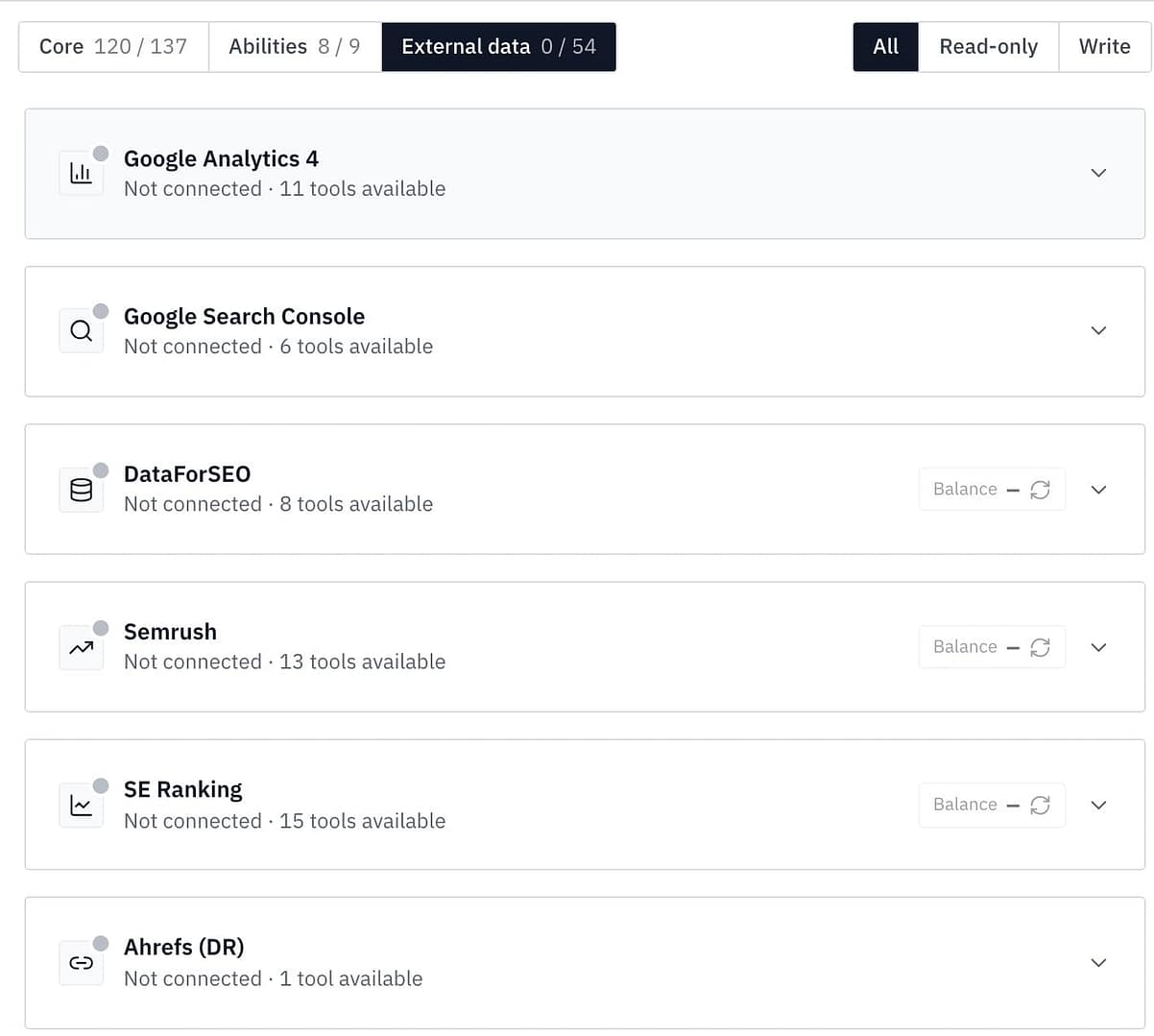
To map out the current ecosystem, an analysis of nine prominent MCP servers reveals stark differences in capabilities, hosting architecture, pricing models, and execution privileges:
| Server | Publisher | What it reads | Runs | Sign-in | Plan and Cost | What it can change |
|---|---|---|---|---|---|---|
| Ahrefs MCP | Ahrefs | Ahrefs API data (keywords, backlinks, domains) | Hosted | Consent screen, MCP-scoped key | Lite plan or higher; billable calls from 50 units | Not stated in docs |
| Semrush MCP | Semrush | Semrush SEO, traffic, market, and project data | Hosted | OAuth or API key header | Four SEO plans include 50,000 units per renewal | Read-only |
| SE Ranking MCP | SE Ranking | Keywords, backlinks, audits, AI search visibility | Hosted | OAuth 2.1 or pasted API key | Included in every subscription | Read-only (restricted key) |
| Serpstat MCP | Serpstat | Keywords, competitors, backlinks, audits | Hosted or local | OAuth (hosted) or API token (local) | Team plan and up; 7-day trial | Serpstat projects (local server) |
| DataForSEO MCP | DataForSEO | Live SERPs, keywords, backlinks, on-page | Hosted or local | OAuth 2.0 or API login/password | Pay-as-you-go; $50 minimum payment | Not stated in docs |
| mcp-gsc | Community (AminForou) | Search Console analytics, indexing, sitemaps | Local | Google account or service account | Free (MIT license) | Sitemaps and properties (configurable) |
| Google Analytics MCP | GA4 accounts, reports, realtime data | Local | Google credentials (read-only scope) | Open source (Apache 2.0) | Read-only | |
| Screaming Frog MCP | Screaming Frog | Crawl data, exports, screenshots | Local app | Paid licence required | USD $279/year | Crawls and local files |
| Easy MCP AI | Themeisle | WordPress site + 6 SEO data providers | WordPress | OAuth 2.1 or API key | Free plugin; external providers billed separately | Site content, via enabled tools |
Chronology and Evolution of the MCP Ecosystem
The rapid maturation of the Model Context Protocol marks a distinct shift in how software communicates with Large Language Models (LLMs).
- Late 2024 to Early 2025: MCP was introduced to standardize how AI clients securely access external tools and data sources. Initially, integrations were heavily developer-focused, relying on local Python or Node.js scripts (
stdiotransport mechanisms) that required technical configuration files. - Mid-to-Late 2025: Major enterprise SEO platforms began recognizing the security and user experience benefits of hosted Streamable HTTP endpoints. Instead of requiring users to manage local tokens, vendors like Ahrefs, Semrush, and SE Ranking deployed native cloud-hosted MCP endpoints utilizing OAuth authentication.
- Current State (2026): The ecosystem has matured into a hybrid landscape. Enterprise tools offer secure, remote-hosted connections backed by API credit meters, while open-source community developers and specialized plugin creators (such as Themeisle with Easy MCP AI) bridge the gap directly inside Content Management Systems (CMS) like WordPress.
Supporting Data: Deep-Dive into Key SEO MCP Servers
1. Enterprise SaaS Giants (Ahrefs, Semrush, SE Ranking, Serpstat)
The heavyweights of the SEO industry have standardized secure, cloud-hosted MCP architectures.
- Ahrefs MCP operates strictly via a remote endpoint (
https://api.ahrefs.com/mcp/mcp). Local setups have been deprecated. Workspace administrators can assign custom monthly API unit limits to prevent runaway automated agent queries. - Semrush MCP provides deep access to keyword, domain, backlink, and traffic analytics. Crucially, it ships natively within enterprise app directories for platforms like Claude, ChatGPT, and Perplexity, bypassing manual configuration files.
- SE Ranking MCP stands out for its broad accessibility, featuring over 160 tools encompassing traditional audits alongside cutting-edge AI search visibility tracking across ChatGPT, Perplexity, Gemini, and AI Overviews.
- Serpstat MCP offers a unique bifurcation: a hosted OAuth version for universal convenience, and a local Node.js
STDIOversion that allows advanced users to locally manage projects and run automated site audit updates.
2. Raw Data and Infrastructure Providers
For agencies and technical developers who require unthrottled, raw data streams without rigid platform constraints:
- DataForSEO MCP serves as a pay-as-you-go powerhouse. Rather than provisioning dozens of hardcoded tools, its v3 architecture equips the AI model with direct documentation-reading tools (
docs_index,docs_search) and an authenticated execution endpoint (api_request), allowing the model to dynamically construct API calls.
3. Analytics and Crawling Utilities
- mcp-gsc: Built by community developer AminForou, this open-source Python tool fills a vital gap by granting AI access to Google Search Console performance data, URL inspection batches, and sitemap management.
- Google Analytics MCP: Officially published by Google, this experimental open-source server uses Application Default Credentials to surface GA4 core reports, funnel analysis, and realtime telemetry in a strictly read-only scope.
- Screaming Frog SEO Spider MCP: Turning the desktop application itself into an active server (version 24+), this tool enables AI agents to direct deep technical crawls, analyze internal link structures, and pull single-URL screenshots locally.
4. CMS-Centric Optimization: Easy MCP AI
While external data providers focus strictly on metrics, WordPress-centric solutions like Easy MCP AI close the loop by allowing AI assistants to execute changes directly on a website.

- By establishing a direct connection over OAuth 2.1 or secure API keys, the plugin links popular SEO plugins—including Yoast SEO, Rank Math, SEOPress, Slim SEO, and The SEO Framework—directly to the AI chat interface.
- In rigorous testing environments, AI agents have demonstrated the ability to audit published posts for missing meta descriptions, draft context-aware summaries under 155 characters based on post content, and automatically write those updates back into the database using specific tools (e.g.,
wp_yoast_update_post_seo).
Official Responses and Security Implications
Handing AI agents the capability to query proprietary marketing data—and in some cases, modify live website code—inherently introduces significant operational risks. Industry experts and platform developers emphasize strict adherence to security best practices:
- The Principle of Least Privilege: Users are strongly advised to initiate every new MCP connection in read-only mode. Monitoring initial server logs ensures that the AI’s autonomous tool calls align with expected tasks before granting write permissions.
- Built-In Guardrails: Advanced CMS integrations, such as Easy MCP AI, incorporate safety features including automatic change histories with before/after snapshots, audit logging, dry-run previews, and "Force draft on create" toggles.
- API Credit Exhaustion: Because enthusiastic AI agents can rapidly explore expansive datasets through recursive questioning, setting strict workspace API unit caps (as implemented by Ahrefs and SE Ranking) is critical to preventing unexpected billing spikes.
Conclusion: Which Server Should You Choose?
Selecting the right SEO MCP server depends entirely on your existing infrastructure, budget, and operational goals:
- If you are an enterprise agency already paying for Semrush or Ahrefs: Connect your vendor’s native hosted MCP server to seamlessly blend keyword intelligence into your daily AI writing and strategy prompts.
- If you run technical site audits locally: Invest in a Screaming Frog license to let your AI assistant interrogate heavy local crawl structures.
- If you manage WordPress content at scale: Implement local CMS bridges like Easy MCP AI to automate on-page metadata optimization safely under strict human supervision.
As AI agents continue to evolve from passive conversationalists into active digital operators, MCP servers represent the vital connective tissue transforming raw search data into immediate, actionable execution.