








By Arun PS and Sushmita Patel
In 2014, the institutionalization of the Pre-Legislative Consultation Policy (PLCP) was hailed as a watershed moment for Indian democracy. The vision was ambitious yet necessary: to transition India from a strictly representative democracy to a deliberative one. By mandating that the government seek public input on draft legislation before it reaches the floor of Parliament, the policy promised to foster transparency, enhance the quality of parliamentary discourse, and ensure that the laws governing the citizenry were shaped by the people they impact.
Yet, a decade later, the reality stands in stark contrast to the promise. Evidence suggests that the PLCP has become a bureaucratic formality at best, and an ignored guideline at worst. As governance increasingly shifts toward closed-door decision-making, the fundamental right of citizens to participate in the shaping of their nation is being systematically sidelined.
The Architecture of Participation: What the PLCP Demanded
Formulated based on recommendations from the National Advisory Council and the National Commission to Review the Working of the Constitution, the PLCP was intended to be the bedrock of inclusive policy-making. The mandate is clear: for any proposed legislation, the concerned ministry must proactively publish the draft on a public domain for a minimum of 30 days.
This is not merely about posting a document. The policy requires ministries to provide:
- A brief justification for the proposed legislation.
- An analysis of its essential elements.
- An assessment of its financial implications.
- A detailed impact assessment concerning the environment, fundamental rights, and the livelihoods of affected communities.
- An explanatory note in plain language to ensure the policy is accessible to the common citizen.
When followed, this process has historically yielded high-quality legislation. Debates surrounding the Kerala Police Act, the Land Acquisition Act of 2013, and the Lokpal Bill of 2011 serve as testaments to the efficacy of stakeholder engagement. In these instances, diverse perspectives refined the legal frameworks, resulting in more robust and legitimate laws.
A Chronology of Non-Compliance
The degradation of the PLCP has not been a singular event but a steady erosion of procedural ethics. Since the policy’s inception, the trend has been a consistent decline in adherence.

The Era of "Closed-Door" Drafting
High-profile legislation, which significantly impacts the socio-legal fabric of the country, has frequently bypassed the consultation process entirely. The Muslim Women (Protection of Rights on Marriage) Bill, 2017—widely debated for its "deterrent" nature—was drafted behind closed doors, with the government explicitly refusing to refer it to the Parliamentary Standing Committee on Law and Justice.
Similarly, the Right to Information (Amendment) Bill, 2019, which effectively diluted one of India’s most powerful transparency tools, was pushed through without public consultation. The government’s defense—that the amendments did not involve "social or financial costs"—defies the spirit of the RTI Act, which is essentially a social tool, not a financial one. Had citizens and civil society been given the opportunity to deliberate, the subsequent public outcry might have been addressed during the drafting phase, rather than through contentious parliamentary sessions.
The Electoral Bond Controversy
Perhaps no issue underscores the dangers of non-consultation as clearly as the Electoral Bond Scheme. Marketed as a mechanism for transparency in political funding, the scheme was implemented without any consultation with civil society. When pressed on the lack of public discourse, the Minister of State for Finance, Shri P. Radhakrishnan, admitted that no civil society organizations were involved in the process. The ensuing controversy, which eventually necessitated intervention by the Supreme Court to force disclosure of donation details, illustrates how the lack of pre-legislative scrutiny can lead to policies that are not only flawed but legally and constitutionally vulnerable.
Data-Driven Disillusionment: The Scale of the Failure
The data collected by the authors paints a grim picture of systemic apathy. Between June 2014 and May 2019, 186 bills were introduced in Parliament. Of these, a staggering 142 (76%) saw no public consultation whatsoever. Of the 44 bills that were placed in the public domain, 24 failed to adhere to the 30-day window mandated by the policy.
Statistical Breakdown (2014–2019)
| Category | Bills (Parliament) | Bills (Circulated) |
|---|---|---|
| Total Introduced/Circulated | 186 | 98 |
| No Consultation | 142 | 38 |
| Incomplete/Shortened Consultation | 24 | 38 |
| Full Compliance (30-day window) | 20 | 55 |
The situation has not improved in the years since. Between June 2019 and August 2019, 38 bills were introduced; 26 of them completely bypassed public consultation. Furthermore, when consultations do occur, they are often performative. Drafts are frequently uploaded to obscure ministry websites rather than a centralized, accessible portal, and rarely are they provided in local languages, effectively barring the vast majority of India’s population from participating.
Official Responses and Institutional Defiance
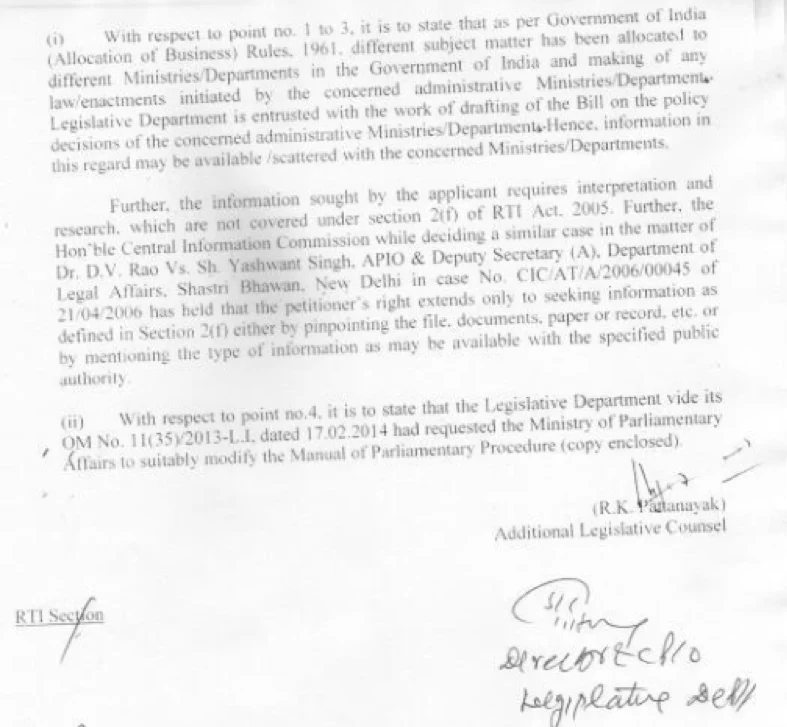
The indifference toward the PLCP reaches the highest levels of the bureaucracy. An RTI response obtained by the authors revealed that the Legislative Department maintains no database on PLCP compliance, claiming such information is "scattered" across various ministries. This is a direct violation of the policy, which mandates the Law Ministry to ensure compliance across all government departments.
Even the Ministry of Parliamentary Affairs has been complicit. When the Ministry of Law and Justice requested that the manual of parliamentary procedures be updated to reflect PLCP requirements, the Ministry of Parliamentary Affairs ignored the communication. Ironically, this same ministry had previously requested other departments to provide suggestions for improving government procedures, highlighting a culture of "selective consultation"—where the government demands input when it suits them but ignores established protocols when it does not.

Implications: The Democratic Deficit
The failure to implement the PLCP has profound implications for the Indian state:
- Diminished Legitimacy: Laws passed without public discourse lack the "social contract" foundation that makes them widely accepted. This leads to increased litigation, as seen in the backlash against the Prevention of Cruelty to Animals (Regulation of Livestock Market) Rules, 2017, which were uploaded to an obscure website and only discovered after the policy had already caused significant economic disruption.
- Poor Policy Design: Without input from those on the ground—NGOs, experts, and affected communities—policies often fail to account for practical realities, leading to "flawed policy making."
- Erosion of Trust: When the government hides the drafting process, it fuels the narrative that the state is working against the interests of its citizens.
Towards a Vibrant Deliberative Democracy
The path to revitalizing the PLCP requires more than just better enforcement; it requires a structural overhaul.
1. Centralized "One-Stop" Portal
The government should develop a platform modeled after the Telecom Regulatory Authority of India (TRAI) consultation process. An enhanced MyGov.in or a dedicated legislative portal would allow citizens to track bills, read plain-language summaries, and submit feedback in regional languages.
2. Legal Mandates and Social Audits
To move beyond voluntary guidelines, the country needs a "Social Audit Legislation." This would impose a legal obligation on policymakers to consult the public. Failure to do so should allow for the legal challenge of a bill on procedural grounds, potentially invalidating laws that were finalized without proper scrutiny.
3. Updating Procedural Rules
Amendments must be made to the Government of India (Allocation of Business) Rules, 1961, and the rules of procedure for both Houses of Parliament. If the Cabinet Secretariat mandates that no "Cabinet Note" be approved without a proof of public consultation, compliance will follow.
Conclusion
As we reflect on the state of our republic, we must return to the ideals that founded it. Mahatma Gandhi’s talisman—the idea that the poorest and weakest stakeholders should be the primary consideration in nation-building—remains the ultimate benchmark for a healthy democracy. By involving the public in the law-making process, we do not weaken the state; we strengthen it. It is time to treat the Pre-Legislative Consultation Policy not as an inconvenient hurdle, but as the essential tool for building a truly inclusive and participatory India. The transition from a representative democracy to a deliberative one is long overdue; the question is whether the current political leadership has the will to initiate it.