









Introduction: The USB-C Moment for AI
Eighteen months ago, the landscape of AI agent development was a fragmented wilderness. If a developer wanted to connect an intelligent agent to a codebase, a database, or a web browser, they were forced to write bespoke "glue code"—fragile, idiosyncratic scripts that broke the moment an API changed. This friction stifled innovation, turning the dream of autonomous agents into a maintenance nightmare.
The industry reached a turning point in late 2024 with the introduction of the Model Context Protocol (MCP) by Anthropic. Designed as an open standard for connecting AI assistants to systems, data, and tools, MCP achieved what many thought impossible: industry-wide consensus. By the end of 2025, tech giants including OpenAI, Google, and Microsoft had adopted the protocol, eventually donating it to a Linux Foundation-governed body to ensure its neutrality and longevity.
Today, MCP serves as the "USB-C" of the agentic world. Just as a single port allows a laptop to interface with monitors, drives, and peripherals, MCP allows any compliant agent to plug into any compliant tool. However, as the ecosystem has exploded in popularity, it has also become cluttered with deprecated projects and "zombie" servers. For developers looking to build high-performance agents, selecting the right tools is no longer about popularity—it is about reliability, precision, and architectural maturity.
A Brief Chronology: From Bespoke Scripts to Open Standards
To understand the current utility of MCP, one must look at the rapid evolution of the agentic stack:
- Early 2024: The "Glue Code Era." Developers spend more time writing integration wrappers than training or prompting their models.
- Late 2024: Anthropic open-sources the Model Context Protocol, providing a standardized interface for context sharing and tool execution.
- Early 2025: Adoption accelerates. Major IDEs and LLM providers integrate MCP natively, drastically lowering the barrier to entry for developers.
- Late 2025: The protocol is handed over to the Linux Foundation. This move signals a transition from "experimental tech" to "enterprise infrastructure."
- 2026 and Beyond: The ecosystem matures. The focus shifts from merely connecting agents to optimizing their performance through highly specialized servers.
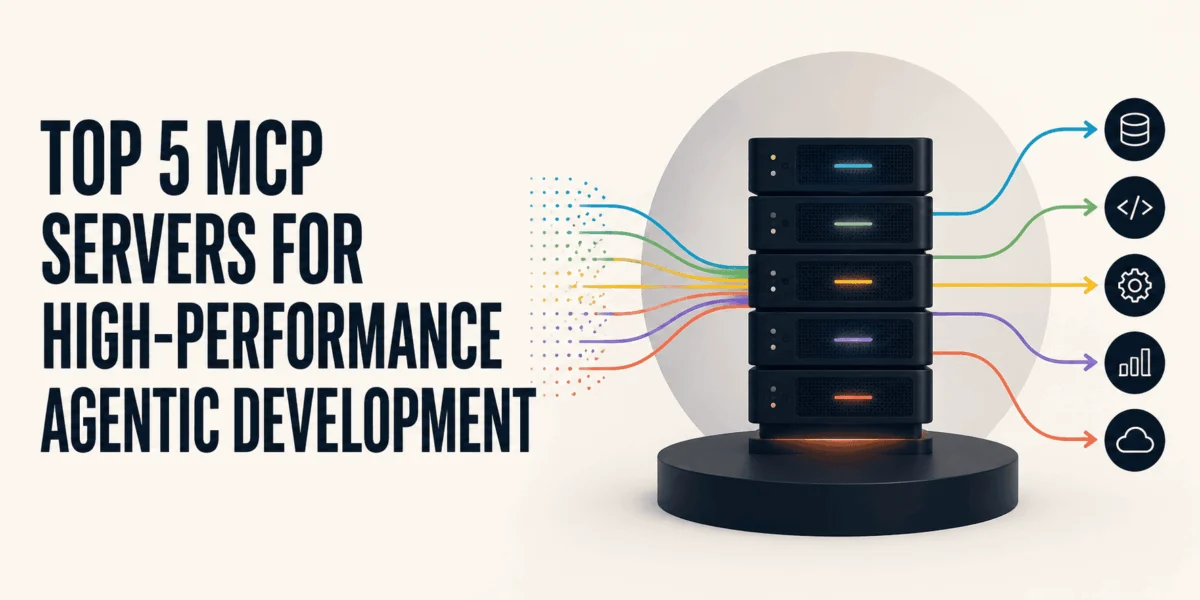
The Core Infrastructure: Top 5 MCP Servers for Performance
To build an agent that is not merely a chatbot, but a functional engineer, you need a carefully curated stack. Here are the five servers that define the current state of high-performance agentic development.
1. GitHub MCP Server: The Backbone of DevOps
The official GitHub MCP server is the non-negotiable foundation of any agentic workflow. It acts as the bridge between your LLM and your development environment.
Why it matters: Unlike third-party wrappers, the official server is maintained by GitHub, ensuring it tracks the evolution of the platform. It allows agents to perform complex tasks: triaging issues, managing pull requests, and monitoring CI/CD Actions via natural language.
- Performance Impact: It enables an agent to move beyond "reasoning" about code to "executing" on it. By allowing the agent to perform administrative tasks within the repo, it frees the developer from manual overhead.
2. Playwright MCP: Deterministic Browser Automation
Many agents struggle with web interaction because they rely on vision models to "look" at screenshots and guess at coordinates—a process that is slow, expensive, and prone to error. Microsoft’s Playwright MCP changes the game by bypassing pixels entirely.
Why it matters: By driving the browser through the accessibility tree, the server provides the agent with structured, deterministic data about a webpage.
- Performance Impact: This eliminates the need for expensive vision-based processing. The agent receives clean, machine-readable data, making interactions with web apps faster, more reliable, and significantly cheaper in terms of token usage.
3. Context7: Precision Documentation
The greatest failure point in AI coding is the "hallucinated API"—where an agent confidently uses a library function that was deprecated years ago. Context7 acts as a real-time, version-specific knowledge injection engine.
Why it matters: It feeds the agent up-to-date documentation for the libraries currently in use, effectively killing the "stale knowledge" problem that plagues most foundation models.
- Performance Impact: By correcting the agent’s internal knowledge before it writes a single line of code, Context7 prevents the "loop of failure" where an agent repeatedly generates broken code based on outdated assumptions.
4. Serena: Semantic Code Understanding
Text-based search-and-replace is a crude tool for code editing. Serena introduces an IDE-grade level of intelligence by utilizing the Language Server Protocol (LSP).
Why it matters: Serena allows an agent to understand the symbolic structure of a codebase across 40+ languages. Instead of pattern-matching strings, the agent can perform surgical, context-aware edits.
- Performance Impact: This is a massive win for token efficiency. Large codebases can be difficult to manage, but with Serena, the agent only touches the specific functions or symbols required, drastically reducing context window bloat and operational costs.
5. The Official Reference Servers
The official reference collection provides the essential primitives that every agent needs to operate in a local environment.
Why it matters: It includes critical components like the Filesystem server (local file access), Git (version control), Fetch (HTTP requests), Memory (persistence), and Sequential Thinking (structured reasoning).
- Performance Impact: These servers are the plumbing of the system. While they are designed primarily as educational references, they are the most stable "building blocks" available for developers establishing the base logic of an agentic system.
Supporting Data and Technical Caveats
It is vital to distinguish between hype and utility. Many older listicles recommend tools that have since been archived. Developers should exercise caution:
- Repository Health: Always check the "last commit" date. If a project hasn’t seen updates in six months, it likely lacks support for the latest MCP schema changes.
- The "Archived" Warning: Several previously popular servers—specifically the standalone Postgres and Puppeteer versions—have been moved or archived in favor of more robust, unified implementations.
- Community Sentiment: With the reference monorepo holding over 80,000 stars, the community focus has clearly shifted toward consolidated, multi-purpose servers rather than fragmented, single-use scripts.
Official Perspectives: The Linux Foundation Transition
The move of the Model Context Protocol to the Linux Foundation is more than just a bureaucratic change. In a joint statement, the contributing organizations emphasized that the goal is "vendor-neutral interoperability." By offloading the maintenance of the core protocol to a neutral body, the industry has signaled that they want to avoid the "walled garden" approach of previous tech eras.
For the developer, this means stability. You can build your agentic stack on MCP today with the confidence that the underlying protocol will not be abandoned by a single corporate entity.
Implications for the Future of Work
The rise of the MCP-connected agent is fundamentally altering the software development lifecycle. We are moving toward a paradigm of "agentic orchestration," where a developer acts as an architect, coordinating a fleet of specialized agents that communicate through a common, standardized protocol.
The Implications:
- Reduced Friction: Developers can swap out agents or tools without rewriting the entire infrastructure, thanks to the plug-and-play nature of MCP.
- Increased Complexity: As agents become more capable, the complexity of the systems they manage will naturally grow, placing more importance on the "Sequential Thinking" and "Memory" primitives provided by the reference servers.
- Cost Efficiency: Through precise tools like Serena and Playwright, we are seeing a reduction in the "token tax" of AI development. By giving the agent better tools, we require less reasoning power to solve the same problem.
Conclusion: Building Your Stack
The era of "glue code" is over. Today, the challenge of agentic development is no longer about how to connect things, but about what to connect. By selecting a combination of robust servers like GitHub for management, Playwright for web interaction, Context7 for knowledge, and Serena for surgical editing, you provide your agent with a coherent set of "hands" to perform real work.
The protocol has done the heavy lifting by standardizing the interface. The next generation of high-performance software will be built by developers who treat these MCP servers not just as utilities, but as the essential architecture of the modern digital workforce.
About the Author: Nahla Davies is a software developer and technical writer with a background in managing large-scale programming operations for Inc. 5,000 organizations. Her work focuses on the intersection of AI, developer productivity, and open-source infrastructure.