








In the modern corporate boardroom, the discourse surrounding climate strategy has shifted from a question of "if" to a question of "how." Yet, as the global economic landscape grows increasingly volatile, a troubling "sustainability paradox" has emerged: corporate commitment to environmental goals is at an all-time high, but the structural capacity to deliver on those promises is being dismantled by the very forces intended to protect the bottom line.
According to the 2026 State of Supply Chain Sustainability Report from the MIT Sustainable Supply Chain Lab—a comprehensive study of 1,810 professionals across 91 countries—83% of supply chain leaders now rate sustainability as "important" or "very important" to their long-term business success. This figure represents the highest level of conviction in the report’s seven-year history. However, this unwavering commitment is increasingly colliding with the harsh realities of tariff wars, geopolitical instability, and a mismatch between operational efficiency and true decarbonization.
The Chronology of Commitment and Contradiction
To understand the current state of supply chain sustainability, one must look at the progression of the last few years.
2024: The Year of Policy Pivot. The report highlights a fascinating, if counterintuitive, trend: following recent U.S. policy shifts that deprioritized environmental mandates, corporate commitment actually strengthened. Approximately 59% of respondents reported becoming more committed to sustainability in response to these shifts, suggesting a "rallying effect" among private-sector leaders who view sustainability as a hedge against regulatory uncertainty.
2025: The Geopolitical Strain. As the year progressed, the focus shifted from policy sentiment to economic survival. Tariff uncertainty became a dominant force, with 68% of organizations forced to delay, scale back, or completely abandon sustainability initiatives to cope with fluctuating trade costs.
2026: The AI Inflection Point. Today, the narrative is defined by the integration of Artificial Intelligence. While AI is being deployed at record speeds to optimize logistics, the report reveals that these gains are not automatically translating into lower net emissions, creating a "decoupling" of operational efficiency from climate impact.
Supporting Data: The Governance Gap
The most striking finding in the MIT report is the chasm between public ambition and internal accountability. While companies are quick to announce net-zero targets, they are lagging significantly in building the administrative architecture required to meet them.
Governance Metrics
- The Cross-Functional Disconnect: Only 51% of companies with publicly stated sustainability goals have established a formal cross-functional sustainability team. This is a critical oversight, as these teams are the primary driver for embedding green choices into daily workflows.
- The Boardroom Vacuum: Only 33% of organizations place sustainability oversight at the board level, signaling that environmental strategy is still often relegated to middle-management silos rather than being treated as a core fiduciary responsibility.
- The Accountability Gap: There is a staggering 44-point performance gap between organizations that utilize cross-functional teams (where sustainability is built into decisions 57% of the time) and those that rely on single-function responsibility (where it drops to a mere 13%).
Operational Realities
Sustainability is finding a home in tactical areas—transportation (39%), procurement (35%), warehousing (34%), and product design (33%). However, the report notes that it "thins out" in areas that dictate long-term emissions, such as capital investment, network design, and long-term risk planning. Companies are becoming better at "greening" their existing operations but remain fundamentally stuck in carbon-intensive legacy infrastructure.
Official Responses and Expert Analysis
Sreedevi Rajagopalan, director of the MIT Sustainable Supply Chain Lab and lead author of the report, characterizes the current state as a supply chain agenda "stuck between conviction and constraint."
"Commitment is strong, measurement is expanding, and AI is accelerating," Rajagopalan notes. "What comes next is harder: converting commitment into accountability, operational integration into strategic decision-making, and incremental decarbonization into genuine transition."
The report suggests that the "external disruption" of geopolitical conflict—cited by over 80% of respondents across North America, Europe, and Asia as a barrier to climate action—is exposing an "internal vulnerability." Organizations designed their decarbonization roadmaps on the assumptions of stable trade and global peace. With those assumptions now shattered, the fragility of these plans is being laid bare.
The AI Paradox: Efficiency vs. Emissions
Perhaps the most provocative data point concerns Artificial Intelligence. While 78% of North American organizations now use AI in their sustainability initiatives, and 87% of those adopters report a positive impact on their goals, the aggregate emissions data tells a different story.
Among mature, "agentic" AI users—those whose systems make autonomous decisions—only 53% report a net reduction in greenhouse gas emissions. Conversely, 29% report an actual increase.
This is particularly evident in the warehouse sector. Among advanced, fully automated facilities, 78% report higher energy consumption following AI implementation, and 76% report higher waste generation. The culprit? A lack of visibility. Only 24% of these warehouses use AI for real-time environmental monitoring. Organizations are effectively using "black box" AI to optimize for speed and cost, often at the hidden expense of energy intensity.
Regional Divergence: The Policy Signal
The data reveals a stark contrast between Europe and North America regarding capital-intensive transitions, such as the shift to battery-electric freight vehicles.
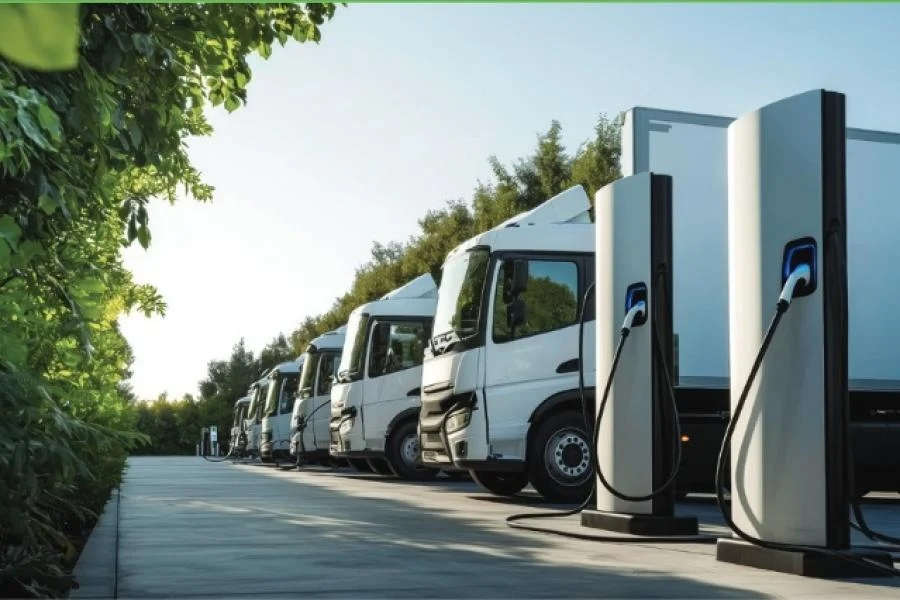
In Europe, 84% of freight companies feel that recent policy changes have positively influenced their decarbonization strategy, and 60% have successfully scaled battery-electric vehicle fleets. In North America, only 44% view policy as a positive driver, and only 36% have achieved similar fleet electrification. This highlights the crucial role of the "policy signal"—where government mandates are clear, capital flows into sustainable technology. Where they are ambiguous, capital remains locked in conventional diesel infrastructure.
Implications for the Future: Collaboration as the Last Resort
If there is a silver lining in the 2026 report, it is the dramatic surge in collaborative engagement for Scope 3 (indirect) emissions. Realizing that the climate crisis cannot be solved in isolation, the industry has seen a massive shift in partnership dynamics:
- Joint Engagement: Participation in joint supplier decarbonization programs jumped from 31% to 58% in just one year.
- Shared Responsibility: Partnerships to manage shared suppliers’ emissions more than doubled, rising from 23% to 55%.
- The Death of Isolation: The share of companies attempting to manage their Scope 3 emissions entirely alone plummeted from 18% to just 6%.
Supported by institutions like the C.H. Robinson Foundation, Breakthrough, CO2 AI, and Dassault Systèmes, the data suggests that the "siloed" approach to sustainability is finally being abandoned in favor of a networked, systemic response.
Conclusion: Hard-Wiring Accountability
The 2026 State of Supply Chain Sustainability Report concludes with a clear warning: corporate commitment is no longer the bottleneck. The world has enough "intent." The current obstacles are structural: governance, accountability, technology infrastructure, and precise measurement.
For corporate leaders, the path forward is clear but difficult. They must move beyond the low-hanging fruit of operational optimization and address the structural design of their supply chains. Organizations that build resilience against geopolitical disruption—and that "hard-wire" accountability into their governance structures—will survive the current era of instability. Those that continue to prioritize ambition over infrastructure will find that, in the face of rising operational costs and volatile trade, their sustainability goals remain nothing more than a well-intentioned, yet unreachable, horizon.