










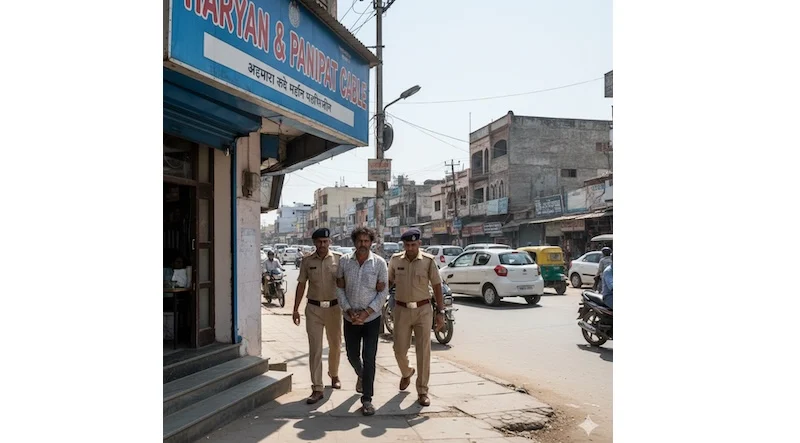
NEW DELHI — In an operation that has sent shockwaves through the domestic media and entertainment sector, law enforcement agencies in Haryana have arrested a local cable operator for allegedly spearheading an unauthorized television distribution racket. The bust has laid bare what industry insiders describe as a sophisticated, rapidly expanding underground market for unencrypted TV signals quietly bleeding revenue from legitimate broadcasters across northern India.
The crackdown, which unfolded in the Gohana region of Sonipat district, underscores a much larger, systemic vulnerability plaguing India’s vast broadcasting ecosystem. As content piracy evolves from simple peer-to-peer sharing into industrialized, commercial-grade operations, the legal and regulatory frameworks designed to protect intellectual property are facing an unprecedented stress test.
1. Main Facts of the Case
The primary subject of the recent law enforcement action is Anurag Narwal—widely known locally by his alias, "Nura." Narwal, operating as a local cable service provider in Gohana, was taken into custody following a targeted raid executed by district law enforcement.
According to official police filings, Narwal stands accused of illegally intercepting and retransmitting premium JioStar network channels to local subscribers without holding the necessary commercial licenses, agreements, or statutory authorization. The operation was not merely a minor local infraction; investigators assert it represents a node in a much wider commercial enterprise designed to siphon copyrighted content and monetize it through unauthorized last-mile networks.
Upon raiding a commercial property situated in the Kathmandi area of Gohana, police investigators recovered critical hardware allegedly utilized in the illicit broadcast chain. The seized inventory included:
- Two high-capacity optical transmitters
- Two optical receivers
- Various signal-splitting and modulation components housed on the upper level of the commercial building
These devices are standard components used in fiber-optic cable television architectures to convert and amplify television signals for distribution to residential households.
A First Information Report (FIR) has been formally registered against Narwal under the provisions of the Copyright Act, 1957. The charges cite deliberate criminal copyright infringement, commercial exploitation of intellectual property without consent, and the possession of specialized hardware exclusively dedicated to unlawful signal distribution. Following his initial detention and preliminary interrogation, Narwal was released on statutory bail, though legal proceedings remain active.
2. Chronology of the Investigation
The unfolding of the Gohana operation reveals a meticulously planned investigative trail that began with intelligence reports regarding localized signal leakage and culminated in cross-district raids.
- Early Intelligence Gathering: Broadcaster compliance teams and anti-piracy cells noticed anomalous viewership metrics and unauthorized feeds circulating within specific pockets of Sonipat district. Preliminary ground surveys indicated that a local operator was feeding unauthorized feeds into domestic coaxial and fiber networks.
- The Raid (Kathmandi, Gohana): Armed with actionable intelligence, local authorities executed a search warrant at a commercial building in the Kathmandi area. The raid yielded the physical evidence—optical transmitters and receivers—confirming that the location was being operated as an unauthorized signal hub.
- Arrest and Booking: Anurag Narwal was identified as the principal operator of the illicit hub. He was taken into custody by local police, formally booked under copyright laws, and subjected to initial questioning regarding his operational partners.
- Tracing the Upstream Supply Chain: During subsequent interrogations, investigators widened their scope. Digital forensics and hardware tracking led police upstream to a major multi-system operator (MSO) based in the neighboring Panipat district.
- Current Status: As of this writing, law enforcement agencies are actively probing the Panipat-based MSO to determine the extent of its complicity. Investigators are working to establish whether the Panipat entity knowingly supplied raw feeds to Narwal or if there are broader, systemic leaks within the region’s commercial distribution hierarchy.
3. Supporting Data and Technical Vulnerabilities
While the arrest of a single cable operator in rural Haryana may appear to be an isolated local crime, industry analysts and cybersecurity experts emphasize that it is symptomatic of a fundamental structural flaw in how television signals are transported across India.
The Unencrypted Feed Loophole
The core challenge facing content creators and broadcasters lies in the mechanics of signal distribution. While direct-to-home (DTH) satellite platforms and authorized digital streaming (OTT) applications rely on end-to-end digital encryption and conditional access systems (CAS), large portions of traditional cable distribution rely on fiber-optic relays.
When these intermediate feeds are transmitted without advanced forensic watermarking, they create a major security blind spot. Unlike a digital stream that embeds unique metadata identifying the exact subscriber or receiver, unencrypted fiber feeds can be intercepted, cloned, and retransmitted infinitely without leaving a digital fingerprint.
"The biggest loophole today is unencrypted distribution," noted a senior executive from a major Indian entertainment broadcaster who spoke on condition of anonymity due to ongoing legal proceedings. "When feeds are shared without watermarking, it becomes nearly impossible to trace who extracted it, who retransmitted it, and where the leak originated. It’s a blind spot that pirates have learned to exploit very effectively."
The Scale of the Underground Market
Industry data compiled by anti-piracy coalitions indicates that signal theft costs the Indian media and entertainment industry billions of rupees annually. Unlicensed cable networks—often referred to in the industry as "analogue darknets" or grey-market cable operators—undercut legitimate operators by offering massive channel bouquets at a fraction of the mandated subscription cost.
Because these grey-market operators pay zero licensing fees, royalty distributions, or GST to state and central exchequers, they maintain hyper-competitive pricing that systematically starves legitimate, tax-paying multi-system operators and broadcasters of vital operating revenue. Furthermore, this informal economy deprives the government of substantial tax receipts.
4. Official Responses and Regulatory Pressure
The Haryana crackdown has occurred against the backdrop of heightened regulatory scrutiny at the national level. India’s Ministry of Information and Broadcasting (MIB) has steadily ramped up its anti-piracy initiatives, seeking to close regulatory loopholes that allow unauthorized redistribution networks to operate with relative impunity.
The Ministry’s Policy Pivot
On November 7, 2025, the Ministry of Information and Broadcasting issued a comprehensive consultation notice announcing a sweeping review of current enforcement mechanisms, monitoring frameworks, and legal penalties associated with content piracy. The review specifically targets unauthorized distribution networks affecting films, linear television channels, and premium OTT streaming platforms.
The government’s renewed focus aims to bridge jurisdictional gaps between state police forces, cyber cells, and federal regulatory bodies, enabling faster raids, harsher statutory penalties, and the immediate seizure of equipment utilized in commercial piracy.
Local Law Enforcement Perspective
Local authorities in Haryana have signaled that the investigation into Narwal’s network is far from over. Gohana police station inspector Arun Kumar emphasized that law enforcement is looking at the broader picture rather than treating the case as a localized misdemeanor.
"The accused was arrested and was released on bail. We are investigating the matter further," Kumar stated during a media briefing.
Police are currently analyzing financial transactions, equipment procurement invoices, and digital communication logs seized during the Kathmandi raid to identify other co-conspirators operating within Sonipat, Panipat, and surrounding districts.
5. Industry Implications and the Road Ahead
The Gohana case serves as a microcosm of the larger war being waged between the formal entertainment economy and underground syndicates. Broadcasters argue that they invest heavily in cutting-edge anti-piracy monitoring software, automated takedown algorithms, and legal enforcement teams, yet all these digital fortresses can be bypassed simply by plugging into an unsecured, unencrypted physical cable line.
The Demand for Mandatory Watermarking
For industry stakeholders, the Haryana incident reinforces a long-standing, urgent demand: mandatory forensic watermarking across all tiers of broadcast transmission.
Broadcasters maintain that until regulatory bodies mandate traceable, dynamic watermarks embedded directly into every signal distributed to MSOs and local cable operators, anti-piracy efforts will remain fundamentally reactive. Under the current paradigm, authorities can only swoop in after a pirate has already set up shop, seized equipment, and distributed stolen content for months—at which point the financial damage has already been sustained.
A Cat-and-Mouse Game
Industry representatives warn that unless lawmakers and regulators introduce rigorous technical mandates coupled with swift, deterrent-level punishments, the market will remain trapped in an expensive, repetitive game of cat and mouse.
Legitimate cable operators, who invest capital in legal compliance, carriage fees, and content acquisition costs, are the primary casualties of this underground ecosystem. Forced to compete against rogue operators who pay nothing for their programming, compliant businesses face margin compression and operational distress.
Ultimately, the arrest in Sonipat district is a stark reminder that as long as unencrypted signals flow freely through India’s vast distribution pipelines, grey-market piracy will remain a lucrative, low-risk venture for those willing to exploit the system’s weakest links. Whether the combined pressure of federal regulatory reviews, police crackdowns, and industry technological upgrades can dismantle these underground networks remains the central challenge for India’s media sector in the years ahead.



