








By Search Industry Analysis
As artificial intelligence continues to reshape the architecture of the internet, digital marketers and search engine optimization (SEO) professionals are scrambling to adapt. For the better part of the last two years, the industry buzzword has been "GEO"—Generative Engine Optimization—with agencies and consultants charging a premium to help brands secure citations and visibility inside large language models (LLMs) like ChatGPT, Claude, and Anthropic.
However, a comprehensive new empirical data analysis suggests that this hyper-fixation on LLM visibility is fundamentally misguided. According to a year-long study tracking millions of web sessions across 100 independent properties, the traffic driven by standalone conversational AI assistants is statistically negligible compared to the enduring powerhouse of traditional and AI-infused search: Google.
Far from signaling the death of Google, the data reveals that the web is undergoing a structural evolution from a passive information repository into an agentic web—a dynamic landscape where search engines act as task coordinators and transaction handlers. For businesses looking to capture future market share, pouring resources into standalone LLM tracking is proving to be a costly distraction from the real frontier of search and commerce.
Main Facts: The Reality of LLM Referral Traffic
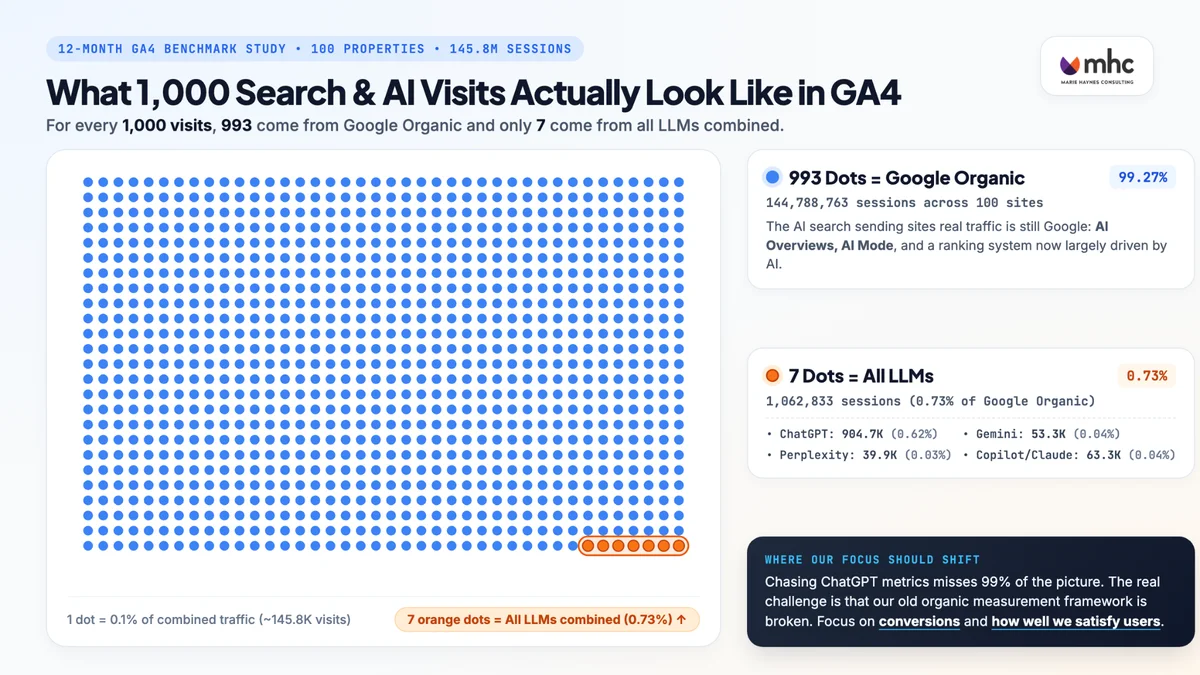
To understand where web traffic is actually originating, search analyst Marie Haynes conducted an extensive review of Google Analytics 4 (GA4) data spanning a 12-month period across 100 websites of varying sizes and industries, encompassing a massive sample size of over 145 million sessions.

The core findings challenge prevailing industry assumptions about the immediate commercial value of direct LLM referrals:
- The Traffic Disparity: Sessions driven to these websites directly from ChatGPT amounted to a meager 0.62% of the volume generated by Google Organic search.
- The Aggregate AI Share: When all other conversational LLMs were factored into the dataset alongside ChatGPT, the total share of traffic rose to a mere 0.73%.
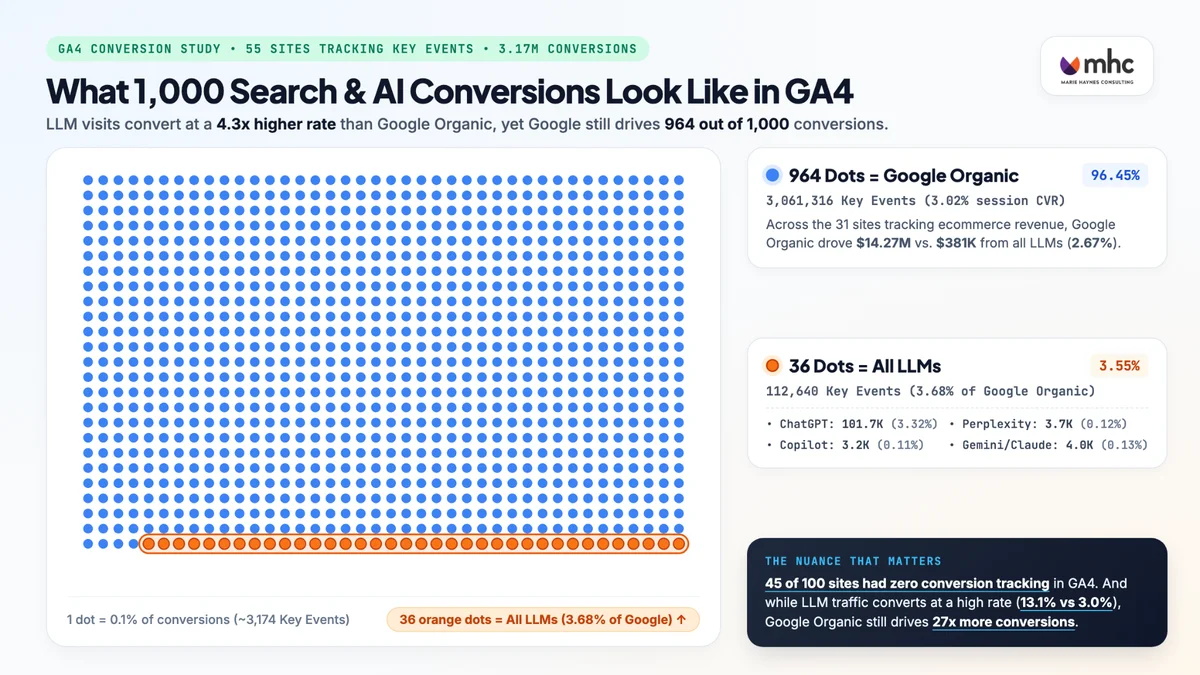
- The Conversion Paradox: While visitors arriving via ChatGPT did demonstrate a notably higher conversion rate—converting at more than 4.5 times the rate of standard Google organic visitors—the sheer volume disparity meant that Google still accounted for 96.5% of total conversions across the observed channels. In total, Google Organic drove 27 times more conversions than all LLMs combined.
- The Growth Plateau: Contrary to initial projections that ChatGPT referral traffic would scale exponentially, historical tracking across the 100 properties revealed that exponential growth abruptly leveled off in August 2025, coinciding with the broader rollout of advanced ecosystem models like GPT-5. Since that peak, referral clicks from ChatGPT have steadily trended downward.
Chronology: The Evolution of Search and the AI Pivot
The Early Panic: Exponential Expectations (2023–2024)
When conversational AI tools first burst into the public consciousness following the launch of ChatGPT in late 2022, digital marketers observed an initial spike in referral clicks. Early extrapolation models led many industry experts to predict an imminent "hockey stick" curve. The prevailing theory was that as consumer habits shifted away from traditional search bars and toward conversational chat windows, third-party link referrals from AI models would soon eclipse traditional search engines. Billions of venture capital dollars flowed into optimization tools designed to monitor, track, and manipulate brand mentions inside LLMs.
The Plateau and Reality Check (Late 2025)
By the second half of 2025, the anticipated exponential trajectory broke. As major AI providers refined their systems to provide direct, synthesized answers within the chat interface—minimizing the need for users to click external links—referral volumes across standard publisher sites plateaued and began to contract. Data sets compiled across mid-sized and enterprise websites confirmed that standalone conversational tools were retaining users within their own ecosystems rather than acting as distribution funnels for the wider web.
The Rise of the Agentic Web (2026 and Beyond)
By 2026, the battleground of digital discovery shifted. Rather than users typing prompts into isolated chat windows, search engines evolved into integrated, multimodal ecosystems. Google, heavily leveraging deep learning models for its core ranking systems, AI Overviews, and newly minted "AI Modes," cemented its position as the undisputed gatekeeper of online intent. Simultaneously, tech giants began laying the groundwork for infrastructure that allows AI agents to execute tasks, manage carts, and complete transactions natively—giving birth to the "agentic web."
Supporting Data: What the Numbers Tell Us
The empirical breakdown of the 145-million-session dataset paints a clear picture of modern digital traffic dynamics:
| Traffic Source / Channel | Share of Organic Volume | Conversion Efficiency | Share of Total Conversions |
|---|---|---|---|
| Google Organic | 99.27% | Baseline (1x) | 96.5% |
| ChatGPT Referrals | 0.62% | High (~4.5x baseline) | ~2.5% |
| Other LLMs Combined | 0.11% | Variable | ~1.0% |
| Total AI LLM Traffic | 0.73% | Moderate | 3.5% |
Furthermore, the audit revealed a concerning operational gap among website owners: out of the 100 properties sampled, 45 were failing to track key events or conversions entirely in GA4, highlighting a widespread inability to measure true business impact regardless of traffic source.
Official Responses and Industry Perspectives
Industry leaders and search executives acknowledge that the web is transforming, but emphasize that human search behavior remains anchored to established ecosystems.
During public developer conferences and interviews, top executives have noted the fundamental shift in how computing interacts with the web:
- Sundar Pichai, Google CEO: Noted that search is evolving to become an "agent manager," shifting from a passive link index to an active work coordinator.
- Demis Hassabis, DeepMind CEO: Observed during future-outlook panels that an "agent-first web" will fundamentally alter how digital architecture operates, noting that autonomous agents do not interact with human-rendered web pages the way people do.
- Sergey Brin, Google Co-Founder: Admitted candidly that predicting the exact configuration of the digital landscape a decade out remains impossible due to the sheer velocity of machine learning advancements.
Despite these structural shifts, search analysts like Marie Haynes argue that the industry’s obsession with GEO represents a misallocation of capital. "While it’s interesting to measure and try to influence whether your content is being cited by ChatGPT, for the vast majority of sites this traffic is miniscule compared to Google organic visitors," Haynes notes. "The AI search that is actually sending people to businesses today isn’t ChatGPT. It’s Google."
Implications for Digital Marketers and SEO Professionals
The empirical reality of 0.73% AI referral traffic versus 99.27% Google dominance carries profound implications for digital strategy. Organizations must pivot away from vanity metrics—such as tracking raw brand mentions in isolated chat models—and redirect their focus toward tangible business outcomes and emerging agentic standards.

1. Shift from Machine Keyword Stuffing to Deep User Satisfaction
Modern search algorithms—powered by deep learning models—continually evolve to prioritize helpfulness, user experience, and intent fulfillment. Rather than trying to game generative text engines with superficial optimization, brands must focus on robust conversion tracking and exceptional customer service.
2. Master Google Merchant Center and Universal Cart
With Google integrating features like the Universal Cart—which aggregates products into unified checkouts within Google Wallet and monitors real-time pricing and stock—visibility increasingly depends on structured, flawless product data feeds. Mastering Merchant Center data is no longer optional for e-commerce brands; it is the prerequisite for inclusion in automated shopping bundles.
3. Prepare for the Universal Commerce Protocol (UCP)
Governed by major commerce players including Google, Shopify, and Stripe, the Universal Commerce Protocol (UCP) provides an open discovery layer enabling AI agents to compare inventory and execute native purchases while keeping the merchant of record. Technical SEO must expand to encompass agentic discovery endpoints and profile structures (such as /.well-known/ucp), ensuring that autonomous shopping agents can seamlessly parse product attributes and transactional pathways.
4. Embrace WebMCP (Model Context Protocol)
As websites begin exposing interactive functions—such as custom calculators, booking schedulers, and multi-step forms—directly to AI agents via WebMCP, businesses have a new frontier to explore. While widespread adoption is still maturing, forward-thinking brands are already brainstorming how autonomous agents will interact with their self-service tools on a consumer’s behalf.
5. Adapt to Intelligent Eyewear and Multimodal Search
The commercial rollout of Intelligent Eyewear (running Android XR and multimodal AI assistants) promises to expand search from screens into the physical environment. Whether through ambient shopping queries ("Find me that shirt and buy it in my size") or real-time spatial troubleshooting, businesses must prepare for a world where consumer intent is captured at the exact moment of physical interaction.
Conclusion
The narrative that traditional search engines are dead and that independent chat tools are capturing the digital audience is demonstrably false. While AI is radically transforming the web, the battleground remains centered within Google’s expanding ecosystem of AI Overviews, AI Modes, and agentic commerce protocols.
Marketers who continue to chase standalone LLM citations risk optimizing for a ghost town. True success in the agentic era requires abandoning superficial SEO tactics, establishing rigorous conversion tracking, and building the technical infrastructure required for AI agents to discover, evaluate, and transact with your business on behalf of human consumers.