






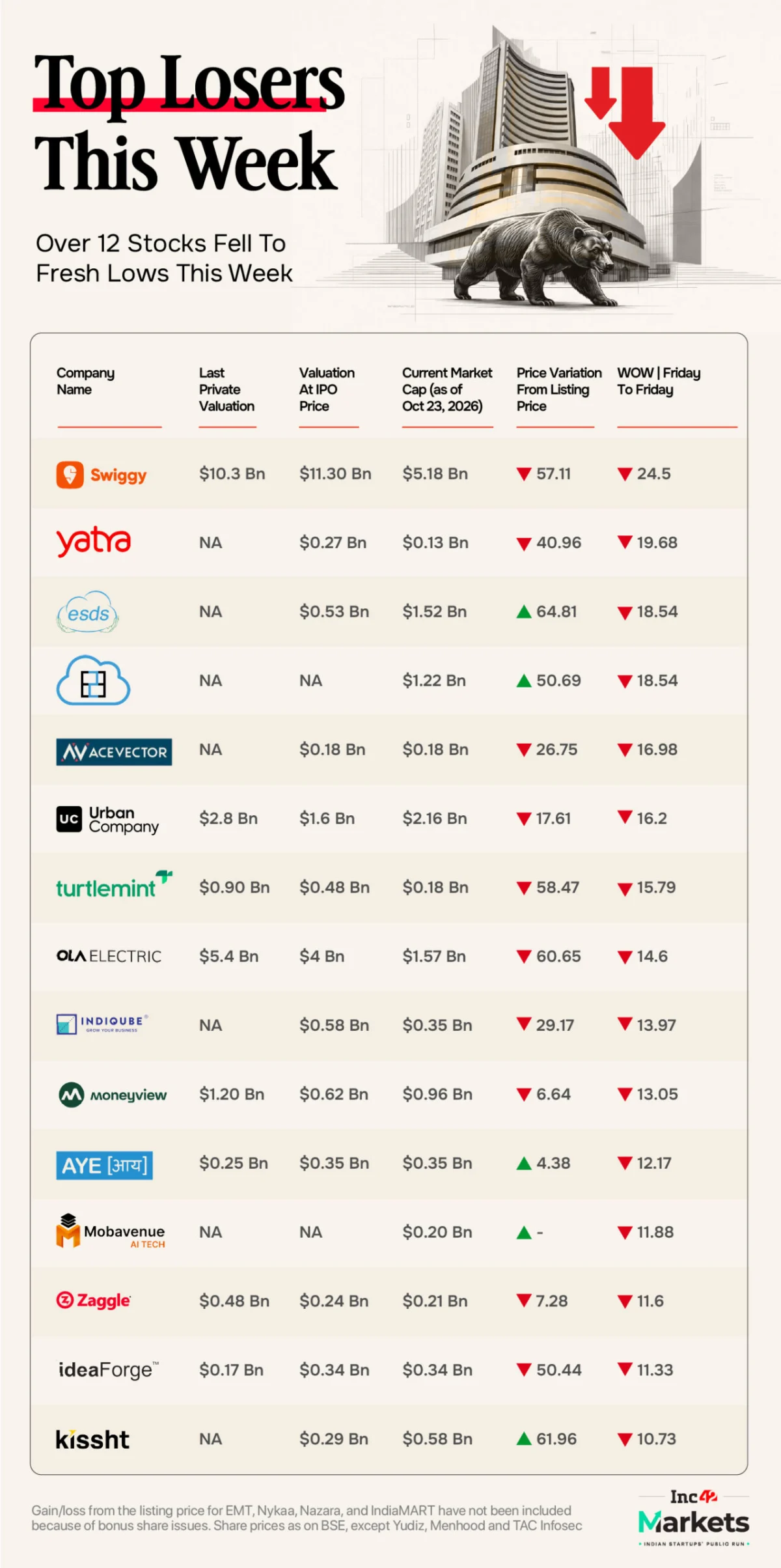
The Indian equity landscape, particularly the burgeoning new-age tech sector, endured a brutal week of trading as a broad-based sell-off wiped out more than $11 billion in combined market capitalization. In a period defined by caution, profit-taking, and investor anxiety over macroeconomic headwinds, the vast majority of the 67 technology companies tracked by Inc42 saw their valuations decline.
The carnage was widespread, with 63 companies recording losses ranging from 1.03% to a staggering 24.5%. Amidst this volatile backdrop, only a handful of outliers—Yudiz, Capillary, ixigo, and Tracxn—managed to defy the gravity of the market, closing the week in the green.
The Epicenter of the Sell-Off: Swiggy’s Record Lows
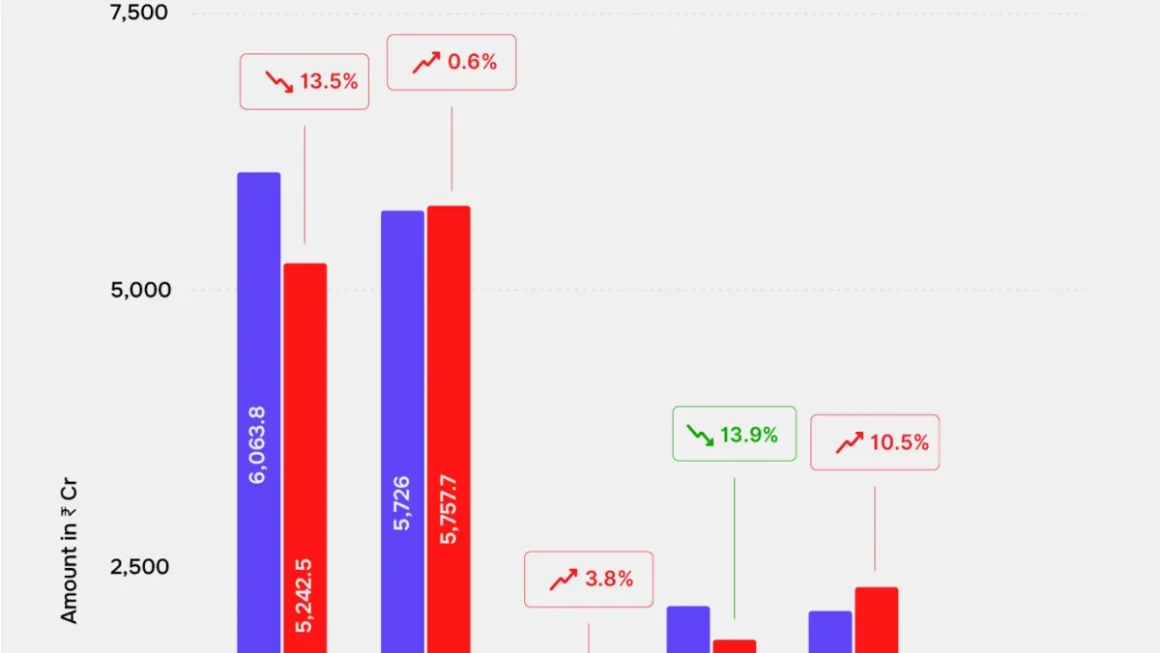
The most significant casualty of the week was food-tech giant Swiggy, which plummeted 24.5% to close at ₹176.70. The sharp decline, which saw the stock hit an all-time low during intraday trade, was triggered by the release of its Q2 FY27 earnings. While the company reported a 36% year-on-year (YoY) revenue surge to ₹7,571 Cr, the market focused on the mounting losses within its quick commerce arm, Instamart.
Instamart’s adjusted EBITDA loss widened to ₹895 Cr, up from ₹849 Cr in the same quarter last year and ₹778 Cr in the preceding quarter. Investors, already jittery about the high-burn nature of quick commerce, reacted sharply to the news, pushing the stock 54.7% below its IPO price of ₹390. Swiggy’s management has attempted to stem the bleeding, citing plans to transition Instamart to an inventory-led model within the next three quarters to improve contribution margins by 80 basis points.

Broader Market Weakness and Macroeconomic Headwinds
The tech sector’s woes were mirrored by the broader Indian stock market, which suffered a definitive end to its recent winning streak. The BSE Sensex shed 2.15% to settle at 73,123.83, while the Nifty 50 retreated 2.63% to 22,600. The holiday-shortened week, which saw markets closed for Dussehra, provided no respite as the index declined across all four active trading sessions.
The Macro Factors at Play
Several external factors conspired to weigh on investor sentiment:
- Crude Oil Prices: Brent crude’s steady climb toward $115 per barrel triggered fears of renewed inflation, rupee depreciation, and squeezed corporate margins.
- Geopolitical Tensions: The ongoing instability in West Asia continued to keep global markets on edge, prompting a flight to safety.
- FII Outflows: Foreign Institutional Investors (FIIs) remained net sellers for the tenth consecutive week, offloading equities worth ₹2,697 Cr. While this marked a moderation from the previous week’s ₹8,991 Cr, the persistent trend underscores a lack of confidence in current valuations.
- Broader Market Erosion: The pain was more pronounced in the midcap and smallcap segments, with the Nifty Midcap 100 and Nifty Smallcap 100 falling 5.6% and 7.3%, respectively.
Vinod Nair, head of research at Geojit Investments, noted that while the moderation in FII selling is a flicker of hope, the combination of elevated crude prices and sharp, widespread weakness in the mid-and-small-cap space keeps the downside risk firmly in play.
Corporate Developments: Innovation vs. Scrutiny
While the markets bled, individual companies continued to execute their strategic roadmaps, often drawing intense regulatory and operational scrutiny.

Eternal’s AI Ambitions
Despite the market downturn, Eternal reported a 92% YoY jump in Q2 FY27 net profit to ₹125 Cr. Founder Deepinder Goyal seized the moment to unveil "Dark," an end-to-end encrypted AI platform tailored for power users, with a global launch slated for late 2026. Furthermore, Eternal announced a strategic merger between its portfolio firm, AdOnMo, and the gated-community management platform Mygate, signaling its intent to deepen its footprint in the urban services ecosystem.
Regulatory Crackdown on Ecommerce
The Central Consumer Protection Authority (CCPA) dealt a blow to several major players, including IndiaMART and Justdial, by initiating action against seven ecommerce platforms. The regulatory move followed the discovery of listings for unauthorised and hazardous explosives. The crackdown forced the removal of 3,940 sellers and product listings, highlighting the ongoing struggle platforms face in policing their vast digital marketplaces.
ideaForge Retrenches
In the aerospace sector, drone manufacturer ideaForge made a tactical retreat from its international expansion efforts. The company terminated its joint venture agreement with US-based First Breach Inc., citing a failure to complete the transaction within the specified deadline. The partnership, which was originally intended to manufacture and distribute unmanned aerial vehicles (UAVs) in the US, has now been abandoned, forcing investors to reassess the company’s global growth trajectory.
The IPO Landscape: A Lukewarm Reception
The week also saw two high-profile public market debuts: B2B manufacturing firm Zetwerk and defense-tech player Tonbo Imaging. Both companies hit the exchanges at a premium, reflecting initial investor enthusiasm. However, the excitement was short-lived as the broader market sell-off caught up with them. By the end of the trading week, both stocks were trading below their BSE listing prices, with Zetwerk down 13.02% and Tonbo Imaging down 2.44%. These debuts brought the total number of new-age tech stocks tracked by Inc42 to 69, with a combined market cap of $152.32 billion—roughly 3.2% of the total BSE-listed market value.

Sector Spotlight: ixigo’s Resilience
Among the few bright spots was the online travel aggregator ixigo, which rose 1.45% following a robust Q2 performance. The company swung from a loss of ₹3.5 Cr in the previous year to a net profit of ₹63.4 Cr this quarter. While this included an exceptional gain from the partial sale of its stake in Freshbus, the underlying operational metrics—such as a 22% rise in Gross Transaction Value (GTV)—were impressive.
Notably, ixigo’s hotel segment saw a massive 158.7% surge in GTV. Despite this, brokerages like Choice Equity remain cautious, flagging potential margin pressure due to planned investments of ₹10-12 Cr in the coming quarters.
Looking Ahead: The Road to Stability
As the market looks toward the coming week, the agenda is packed with high-stakes events. Investors are bracing for:
- Monetary Policy Decisions: Rate updates from the US Federal Reserve and the Bank of Japan are expected to set the tone for global liquidity.
- Economic Indicators: US GDP data and India’s industrial production numbers will be closely monitored for signs of a slowdown.
- Earnings Season: The ongoing Q2 corporate earnings cycle will remain the primary driver of stock-specific movements, with investors scrutinizing management guidance for signs of margin recovery.
For the new-age tech sector, the path to recovery remains steep. With 12 companies—including FirstCry, Unicommerce, and Yatra—hitting fresh 52-week lows this week, the market is sending a clear message: profitability and sustainable business models are no longer optional. As the dust settles on this $11 billion wipeout, the focus will shift from aggressive expansion to fundamental efficiency. The coming months will be a crucible for these companies, determining which ones have the capital discipline to survive the current market storm and which will continue to face the wrath of disillusioned investors.