





KLOSTERNEUBURG, Austria — In a breakthrough that could fundamentally reshape the architecture of future quantum supercomputers and distributed networks, researchers at the Institute of Science and Technology Austria (ISTA) have successfully demonstrated a fully autonomous method for linking physically separated quantum bits (qubits). Published recently in the prestigious journal Physical Review X, the experiment marks the world’s first experimental validation of a theoretical framework first proposed over two decades ago.
By replacing traditional, highly intricate active feedback loops and probabilistic measurement schemes with a novel "quantum bath" powered by correlated particles of light, the ISTA team has cleared a major hurdle on the path toward scalable, fault-tolerant quantum computing.
Main Facts: The Core Breakthrough
At the heart of the ISTA team’s achievement is a paradigm shift in how distributed entanglement—the phenomenon wherein physically separated particles remain deeply interconnected despite spatial distance—is generated and sustained.
- The Autonomous Approach: Traditional strategies for creating distributed entanglement rely heavily on active control, precise timing, real-time feedback, and repeated "post-selection" measurements. The ISTA method is entirely autonomous, requiring zero active intervention once initiated.
- The Quantum Bath: Instead of forcing qubits to communicate via direct photon exchange, the researchers embedded the isolated qubits within a specialized "quantum bath"—an engineered environment composed of a continuous stream of correlated microwave photons.
- Bridging the Mismatch: The system successfully bridges a long-standing technological divide by taking readily available continuous-variable quantum states and utilizing them to anchor and stabilize discrete-variable ("all-or-nothing") entanglement required for practical quantum processing.
- Longevity of State: Because the quantum bath continuously feeds and stabilizes the system, the resulting entanglement outlasts the natural lifetime of the individual qubits, remaining perpetually available as an on-demand resource.
- The Theoretical Milestone: The experiment translates a purely theoretical proposal—one that sat unproven in academic literature for more than 20 years—into a functioning laboratory prototype.
Chronology: From a Two-Decade-Old Theory to Laboratory Reality
The realization of this breakthrough is the culmination of decades of theoretical evolution and meticulous experimental engineering.
The Theoretical Genesis (Early 2000s)
More than twenty years ago, theoretical physicists began exploring the concept of dissipative quantum engineering. Rather than viewing the surrounding environment (the "bath") as an enemy of fragile quantum states—a primary driver of decoherence and information loss—theorists asked whether an environment could instead be tailored to protect and create quantum correlations. While the math looked promising on paper, recreating these idealized conditions in a physical laboratory proved exceptionally difficult for generations of researchers.
The Experimental Quest at ISTA
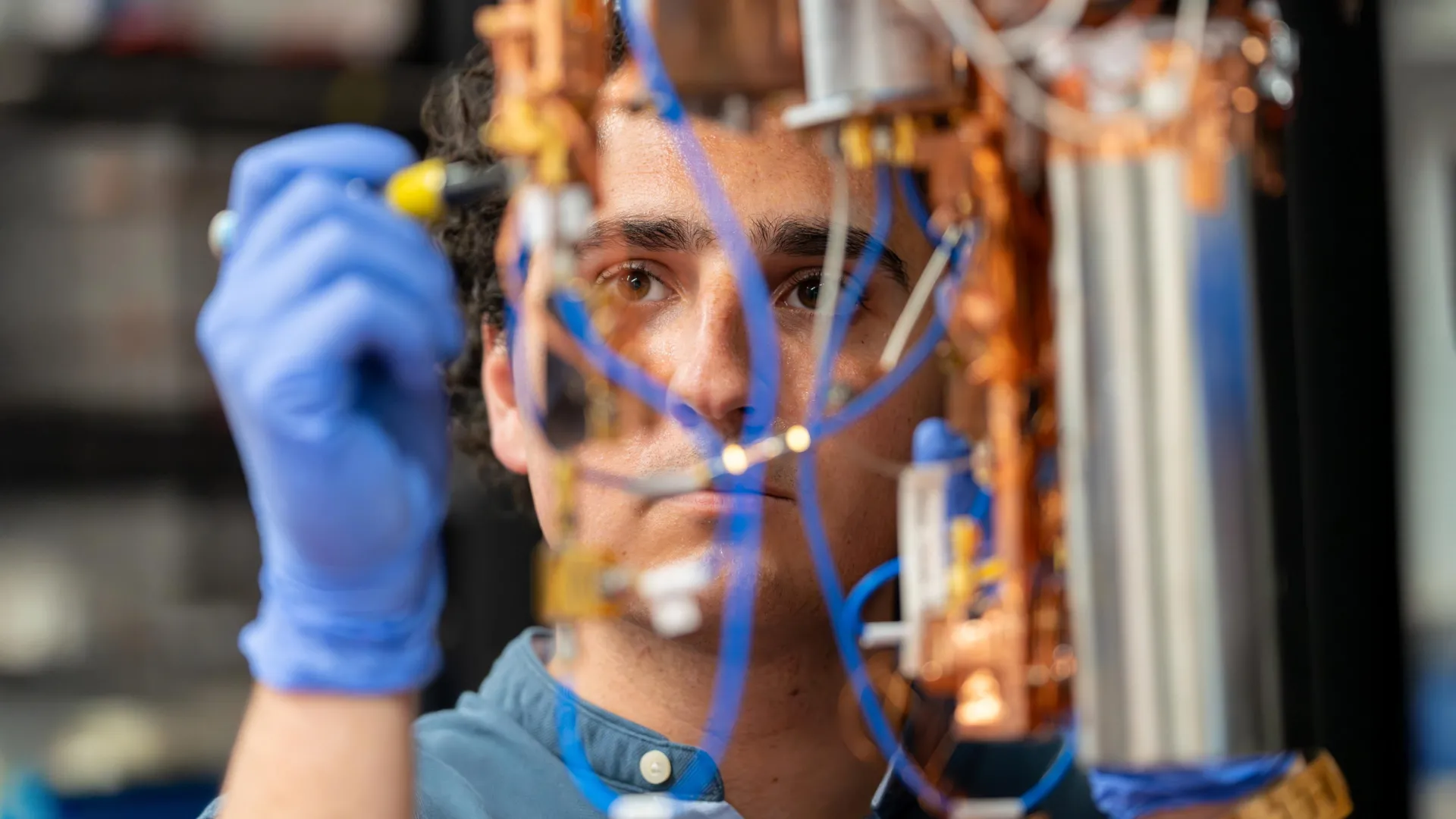
Fast forward to the modern era, where PhD student Alejandro Andrés-Juanes and Professor Johannes Fink at ISTA, working alongside an international team of collaborators, took up the challenge. They focused on superconducting circuits—a leading platform for quantum computing that relies on microwave architecture.
Prototype Construction and Testing
The researchers designed a prototype featuring two spatially separated qubits coupled to a shared, centralized source of correlated microwave photons. Rather than relying on fleeting, one-off photon exchanges, they tuned the system so that the continuous flux of light particles from the bath would naturally herd the distant qubits into a synchronized, entangled ground state.
Quantum Tomography and Validation
To verify that the qubits were indeed entangled within the bath, the team employed quantum tomography—a complex diagnostic technique that reconstructs the multi-dimensional state of a quantum system by taking rapid snapshots of its behavior. Using measurement windows lasting a mere 20 to 80 nanoseconds (billionths of a second), the researchers successfully mapped and confirmed the hidden quantum correlations, officially bringing a 20-year-old prediction to life.
Supporting Data: Technical Specifications and Efficiencies
While the conceptual success of the experiment is groundbreaking, the researchers remain transparent about the current technical hurdles and efficiency metrics of their prototype.
- Transfer Efficiency: Currently, the prototype system successfully transfers approximately 10% of the quantum bath’s total available entanglement to the targeted qubits. While sufficient for a proof-of-concept, scaling this efficiency is a primary goal for future iterations.
- Measurement Timelines: Quantum tomography measurements were conducted within highly compressed intervals of 20 to 80 nanoseconds, highlighting the rapid dynamics inherent to superconducting microwave circuits.
- Photon Wavelengths: The experiment utilized microwave photons, which possess low energy levels ideal for manipulating quantum information within stationary superconducting architectures. Concurrently, optical photons—though not used in this specific entanglement bath—are being researched by the Fink group for potential long-distance transmission via fiber optics.
- The 20-Year Gap Explained: According to the research team, the primary reason the theory remained unrealized for two decades is that original models relied on idealized parameters that failed to account for real-world environmental noise, circuit dissipation, and phase instabilities. The ISTA experiment successfully identified and navigated these practical roadblocks.
Official Responses and Expert Perspectives
The implications of the ISTA study have generated considerable excitement within the global quantum physics community, particularly regarding the simplification of future hardware architectures.
"In this work, we aimed to overcome this mismatch between the readily available and the practically useful forms of entanglement," explains Alejandro Andrés-Juanes, PhD student at ISTA and lead author of the study. "By stabilizing the entangled states remotely, our approach is fully autonomous and requires no active control or measurement."
Addressing the fundamental philosophy of how quantum systems interact with their surroundings, Professor Johannes Fink emphasized the shift from mitigating environmental damage to weaponizing the environment for stability:
"In our method, the quantum bath—meaning the qubits’ environment—is the source of entanglement. It creates a new ground state through a continuous stream of correlated photons," Fink states. "This way, the entangled qubit state is stabilized, even beyond the qubits’ own ‘lifetime’, and remains always available as a resource for further quantum processing. This makes the approach conceptually significant."
Reflecting on the experimental barriers that stalled progress for twenty years, Fink added:
"Our experiments helped us reveal several factors that may have prevented scientists from designing a functional quantum bath using a single source of correlated photons for distributed entanglement."
Implications: Building Blocks for Scalable Quantum Computers
The successful demonstration of a fully autonomous quantum bath carries profound implications for the future trajectory of quantum technology, particularly in areas concerning network scaling and fault tolerance.
1. Eliminating the Need for Complex Feedback Loops
Current state-of-the-art methods for generating distributed entanglement—such as the heralded entanglement schemes recognized by the 2022 Nobel Prize in Physics—rely on intricate timing, detectors, and real-time electronic feedback to decide whether an entanglement attempt succeeded. If it fails, the process must be repeated. By automating this process via a persistent quantum bath, future quantum computers could bypass the bottlenecks of active control electronics, drastically reducing system complexity.
2. Paving the Way for Modular Quantum Computing
As individual quantum processors reach the physical limits of how many qubits can be packed onto a single chip, the industry is shifting toward modular architectures. Connecting multiple smaller quantum processing units (QPUs) via distributed entanglement is essential for building ultra-powerful quantum supercomputers. The ISTA approach provides a viable blueprint for keeping disparate modules permanently synchronized.
3. Toward Fault-Tolerant Operation
Decoherence—the loss of quantum information due to environmental interference—remains the Achilles’ heel of quantum computing. By demonstrating that an engineered environment can actively sustain and protect an entangled ground state beyond the natural lifetime of the qubits, the ISTA group points the way toward more resilient, fault-tolerant hardware designs.
Looking Ahead
While the ISTA prototype currently operates at a modest 10% transfer efficiency and is far from commercial deployment, it shatters a long-standing technological ceiling. As Andrés-Juanes notes, the method is inherently scalable, offering a straightforward path toward synchronizing multiple distant qubits.
With ongoing investigations into optical fiber integration and efficiency optimization, the Fink research group at ISTA is positioning itself at the vanguard of the next generation of quantum communication networks—where the environment is no longer the quantum computer’s worst enemy, but its greatest stabilizer.