The cybersecurity landscape has been thrust into a state of high alert following the discovery of a critical arbitrary file access vulnerability, cataloged as CVE-2026-21589, affecting a wide array of Atlassian’s self-managed Data Center products. Within hours of the release of technical analysis and proof-of-concept (PoC) material by security researchers, threat actors have already begun weaponizing the flaw to target vulnerable enterprise environments.
As organizations scramble to patch their systems, the security community has issued urgent warnings, noting that the window between vulnerability disclosure and active exploitation has effectively closed.
The Chronology of a High-Stakes Disclosure
The timeline of CVE-2026-21589 reflects the modern "race against time" inherent in software security.
- Initial Patch Release: Atlassian officially addressed the vulnerability in its suite of Data Center products, providing security updates to mitigate the file access flaw.
- Technical Disclosure: Shortly thereafter, researchers from the offensive security firm watchTowr published an in-depth technical rundown of the vulnerability. Their report provided the necessary context for how the flaw could be weaponized, effectively lowering the barrier to entry for prospective attackers.
- Weaponization: Less than 24 hours after the patches were issued, threat intelligence firm Previdian reported that their global network of honeypots had begun recording active exploitation attempts. These attempts, characterized by specific payload structures, confirm that attackers are actively scanning the internet for unpatched Atlassian instances.
This rapid transition from "patched vulnerability" to "active exploitation" underscores the critical importance of immediate patch management for enterprise software.
Technical Analysis: Anatomy of the Vulnerability
The core of CVE-2026-21589 lies in a shared library component: atlassian-plugins-webresource*.jar. This library is a foundational element across the vulnerable product suite, meaning the impact of the flaw is widespread.
The Path-Traversal Bypass
The vulnerability stems from a quirk in the application’s routing logic. The affected software contains functions designed to convert double colons (::) into forward slashes (/). Researchers discovered that this mechanism could be abused to bypass existing security filters that were designed to prevent directory traversal.
By crafting a payload shaped like ..::..::..::<dir>::file.txt, an attacker can effectively "smuggle" a traversal request through the application’s routing layer. Because the slash-stripping defenses are tricked by the double-colon transformation, the application interprets these inputs as legitimate file paths, allowing unauthorized access to files within the application server’s root directory.
From File Access to Full System Compromise
While arbitrary file access is a severe vulnerability on its own, its true danger lies in the specific files an attacker can reach.
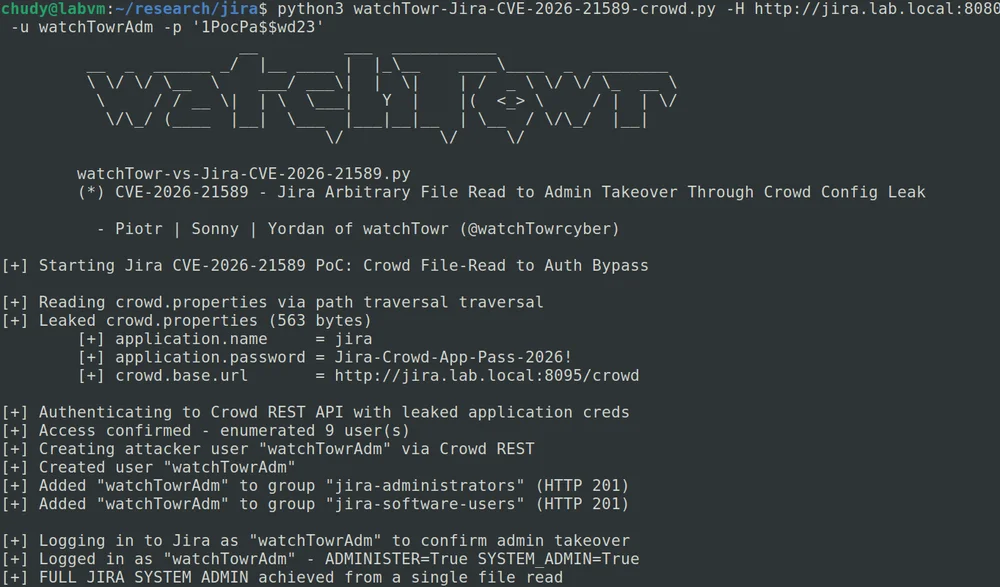
The researchers at watchTowr demonstrated that by targeting specific configurations, the vulnerability could be escalated. For instance, in Atlassian Crowd deployments, the file WEB-INF/classes/crowd.properties is stored in a location accessible via this flaw. This file contains plaintext application names and passwords.
With these credentials in hand, an attacker can authenticate directly to the Crowd identity and SSO hub. Once authenticated as an administrator, the attacker gains the ability to:
- List all users within the environment.
- Create new, unauthorized administrative accounts.
- Modify group memberships (e.g., adding a malicious account to the
jira-administratorsgroup). - Effectively seize total control of the Jira instance and its associated data.
Affected Products and Scope
CVE-2026-21589 is not an isolated incident; it represents a systemic issue due to the shared code base of Atlassian’s Data Center ecosystem. The following products are confirmed to be vulnerable:
- Bitbucket Data Center
- Confluence Data Center
- Jira Service Management Data Center
- Jira Software Data Center
- Bamboo Data Center
- Crowd Data Center
- Crucible and Fisheye
Atlassian has noted that while the vulnerability does not allow for directory listing or enumeration—meaning an attacker must know the exact path and name of the target file to exploit it—the potential for data exfiltration and privilege escalation remains critically high.
Official Response and Mitigation Strategies
Atlassian’s response has been swift, urging all customers to prioritize the deployment of the provided security patches. The company has published a detailed advisory outlining the necessary steps for remediation.
Immediate Action Required
For organizations unable to deploy the patch immediately, the guidance is clear: isolate the vulnerable instances.
- Network Isolation: Remove vulnerable instances from public-facing infrastructure. If a server must remain accessible, it should be placed behind a strict firewall or VPN that prevents unauthorized external access.
- Log Analysis: Security teams should conduct a forensic review of application access logs. Look for specific request patterns that match the
..::syntax, as these are strong indicators of attempted exploitation. - Credential Rotation: If an instance is suspected of having been compromised, simply patching the vulnerability is insufficient. Organizations must immediately rotate all credentials, particularly those stored in configuration files or linked to SSO providers like Crowd.
The Role of Security Research
The role of firms like watchTowr in this scenario is multifaceted. While their publication of technical details undoubtedly assisted malicious actors, their work also provided defenders with the necessary "indicators of compromise" (IoCs) to monitor their networks. watchTowr has made a diagnostic script available on GitHub, which allows administrators to test whether their specific instances are susceptible to the vulnerability, providing a vital tool for rapid assessment.
Strategic Implications for the Enterprise
The exploitation of CVE-2026-21589 highlights several sobering realities for modern cybersecurity posture:
1. The Peril of Shared Components
The vulnerability demonstrates how a single, shared library can become a "single point of failure" for an entire product suite. When a vulnerability exists in a common JAR file, it creates a massive attack surface that spans disparate products, from issue tracking to identity management. Enterprises must account for this when performing software inventory and risk assessment.
2. The Speed of Weaponization
The "n-day" window—the time between a patch release and active exploitation—is shrinking. Attackers are increasingly utilizing automated tools to reverse-engineer patches within hours of their release. This shift means that traditional, manual patching cycles are no longer sufficient. Organizations must move toward automated, high-priority patch deployment processes.
3. "Known Paths" and Security Through Obscurity
Atlassian’s note that the vulnerability requires "prior knowledge of the target file’s exact name and path" might lead some to a false sense of security. However, in the context of enterprise software, most paths are predictable. Attackers often use automated scanning and common file lists to discover sensitive configuration files. Reliance on "secret" file paths is not a robust defense mechanism.
4. The Value of Honeypots
The early warning provided by the Previdian honeypot network highlights the value of threat intelligence. By observing exploitation trends in a controlled environment, defenders can gain critical intelligence on attacker behavior, such as the specific IPs involved or the nature of the payloads being used, even before a broad-scale attack campaign begins.
Conclusion: A Call to Vigilance
The emergence of CVE-2026-21589 is a reminder that the digital infrastructure supporting modern enterprise operations is under constant, sophisticated assault. The vulnerability is not merely a software bug; it is a gateway that, if left open, allows for complete administrative takeover.
Organizations utilizing Atlassian Data Center products must treat this alert with the highest level of urgency. Beyond the immediate technical fix, this event serves as a mandate to review incident response plans, reinforce perimeter security, and adopt a "zero-trust" approach to internal configuration files.
As the threat landscape evolves, the difference between a minor incident and a catastrophic data breach often comes down to the speed of response. For those managing Atlassian instances today, that response must be immediate, comprehensive, and prioritized above all other operational tasks.