










As the artificial intelligence landscape rushes headlong into the era of "AI for Science," billions of dollars and countless compute cycles are being poured into Large Language Model (LLM) agents designed to achieve autonomous scientific discovery. Scarcely a week passes without a headline heralding a major computational breakthrough: OpenAI claims to have mastered the Navier-Stokes equations; systems like AlphaEvolve and the Kosmos AI scientist generate headlines for engineering feats.
Yet, beneath the glossy marketing materials and benchmark sweeps, a glaring disconnect persists. When pitted against top-tier human researchers on complex, real-world machine learning challenges, state-of-the-art AI agents continue to fall short of human-level performance.
To bridge this gap, a new study accepted at COLM 2026—"Can LLM Agents Discover? Evaluating Creativity on ML Engineering Tasks," authored by Yunxiang Zhang and Professor Lu Wang from the University of Michigan—proposes an unexpected diagnostic lens: creativity. Rather than merely looking at raw computational power or optimization curves, the researchers argue that quantifying how AI models structure and execute the creative search process can explain why some frameworks dramatically outperform others.
Chronology of the Study: From Theoretical Frameworks to Empirical Benchmarks
The intellectual genesis of the University of Michigan project lay in a deceptively simple question: How do we quantify the vague notion of an AI "making a creative leap"?
To operationalize this, Zhang and Wang grounded their work in decades of cognitive psychology and creativity research. They synthesized three foundational pillars:
- The Standard Definition of Creativity: Formulated by Mark A. Runco and Garrett J. Jaeger, true creativity demands the simultaneous production of ideas that are both original (novel) and useful (effective or appropriate).
- Structured Conceptual Spaces: Grounded in Margaret Boden’s seminal frameworks, creativity is conceptualized as the generation of novel ideas through the exploration of structured conceptual spaces, akin to mapping pathways through musical intervals or problem-solving mazes (a concept originally detailed by Newell, Shaw, and Simon).
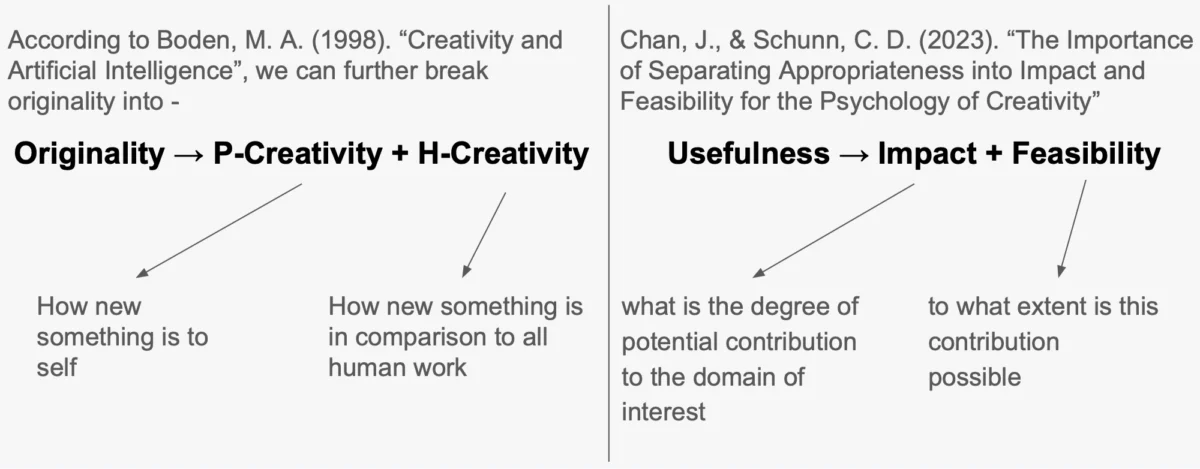
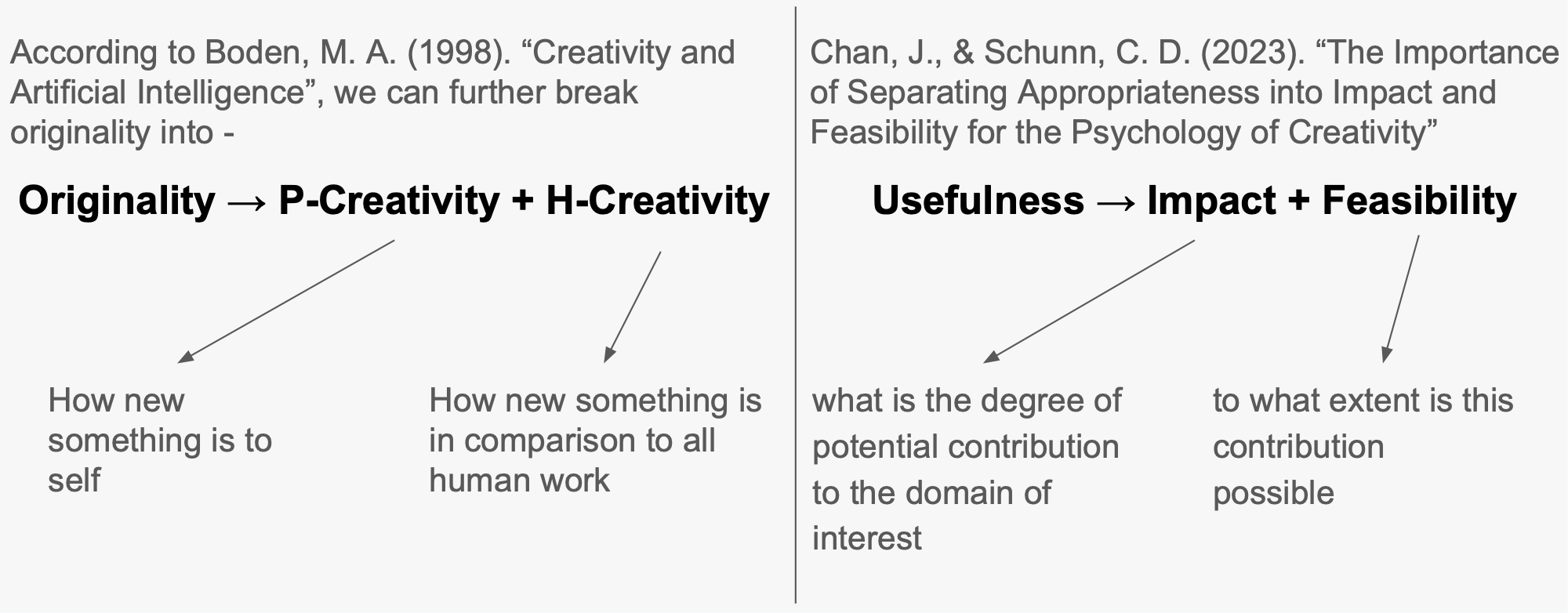
- The Multidimensional Breakdown: The researchers further decomposed originality into P-Creativity (novelty relative to the program’s own history and memory) and H-Creativity (novelty compared to the entire corpus of human knowledge), alongside usefulness metrics like Impact and Feasibility.
With this rigorous scaffolding established, the research team structured a massive empirical evaluation suite. Drawing from MLE-bench—a rigorous benchmark testing ML engineering proficiency across Kaggle competitions—they filtered for ten tasks spanning image, natural language processing, and tabular data. Crucially, they selected competitions boasting between 877 and 3,747 public human notebooks, ensuring a rich historical baseline for H-creativity comparisons.
The experiments pitted two prominent agent frameworks—AIDE (a greedy tree-search agent) and AIRA-Dojo (which expands upon AIDE with diverse search strategies and operators)—against two backbone models: GPT-5 and Qwen3-32B. Each agent was subjected to eight independent runs per model-task combination, operating under an 8-hour budget and a maximum cap of 10 episodes (where an episode represents a successful code-to-submission cycle).
Supporting Data: What the Metrics Reveal
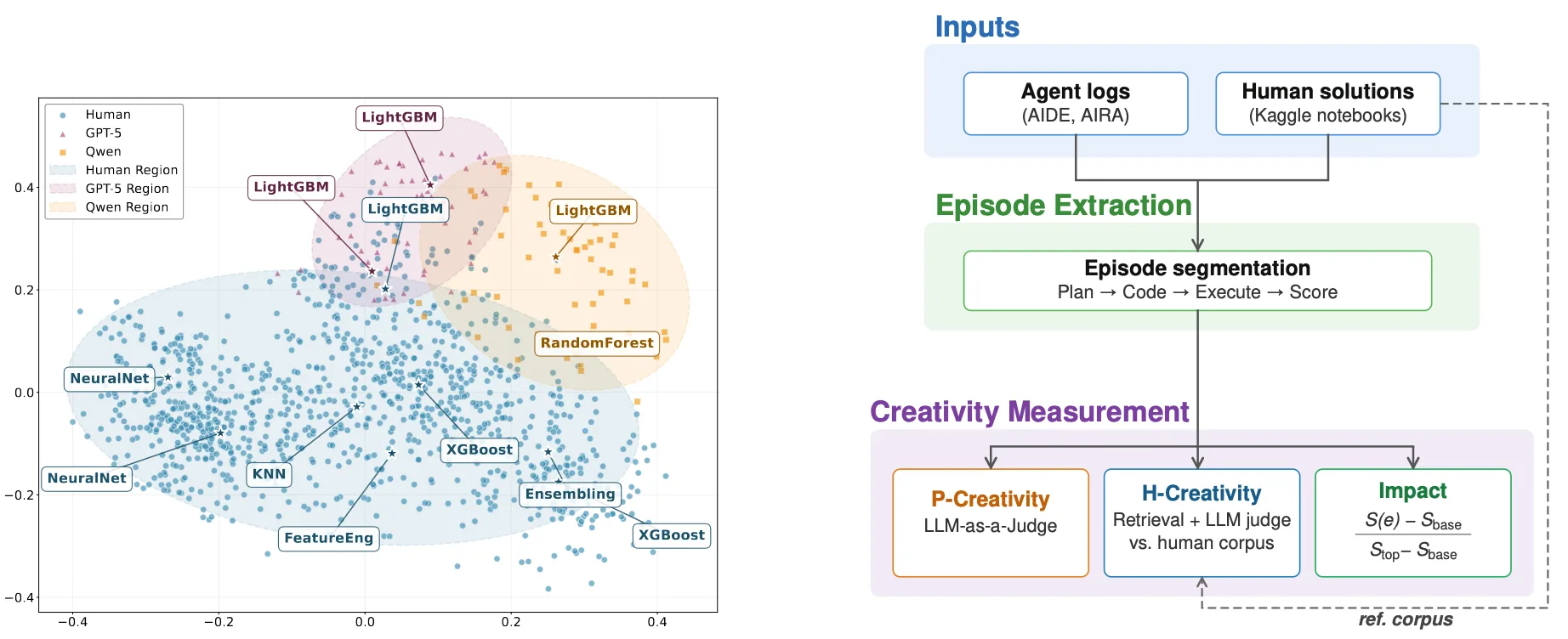
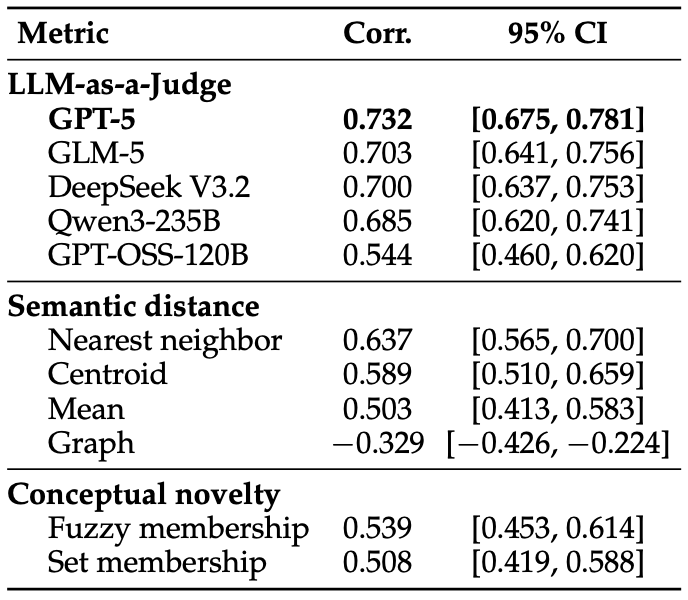
To evaluate these systems at scale without relying on cost-prohibitive manual expert reviews, the researchers tested various automated proxy metrics against human annotations. By tasking three expert annotators to label 300 episodes for P-creativity, they benchmarked semantic distance, conceptual novelty, surprisal metrics, and LLM-as-a-judge frameworks.
The findings were unequivocal: LLM-as-a-Judge using GPT-5 achieved the strongest, most statistically significant agreement with human judgment (Spearman correlation with $p < 0.001$), comprehensively outperforming traditional embedding-based proximity metrics.
Armed with this validated pipeline, the empirical data revealed several startling insights regarding how AI agents behave during extended test-time compute.
1. The Trap of Early Exploration and Premature Exploitation
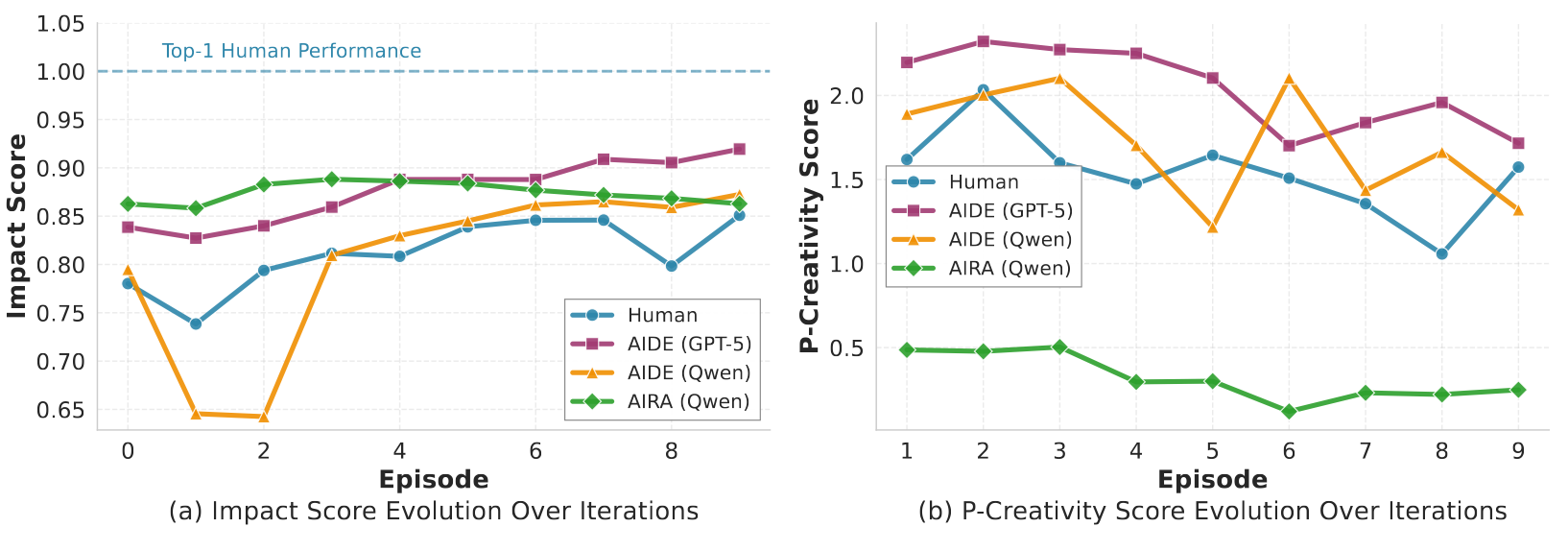
Across all tested agents, a universal trajectory emerged: systems invariably transition from an exploratory phase to an exploitative one at a remarkably aggressive rate.
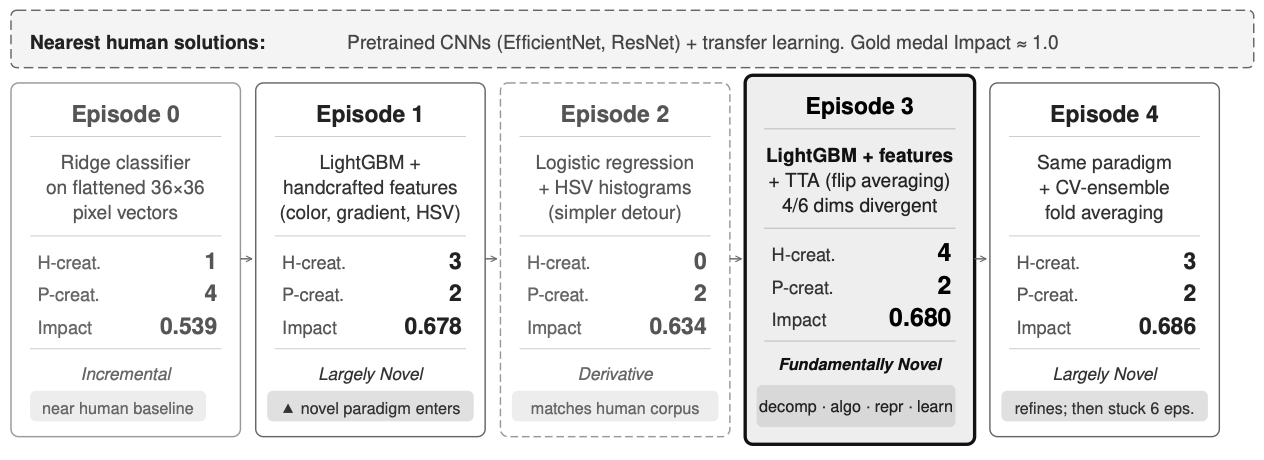
While human researchers also experience this shift over months of competition, AI agents show a dramatically steeper decline in P-creativity after just a few iterations. Behavioral analysis of the models’ internal reasoning traces confirmed that strategic exploration accounts for roughly 75% of early reasoning steps, but plummets to just 25% by the end of a run. Once an agent commits to a particular computational paradigm, it locks in, refining within that narrow corridor rather than stepping back to seek paradigm-shifting alternatives.
2. Search Strategy Alone Does Not Dictate Success
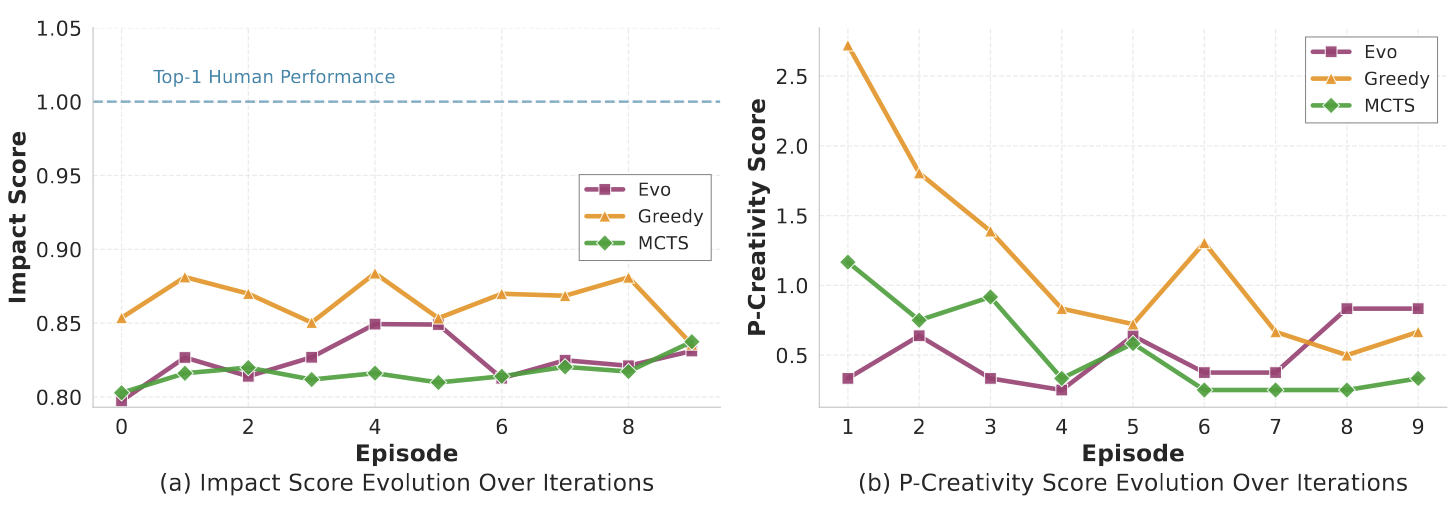
In a counterintuitive finding, comparing different search algorithms within the AIRA-Dojo framework (such as Monte Carlo Tree Search [MCTS], evolutionary search, and greedy search) revealed that underlying search strategies produce remarkably similar long-term trajectories.
While greedy search started with the highest initial P-creativity before steeply declining, it ultimately achieved the highest impact. The lack of wild variance across strategies highlights a critical design takeaway: simply swapping out search trees or optimization algorithms is insufficient. The entire scaffolding, prompt engineering, context window management, and feedback loops must operate in absolute harmony.
3. High Novelty, Low Conversion: The H-Creativity Paradox
Perhaps the most provocative discovery centers on historical human comparisons. When measuring H-creativity against human solutions submitted by medalists, the researchers found that LLMs consistently generate far more novel solutions than human gold-medal winners.
For instance, AIDE paired with GPT-5 achieved an H-creativity score of 1.423, vastly outpacing Human Gold Medalists (0.744), Silver Medalists (0.524), and Bronze Medalists (0.293). Yet, despite generating solutions with twice the historical novelty of elite human competitors, only 21% of GPT-5 runs actually secured a medal.
The data confirms that while agents excel at generating bizarre, unconventional, and highly original approaches, they systematically fail to convert that raw novelty into feasible, robust, and impactful engineering execution.
Official Perspectives and Academic Implications
The study’s authors emphasize that the disconnect between artificial and human intelligence in scientific discovery cannot be bridged simply by throwing more compute at raw optimization.
"Our findings point directly to the urgent necessity of dual optimization," the research team notes. "If we are to build truly autonomous research agents, we must stop treating novelty and impact as orthogonal concepts. Future frameworks must explicitly optimize for the intersection of P-creativity, H-creativity, and rigorous empirical usefulness."
External AI safety and machine learning researchers have echoed these sentiments, pointing out that historical temporal analysis of agent episodes shows that AI-generated ideas span the entire timeline of a human competition. GPT-5, in particular, demonstrated a remarkably uniform temporal spread of nearest-human neighbors, suggesting that scaling up a model’s foundational reasoning capabilities naturally helps it navigate mature human paradigms rather than blindly repeating early, abandoned rookie mistakes.
Broader Implications for the Future of Autonomous Science
The implications of the COLM 2026 study extend far beyond Kaggle leaderboards and machine learning benchmarks. As the AI community races toward generalized autonomous scientific discovery, this research serves as both a cautionary tale and a roadmap.
The Myth of Pure Autonomy
While recent months have seen demonstrations of AI systems discovering novel algorithms with minimal human oversight, the overwhelming consensus within applied research laboratories points toward Human-AI complementarity as the most viable medium-term paradigm. Humans provide the rigorous constraint-checking, feasibility oversight, and domain intuition required to convert wild agentic novelty into pragmatic, high-impact science.
The Horizon of Dual-Objective RL
By demonstrating that P-creativity and impact can be reliably quantified at scale using LLM-as-a-judge pipelines, the University of Michigan study opens the door for entirely new reinforcement learning (RL) paradigms. Future agent architectures could incorporate creativity scores directly into their reward functions, actively penalizing repetitive exploitation while incentivizing transformative conceptual leaps.
Limitations and Next Steps
The researchers are quick to acknowledge the boundaries of their current work. Evaluations were necessarily capped at 10 episodes due to context window and compute constraints. Furthermore, applying this creativity-centric evaluation framework to truly open-ended scientific research—where ground-truth quantitative metrics and bounded historical corpora do not exist—will require the development of sophisticated surrogate usefulness signals.
Nevertheless, as foundational models scale beyond the capabilities of GPT-5 and Qwen3-32B, the baseline aptitude of these agents is climbing rapidly. The day when an AI system can not only dream up a radically novel scientific hypothesis, but successfully engineer, test, and convert it into a world-class breakthrough, is drawing closer. But as Zhang and Wang demonstrate, achieving that future will require teaching artificial intelligence not just how to search, but how to truly create.



