









In the rapidly evolving landscape of data science and artificial intelligence, there exists a pervasive "tutorial trap." Aspiring engineers and data scientists often view the fundamental syntax and structures of Python as a mere vestibule—a waiting room they must pass through as quickly as possible to reach the "prime time" libraries like PyTorch, TensorFlow, or Scikit-learn. The assumption is that the real work happens exclusively within these high-level frameworks.
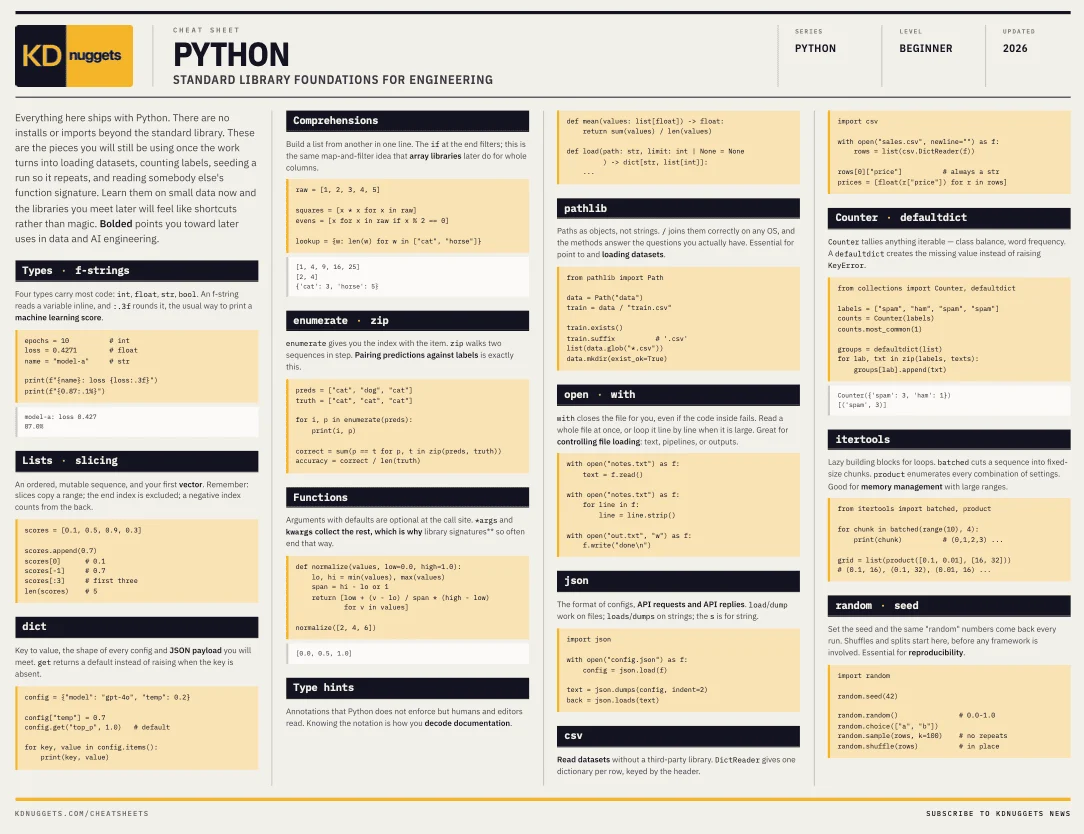
However, this mindset often produces practitioners who can replicate a tutorial with surgical precision but find themselves utterly stranded the moment their unique data deviates from the curated examples. To address this widening skill gap, KDnuggets has released a new Python Engineering Foundations Cheat Sheet, a comprehensive guide designed to ground practitioners in the essential, immutable concepts that underpin every successful AI project.
The Illusion of the "Waiting Room"
The Downside of Shortcut Learning
The modern learning path for many data professionals is heavily weighted toward library-specific proficiency. While frameworks are essential for scaling models, they are built upon the bedrock of core Python. When a student treats basic data structures, list comprehensions, or file handling as "preliminaries" to be rushed through, they fail to develop the intuitive grasp of how data flows through a system.
The result is a fragile expertise. When a model fails, or a dataset throws an unexpected error, a practitioner who relies solely on library syntax often lacks the fundamental understanding required to debug the underlying logic. As the saying goes in software engineering, "debugging without understanding is a fool’s game."
The KDnuggets Philosophy
The philosophy behind the new cheat sheet is simple: professional-grade engineering is not about how many libraries you can import; it is about how well you understand the language executing those libraries. The concepts covered in the guide are not transient; they are the primitives that remain constant even as the ecosystem evolves. Whether you are manipulating a small list of dictionaries or an array of ten million rows in a vectorized environment, the underlying logical operation remains the same. By mastering these concepts early, developers can see past the "syntax magic" of complex frameworks and understand exactly what the machine is doing.
Chronology of Python’s Rise and the Engineering Gap
Python was not originally designed as a high-performance engine for machine learning. Its ascent to the top of the data science hierarchy was a gradual process fueled by its readability and, crucially, its extensibility.
- The Scripting Era (1991–2005): Python was primarily used for system administration, web development, and general automation. The focus was on "glue code"—connecting different systems together.
- The Numerical Awakening (2006–2012): The rise of NumPy and SciPy signaled the beginning of the shift. Developers began to realize that Python could handle complex mathematical operations if the heavy lifting was offloaded to C-based extensions.
- The Deep Learning Boom (2013–Present): The current era, dominated by massive neural networks and LLMs, has abstracted away the "how" of computation. While this has democratized AI, it has also created a generation of developers who are increasingly disconnected from the file system, memory management, and data serialization—the core tasks that make up 80% of any real-world production system.
The KDnuggets cheat sheet serves as a corrective to this history. It brings the focus back to the "glue code" era, reminding developers that data science is, at its core, software engineering.
Supporting Data: The Reality of Production Work
Industry data consistently shows that the most time-consuming aspects of AI projects are not model selection or hyperparameter tuning. According to surveys from organizations like O’Reilly and various industry reports, nearly 70% to 80% of a data scientist’s time is spent on:
- Data Wrangling: Cleaning, restructuring, and formatting raw data from heterogeneous sources.
- Pipeline Orchestration: Ensuring that data flows reliably from a source (like an API or a database) to a model.
- Environment Management: Dealing with dependency hell, version drift, and hardware constraints.
The KDnuggets guide focuses on these exact pain points. It prioritizes the "boring" but vital tasks: safely opening files, handling configuration formats (JSON, YAML), counting dataset contents to ensure integrity, and fixing random seeds to ensure reproducibility. These are not "pre-engineering" tasks; they are the engineering work.
Official Perspectives: The Value of "Prose" Literacy
One of the most profound sections of the new resource deals with code literacy—specifically, the ability to read and understand library documentation.
Decoding the Language of Libraries
Many newcomers struggle to navigate official documentation because they do not understand standard Python notation. Concepts like function signatures, type annotations, and optional arguments are the "prose" in which the industry communicates. When a developer cannot read a function signature, they are forced to rely on trial-and-error, Stack Overflow snippets, or, increasingly, generative AI prompts.
By teaching developers to be conversant in this notation, the cheat sheet empowers them to solve problems independently. Instead of asking a chatbot to "write me a function for X," a proficient engineer can read the documentation for a library, understand the required arguments, and implement a robust solution that is tailored to their specific data structure.
The "Zero-Dependency" Advantage
A key strength of the KDnuggets guide is its focus on standard library features. Everything featured in the cheat sheet ships with the Python installation itself. In a world where dependency management is a primary source of project failure and security vulnerabilities, the value of knowing the native toolset cannot be overstated. There is nothing to install, nothing to pin in a requirements.txt file, and no risk of version drift.
Implications for the Future of AI Development
The Shift Toward Robust Engineering
As the hype cycle around AI matures, organizations are beginning to prioritize "Production AI" over "Experimental AI." The market is moving away from developers who can build a notebook-based prototype and toward engineers who can build, test, and maintain robust, scalable systems.
The implication for individuals is clear: foundational knowledge is the best hedge against technological obsolescence. While specific AI frameworks will undoubtedly rise and fall, the ability to manipulate data structures, manage memory, and write clean, documented, and reproducible Python code will remain a permanent asset.
Bridging the Gap
The release of this cheat sheet is an invitation to revisit the basics. For the newcomer, it is a roadmap to avoid the most common pitfalls of the "tutorial trap." For the veteran, it serves as a high-utility reference that reinforces the best practices that are so often lost in the rush to deploy.
Ultimately, the goal is to shift the professional identity of the data practitioner. By mastering the fundamentals, developers move from being "users of libraries" to "engineers of systems." They stop treating the language as a hurdle and start treating it as the powerful, flexible tool that it is.
Conclusion
The KDnuggets Python Engineering Foundations Cheat Sheet is more than just a list of functions; it is a pedagogical intervention. It encourages a return to the roots of software engineering, where readability, reliability, and reproducibility are the primary metrics of success.
In an era where we have the luxury of offloading complex math to high-performance libraries, we must not forget the responsibility of the engineer to understand the system as a whole. By grounding their practice in these fundamentals, data professionals can ensure that their work is not only impressive in its output but also sound in its construction. Whether you are a student just starting your journey or a seasoned practitioner looking to sharpen your skills, the foundation is, and will always be, the most important part of the architecture.



