






In the rapidly evolving landscape of embodied artificial intelligence, Vision-Language-Action (VLA) models stand at the frontier. These models, which allow robots to interpret visual scenes and translate natural language instructions into physical movement, represent a monumental shift in how we bridge the gap between digital reasoning and mechanical execution. However, for many engineers and researchers, the barrier to entry remains high. Large-scale models like the 7-billion-parameter OpenVLA often feel prohibitively expensive, architecturally fragile, and notoriously difficult to verify.
The core challenge for any developer looking to enter this field is simple: How do you know your fine-tuning pipeline is actually working before you commit days of compute time and thousands of dollars to a full-scale robot experiment? This article provides a small, reproducible, and fully verifiable roadmap to performing a Low-Rank Adaptation (LoRA) fine-tune of OpenVLA within a Google Colab environment.

The State of OpenVLA: Understanding the Architecture
OpenVLA, introduced in the seminal paper OpenVLA: An Open-Source Vision-Language-Action Model, is a 7-billion-parameter model pretrained on an expansive dataset of 970,000 real-world robot demonstrations. Its function is to serve as a universal policy for robot control.
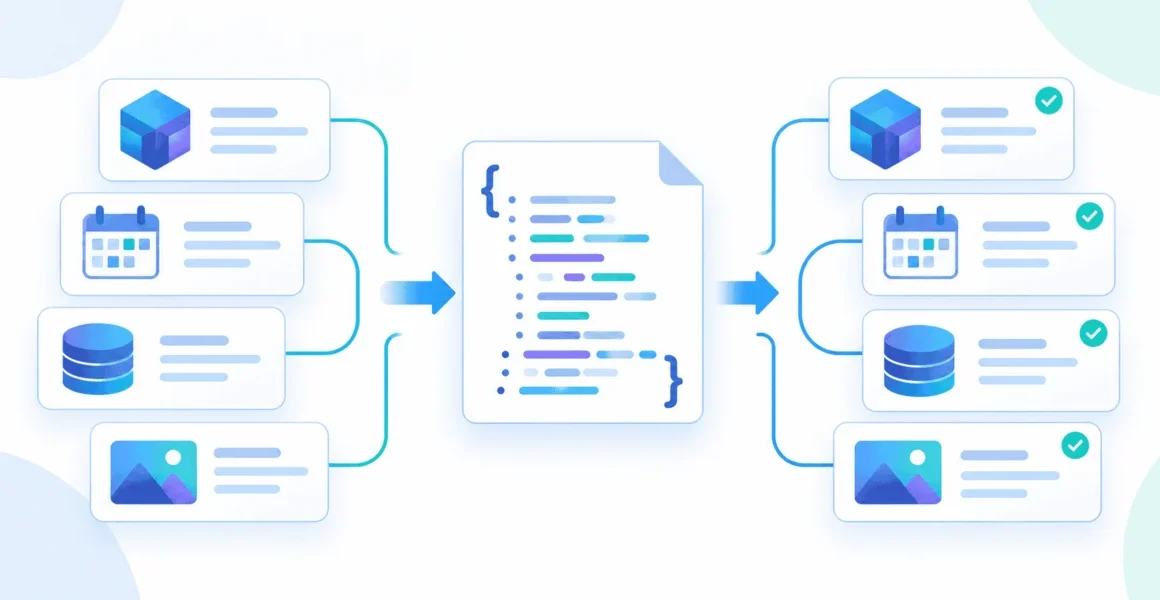
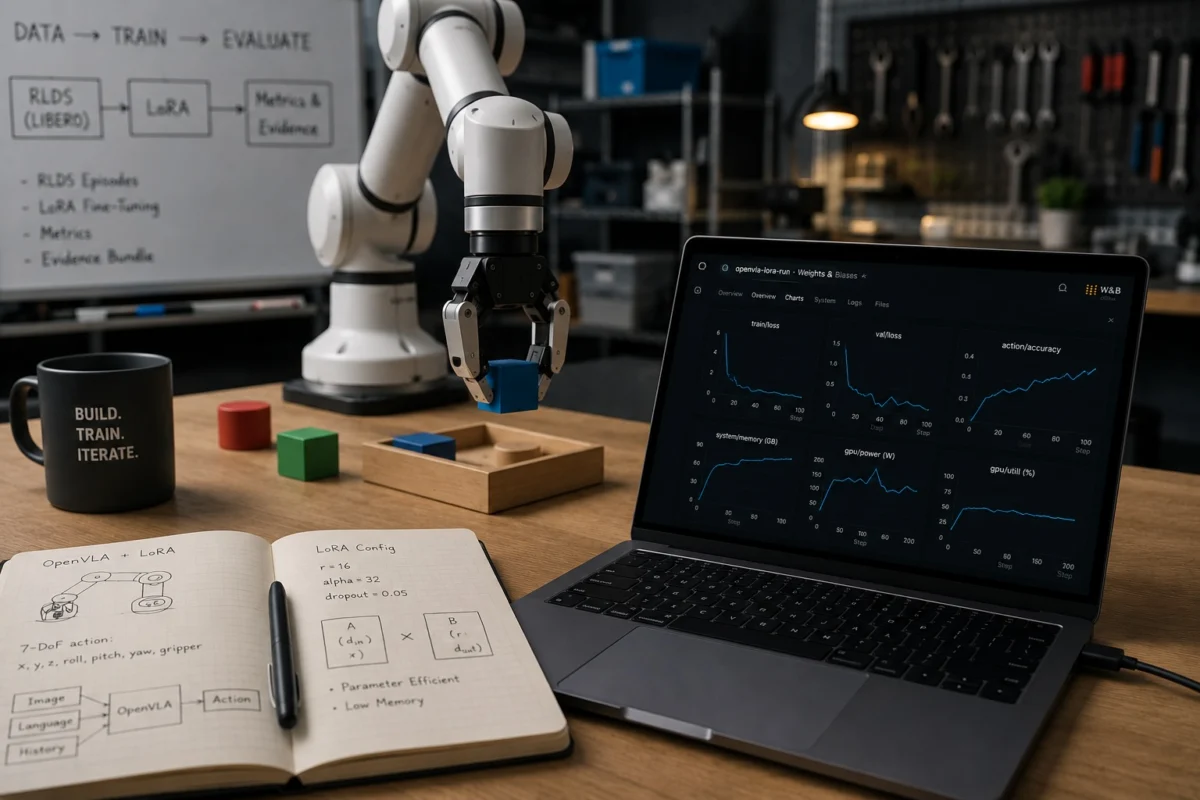
At its core, a VLA model is a multi-modal processor. It takes two primary inputs: a camera image representing the robot’s workspace and a natural language instruction (e.g., "pick up the black bowl and place it on the plate"). The model processes these inputs to output the next discrete action tokens required by the robot. These tokens are then decoded into normalized seven-degree-of-freedom (7-DoF) commands—representing x, y, and z coordinates, roll, pitch, yaw, and the gripper state.

Fine-tuning allows developers to adapt this pre-trained intelligence to specific environments. Whether you are dealing with a new camera angle, a specialized gripper, or a unique task space, fine-tuning aligns the model’s general knowledge with the specific "embodiment" of your robotic hardware.
The Chronology of an Integration Validation
To move from theoretical interest to hands-on practice, we have established a controlled, 100-step "smoke test." This workflow is designed not as a performance benchmark—which would require exhaustive simulation or real-world testing—but as an integration validation to ensure that every link in the training chain is functional.

Phase 1: Environment and Dataset Preparation
The process begins by configuring the Colab runtime to an A100 High-RAM environment. Given the complexity of the OpenVLA dependency stack, the notebook employs a dual-environment strategy: one environment handles the specific dependencies required for training, while a secondary environment manages the synchronization with Weights & Biases (W&B).
We utilize the libero_spatial_no_noops dataset, a standard in the Robot Learning Dataset Standard (RLDS) format. This dataset is critical because it isolates spatial manipulation tasks, stripping away "no-op" frames where the robot remains idle. By focusing on active movement, the model learns more efficiently during the initial training steps.

Phase 2: The Training Loop
The training command leverages torchrun to execute the official vla-scripts/finetune.py. By utilizing LoRA, we freeze the vast majority of the 7-billion-parameter backbone, training only a small set of low-rank adapter matrices. This reduces the memory footprint significantly, enabling high-performance training on a single GPU.
The effective batch size is managed through gradient accumulation, ensuring that even with a physical batch size of two, the model receives meaningful updates derived from sixteen samples per gradient step. This balance keeps the training process stable within the memory constraints of a Colab instance.

Phase 3: Verification and Synchronization
Once the 100-step training cycle concludes, the notebook triggers an automated synchronization process. It packages logs, environment configurations, and metrics, uploading them to W&B. This creates an "audit trail" that allows developers to inspect the performance metrics, system utilization, and training artifacts remotely.
Supporting Data: Measuring Success in the Short Term
In this 100-step validation, we look for three primary signals to confirm the integrity of the training process:

- Train Loss: A downward trend indicates that the model is successfully minimizing the discrepancy between its predictions and the demonstrated actions.
- L1 Action Loss: This measures the absolute distance between the predicted 7-DoF robot control values and the ground-truth values. A decrease here confirms that the model is learning the spatial and physical mechanics of the task.
- Action Accuracy: This reflects how often the predicted action tokens align with the expert demonstrations. In our run, this metric showed a steady upward trajectory, climbing from 0.09 at the start to a peak near 0.35.
Crucially, we monitor system telemetry. By reviewing the GPU Power Usage and memory throughput in W&B, we can verify that the hardware was not just running, but actively computing. Sustained power consumption between 170 and 190 watts provides objective proof that the training job was not a "dummy run" but a genuine exercise of the GPU’s capacity.
Official Perspectives: The Role of LoRA in Robotics
The choice of LoRA as the primary adaptation method is supported by the OpenVLA project’s own findings. Research has demonstrated that LoRA can achieve performance parity with full fine-tuning while training only 1.4 percent of the model’s total parameters.

From an industry perspective, this is a game-changer. It lowers the barrier to entry for small labs and independent researchers who cannot afford massive server clusters. The official guidance on fine-tuning suggests that the primary hurdle for practitioners is "embodiment shift"—the point where a pretrained model fails because the target robot’s geometry or sensor placement differs from the original training data. LoRA provides a surgical, efficient mechanism to address this shift without the overhead of retraining the entire model.
Implications for Future Development
This methodology has profound implications for the future of robotic learning. By establishing a culture of "inspectable" experiments, we shift the focus from merely achieving a successful run to ensuring reproducibility.

The "Evidence-First" Paradigm
For any developer, the lesson is clear: before attempting a full-scale deployment, one must first prove that the data pipeline is sound. By generating a suite of evidence—including logs, environment snapshots, and verified telemetry—we transform the training process from a black box into a transparent audit.
Scalability and Reliability
The success of this 100-step run provides a foundation for more complex experiments. Once the pipeline is verified, a researcher can confidently increase the step count, introduce more diverse datasets, or adjust the LoRA rank without fearing that an underlying configuration error will invalidate the entire run. This "fail-fast" approach is essential for the iterative nature of robotics research.

Accessibility and Democratization
Finally, by using accessible tools like Colab and standard datasets like LIBERO, this approach democratizes access to state-of-the-art VLA models. It bridges the gap between massive academic research projects and the practical needs of the developer community. When we can verify our training loops in minutes, the pace of innovation in embodied AI accelerates for everyone.
Conclusion: A Blueprint for Progress
The path to building intelligent, autonomous robots is paved with trial and error. By adopting a rigorous, evidence-based approach to fine-tuning, we remove the guesswork from the equation. Whether you are aiming to improve a gripper’s precision or teach a robot new spatial relationships, the ability to perform a verifiable, reproducible fine-tuning run is your most valuable asset.

The provided Colab notebook is more than just a tutorial; it is an invitation to inspect, iterate, and innovate. As the field of VLA models continues to mature, the developers who prioritize transparency and methodological rigor will be the ones who define the next generation of robotic capability. By proving the training run is real, measurable, and sound, you set the stage for success in the complex, physical world.
Reproduction Resources:
- Colab Notebook: Access here
- W&B Run Logs: Inspect here
- Dataset:
libero_spatial_no_noopsvia the OpenVLA repository.