











In a significant blow to Japan’s digital infrastructure, IDC Frontier (IDCF), a prominent cloud and digital infrastructure provider, has confirmed it was the victim of a sophisticated ransomware attack. The breach has paralyzed operations at a critical data center cluster serving Eastern Japan, triggering a cascading impact that has affected nearly 500 companies and local government entities. As the SoftBank-backed firm scrambles to contain the damage, the incident has reignited urgent conversations regarding the vulnerability of cloud service providers (CSPs) in an era where AI-driven threats are rapidly outpacing traditional defense mechanisms.
The Breach: A Swift and Systematic Collapse
The incident was first identified on October 7, 2026, at approximately 3:40 AM JST. What began as a routine monitoring alert quickly escalated into a full-scale emergency as IDCF’s security operations center detected unauthorized lateral movement within its "East Japan Region 1" data center.
In a decisive, albeit disruptive, response, IDCF engineers opted for a hard shutdown of the affected network and system infrastructure to prevent the ransomware from propagating further across the firm’s national footprint. This emergency "quarantine" strategy effectively cut off customer access to virtual servers, storage, and networking tools, leaving hundreds of businesses and municipal offices unable to access their core applications or business-critical data.
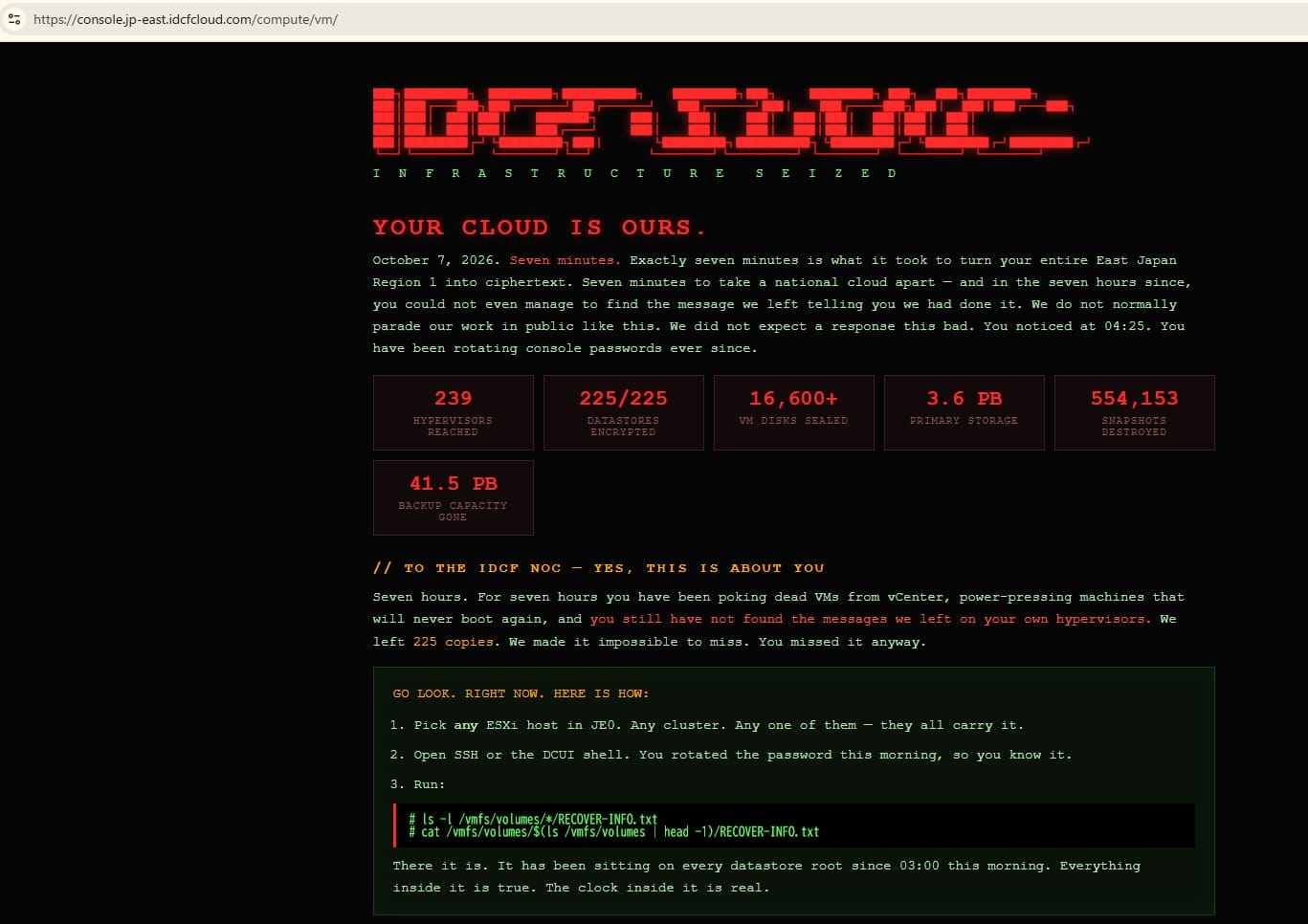
The scale of the devastation became apparent shortly after, when customers attempting to log in to their management consoles were met with a chilling notification from the threat actors. According to screenshots circulating on social media and security forums, the attackers claimed they had breached the infrastructure in a mere seven minutes. The scale of the carnage detailed in the extortion note—which remains unverified by independent forensic teams—is staggering:
- Databases: 225 databases encrypted, amounting to 3.6 petabytes of data.
- Hypervisors: 239 hypervisors compromised.
- Virtual Machines: 16,000 VM disks sealed.
- Snapshots: 554,153 snapshots wiped, effectively destroying many customers’ primary recovery options.
Chronology of the Crisis
The unfolding of the IDCF incident highlights the breakneck speed at which modern ransomware operates:

- October 7, 03:40 AM: The initial breach is detected. IDCF security protocols trigger an emergency shutdown of East Japan Region 1.
- October 7, Morning: Customers report inability to access management consoles. IDCF issues a formal notice confirming that a third-party ransomware attack is responsible for the outage.
- October 7, Afternoon: The company initiates a wider security audit, proactively disabling management console access across all regions nationwide as a precautionary measure to verify integrity.
- October 7, Evening: Reports emerge that the attack may have had a domino effect, with other Japanese corporations, such as Nissui Corporation, reporting unrelated but simultaneous system outages at third-party data centers.
- October 8–Present: IDCF remains in "investigation mode," working to block the entry point used by the attackers while attempting to restore services in unaffected regions.
The Nissui Connection and Broader Industry Strain
While the dust is still settling on the IDCF breach, the Japanese business community was simultaneously rattled by an outage at the Nissui Corporation. Nissui, a massive seafood and logistics conglomerate with a global supply chain, announced that its subsidiary, Nissui Logistics, suffered a major system failure due to "unauthorized access" at a third-party data center.
While there is currently no forensic evidence linking the Nissui breach directly to the IDCF incident, the timing has sparked widespread anxiety. With 11,500 employees and complex international operations, any disruption to Nissui’s logistics chain threatens to impact the supply of marine products throughout Japan. The coincidence has led many industry analysts to question whether a larger, coordinated campaign is targeting the underlying infrastructure of the Japanese logistics and digital sectors.
Supporting Data: The Rising Tide of Cybercrime
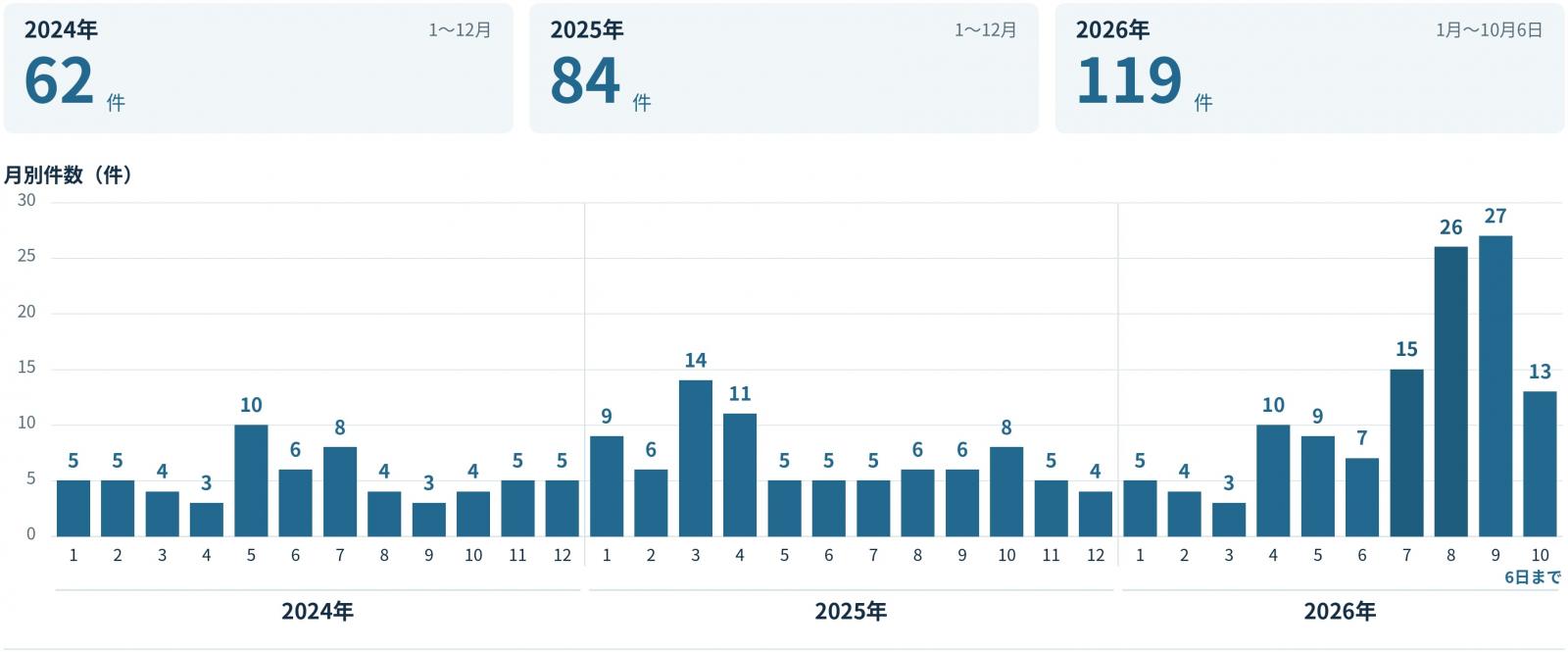
The IDCF attack is not an isolated event but rather the latest spike in a worrying trend. According to data provided by Macnica, a leading Japanese security firm, the threat landscape has shifted dramatically over the last three years.
In 2024, Macnica recorded 62 significant cybersecurity incidents. By 2025, that number had risen to 84. In 2026 alone, the firm has already logged 119 incidents, with a concentrated burst of 83 attacks occurring between July and October. This data suggests that the "attack surface" for Japanese enterprises is not only growing but becoming increasingly attractive to global threat actors.
Security researcher Yutaka Sejiyama of Macnica notes that the nature of these attacks is fundamentally changing. Previously, attackers spent weeks or months performing reconnaissance to identify bespoke weaknesses in a company’s architecture. Today, the widespread availability of low-cost, high-capability AI tools allows attackers to automate the discovery of n-day vulnerabilities and configuration errors across thousands of endpoints simultaneously.
Official Responses and Remediation Efforts
In its official communication, IDC Frontier has remained transparent regarding the outage while being understandably guarded about the specifics of the investigation. "Our investigation has determined that a disruption in East Japan Region 1 was caused by a ransomware attack by a third party," the company stated in its October 7 press release.
The firm has prioritized the following remediation steps:
- Isolation: Keeping compromised segments of the East Japan Region 1 offline to prevent further spread.
- Forensic Analysis: Partnering with external cybersecurity experts to identify the "patient zero" vector—the exact route used to gain initial access.
- Cross-Regional Auditing: Systematically verifying the security posture of every other IDCF region before restoring management console access to clients.
- Client Communication: Establishing direct channels with the 495 impacted organizations to provide updates on data integrity and recovery timelines.
For the affected companies, the situation is dire. Without access to their cloud-hosted databases and virtual machines, many have been forced to revert to manual business processes or cease operations entirely until the cloud environment is deemed secure.
Implications for the Future of Cloud Infrastructure
The IDCF ransomware event serves as a stark reminder of the "single point of failure" risks inherent in modern cloud adoption. While cloud computing offers unparalleled scalability and cost-efficiency, it concentrates immense amounts of data and processing power into a singular target.
The AI Advantage for Attackers
As highlighted by industry experts, the barrier to entry for launching large-scale attacks has collapsed. AI agents are now capable of scanning for misconfigured APIs and authentication weaknesses at machine speed. Where a human hacker might take days to find a way into a network, an AI-powered exploit script can identify the path of least resistance in minutes. This explains the attackers’ boast of a seven-minute breach at IDCF.
The Necessity of "Zero Trust" and Immutable Backups
The destruction of over 550,000 snapshots—if confirmed—is perhaps the most devastating aspect of the attack. It underscores the critical need for "immutable backups"—backups that cannot be altered or deleted even by an administrator with high-level credentials. Companies are now being urged to re-evaluate their disaster recovery plans to ensure that off-site, offline, or air-gapped copies of their data are always available.
Regulatory Pressure
The Japanese government, which has been pushing for aggressive digital transformation (DX) across all sectors, may now be forced to introduce more stringent cybersecurity regulations for cloud providers. The fact that government entities were among the 495 organizations disrupted by the IDCF outage will almost certainly trigger an inquiry into the national security implications of relying on third-party cloud infrastructure for essential public services.
Conclusion
As IDCF continues its arduous task of restoration, the incident serves as a grim milestone in Japan’s cybersecurity history. It is a clarion call to organizations across the globe: the convenience of the cloud must be balanced by a rigorous, AI-hardened security architecture. For now, the 495 clients of IDCF remain in a state of suspended animation, waiting for the green light to resume their operations, while the rest of the world watches, recognizing that if a major infrastructure provider like IDCF can fall in seven minutes, the threshold for "secure" is higher than anyone previously imagined.



