For many data engineers and developers, the "MemoryError" is a rite of passage. It often arrives in the quiet of the night, triggered by a routine script that has performed flawlessly for months, only to collapse under the weight of a suddenly massive log file or a seasonal spike in traffic. When a 9 GB file attempts to load into a process restricted by a standard RAM footprint, the application crashes—not because the logic is flawed, but because the architecture is eager.
In Python, the default behavior of many operations is to materialize data in full, loading lists into memory to allow for convenient filtering or sorting. However, as datasets grow, this "eager" approach becomes a liability. This article explores the architecture of memory-efficient data pipelines using Python’s iterators and generators—a design pattern that allows developers to process virtually infinite datasets with a constant, minimal memory footprint.
Main Facts: The Eager vs. Lazy Divide
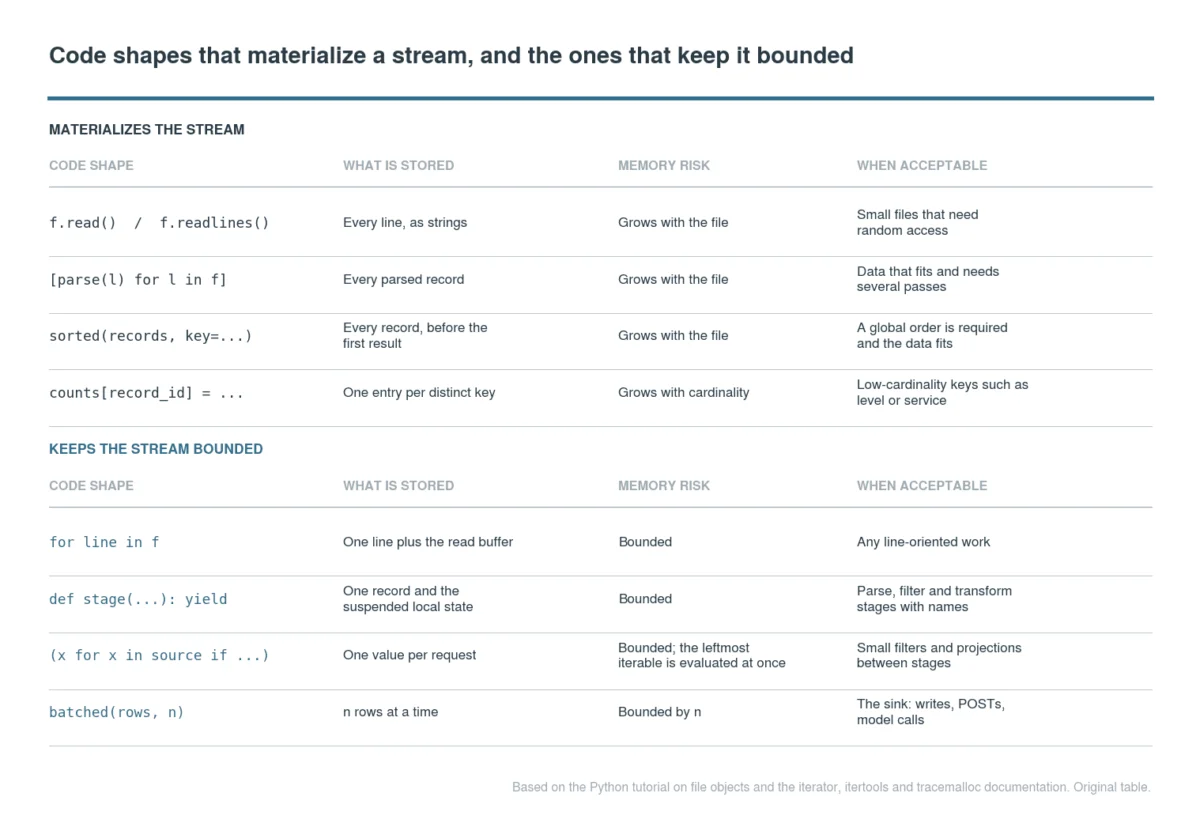
The fundamental conflict in data processing is between "eager" evaluation and "lazy" evaluation. Eager evaluation, exemplified by list comprehensions like records = [parse(line) for line in f], commands the Python interpreter to build the entire collection in memory before moving to the next line of code. If the file contains 10 million records, the system must hold 10 million objects simultaneously.
Conversely, lazy evaluation—the cornerstone of streaming—defers the computation of each element until it is explicitly requested. By utilizing iterators and generator functions, developers can transform a massive file into a "stream" of data. In this model, only one record (or a small, controlled batch) exists in RAM at any given moment. Once a record is processed, filtered, or written to a destination, it is discarded by the garbage collector, freeing memory for the next incoming piece of data.
Chronology: From Simple Scripts to Production Failures
The life cycle of a data processing script often follows a predictable path:
- The Prototype: A developer writes a script to parse a small log file. They use
readlines()or list comprehensions because they are idiomatic and fast for small-to-medium data. - The Stable Period: The script runs successfully in production for months. It processes daily logs that fit easily into the server’s RAM.
- The Inflection Point: A change in logging policy—such as a shift in log rotation or a massive influx of traffic—causes the log file size to balloon.
- The Crash: The script reaches its memory limit, the
MemoryErroris raised, and the nightly job fails. - The Refactor: The developer must transition from an eager, list-based architecture to a streaming, generator-based architecture. This shift requires moving away from "all-at-once" processing to "one-by-one" pipelines.
Supporting Data: Why Streams Win
To understand the efficacy of streaming, one must consider the mechanics of the Python iterator protocol. An "iterable" is an object that can return an iterator (like a list or file object), while the "iterator" is the stateful object that maintains the cursor. When you execute a for loop, Python calls iter() on the object and then next() repeatedly.
Memory Comparison
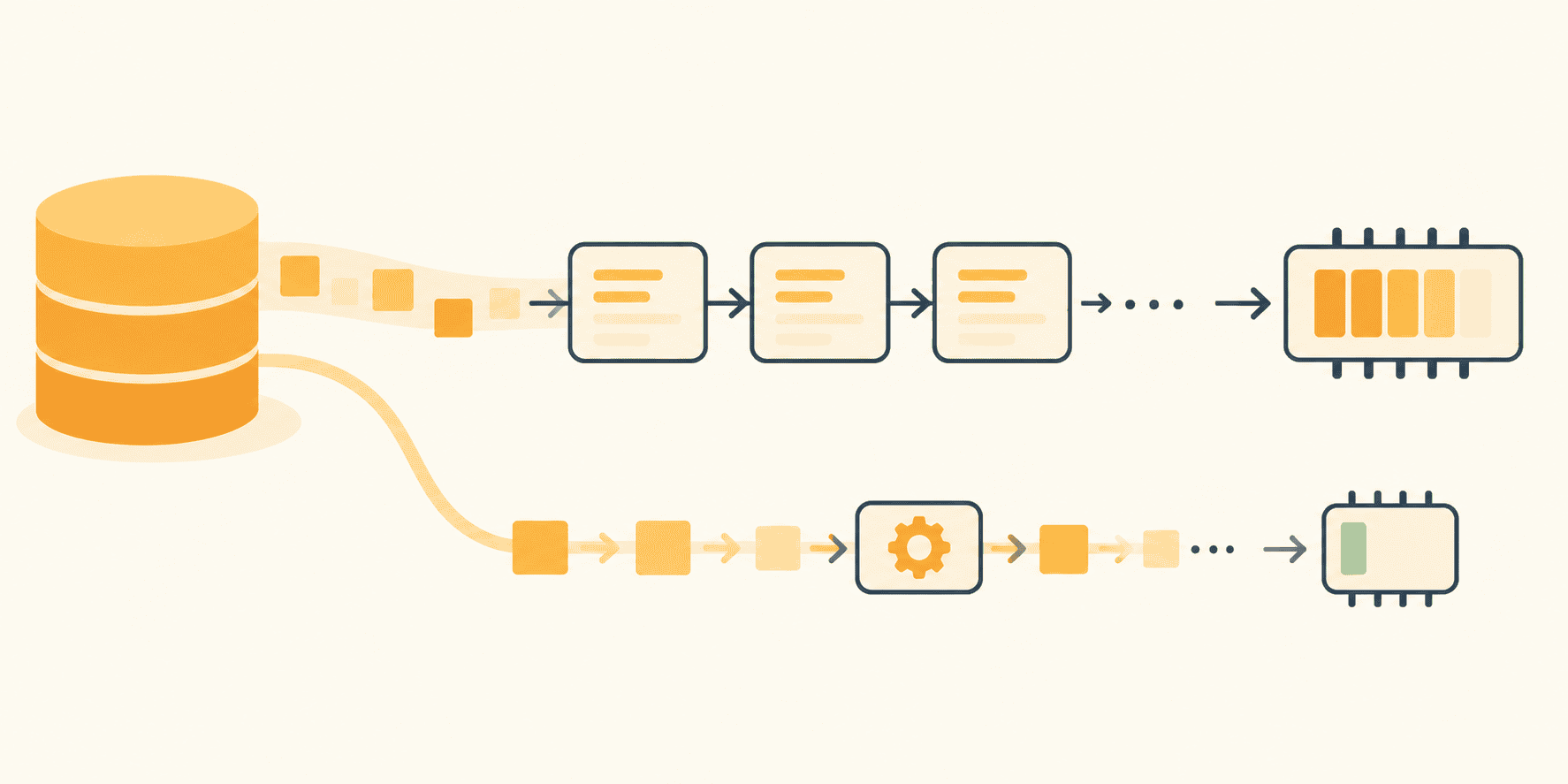
In a controlled test environment, processing a 200,000-line log file (approximately 17 MB) using eager list-based logic resulted in a peak memory consumption of 198 MB. When the same task was refactored into a streaming pipeline, the peak memory usage dropped to 0.4 MB.
Crucially, in the streaming model, this peak remains constant regardless of whether the file size is 17 MB, 17 GB, or 170 GB. The memory usage scales with the complexity of the processing logic and the size of the batch, not the size of the total dataset. This decoupling of memory usage from data volume is the "holy grail" of robust data engineering.
Technical Implementation: Building the Pipeline
Building a memory-efficient pipeline requires a staged, modular approach.
1. The File Object Iterator
Never read a file into memory at once. A file object in Python is already an iterator. Using for line in f: is the first and most critical step in memory management. It reads the file in buffered chunks rather than loading the entire string.
2. Generator Functions
Any function containing the yield keyword becomes a generator. Unlike standard functions that return a result and exit, a generator function pauses execution, yielding a value to the caller while preserving its local state.
def parse_records(lines):
    for line in lines:
        # Transformation logic here
        yield record
3. Generator Expressions
For simple transformations, use generator expressions. They look like list comprehensions but use parentheses () instead of square brackets []. They are the "one-line cousins" of generator functions and are ideal for light filtering or mapping.

4. The Sink (The Boundary)
You must eventually materialize your data—into a database, a new file, or an API. This is where you should implement "batching." Since Python 3.12, the itertools.batched() function provides a native way to group streams into manageable chunks. This allows you to perform bulk inserts or writes without ever holding the entire dataset.
Implications: When to Avoid Laziness
While streaming is powerful, it is not a universal solution. Certain operations are inherently "non-streamable."
- Global Sorting: To sort a file, you must know the value of the last record to determine the position of the first.
- Exact Deduplication: To identify a duplicate across a whole dataset, you must maintain a "seen" set of all previously processed keys.
- Percentile Calculations: Calculating the 99th percentile of latency across a week’s worth of logs requires having access to all latency values.
In these cases, attempting to force a streaming architecture will only lead to "hidden" memory bugs, where you have created a complex pipeline that eventually feeds into a list() or sorted() function, effectively hitting the same MemoryError you were trying to avoid. For these scenarios, one should look toward external tools (like disk-based sorting or databases) or approximation algorithms (like T-Digest for percentiles).
Conclusion: The Philosophy of Staged Data
The shift to memory-efficient processing is as much a shift in mindset as it is a change in syntax. The goal is to create a "data path" where the code is readable, testable, and robust. By keeping the middle of the pipeline lazy—using generators to move records through parsing, filtering, and transformation stages—you ensure that your application remains responsive.
Measurement is the final, non-negotiable step. Using tracemalloc to track peak memory usage allows developers to verify their assumptions. If a process peaks unexpectedly, the cause is usually an escaping reference (like a global list) or a library call that is silently materializing the stream.
Ultimately, a well-engineered streaming pipeline is a work of structural beauty. It allows a developer to trace where data enters, how it is transformed, and exactly where it is materialized. When the architecture is sound, the "large file" problem ceases to be a crisis and becomes a standard operating procedure. By respecting the boundaries of memory and mastering the art of the yield, Python developers can build systems that don’t just handle today’s data, but are ready for the scale of tomorrow.