



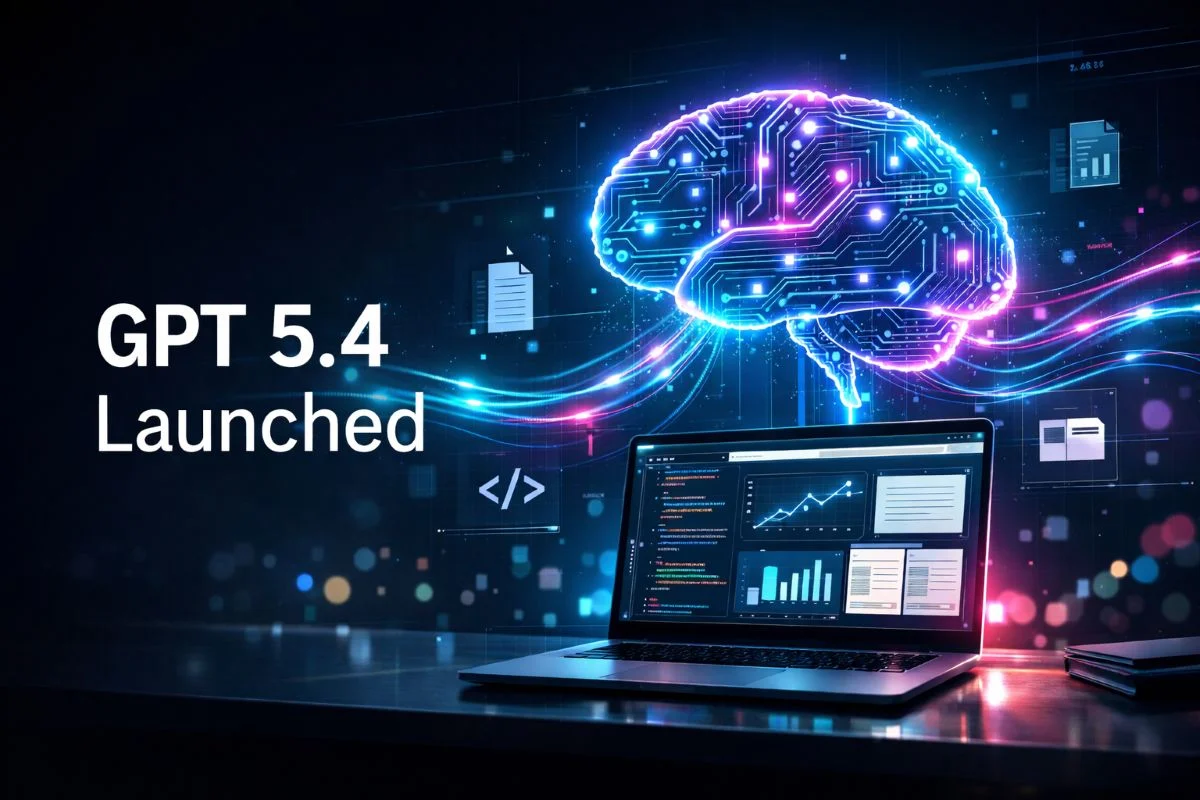
The landscape of artificial intelligence underwent a seismic shift on March 5, 2026, as OpenAI officially unveiled GPT 5.4. Moving beyond the paradigm of simple conversational agents, this latest iteration in the GPT-5 series represents a foundational shift toward "agentic" computing—systems that do not merely answer questions but actively execute complex, multi-step professional workflows. By synthesizing advanced chain-of-thought reasoning, high-fidelity coding capabilities, and seamless productivity tool integration, GPT 5.4 is positioned as the most robust enterprise-grade AI model to date.
The Evolution of Reasoning: Main Facts and Technical Milestones
GPT 5.4 is not an incremental update; it is a architectural refinement designed to bridge the gap between "chatting" and "doing." At its core, the model leverages a significant leap in reasoning efficiency. OpenAI has integrated its "Thinking" architecture—a process that allows the model to deliberate, evaluate multiple potential paths, and self-correct before generating a final response.
Key Technical Specifications
- Context Window: Featuring a massive 1-million-token context window, allowing for the ingestion of entire legal libraries, massive codebases, or years of financial records.
- Native Tool Use: Enhanced capability to interface directly with operating systems and third-party software suites, enabling autonomous task completion.
- Multi-Step Orchestration: The model excels at decomposing high-level user goals into granular, actionable sub-tasks, a prerequisite for autonomous workflow automation.
Chronology: From GPT-4 to the GPT 5.4 Milestone
The trajectory of OpenAI’s model development has been marked by a transition from generalist text generation to specialized task performance. Understanding the arrival of GPT 5.4 requires a look back at the rapid-fire releases that preceded it:
- 2023: The launch of GPT-4 introduced the world to robust multimodal capabilities, blending text and vision into a cohesive reasoning engine.
- 2025: GPT-5 debuted, offering a unified reasoning framework that set a new benchmark for coherence and long-form document comprehension.
- December 2025: GPT-5.2 (Thinking) introduced the "Thinking" paradigm, prioritizing factual accuracy and stability in long-running tasks.
- February 2026: GPT-5.3 (Codex) refined the model’s architectural tuning specifically for programming, laying the groundwork for complex agentic coding.
- March 5, 2026: The launch of GPT 5.4 unified these disparate streams—speed, coding prowess, and deep reasoning—into a single, flagship model.
This timeline reflects a deliberate strategy: first mastering language, then logic, then technical execution, and finally, integration.
Supporting Data: Why GPT 5.4 Outperforms Its Predecessors
The shift to GPT 5.4 is underscored by its performance in professional benchmarks. Compared to the GPT-5.2 series, internal testing reveals a 40% increase in success rates for multi-step reasoning tasks.
Comparative Performance Metrics
- Coding Efficiency: By integrating the specialized training of the 5.3 Codex, GPT 5.4 demonstrates a 25% reduction in syntax errors when generating complex, multi-file software projects.
- Instruction Adherence: Through refined reinforcement learning from human feedback (RLHF), the model maintains strict adherence to complex formatting and operational constraints, minimizing "hallucination" in high-stakes environments.
- Latency vs. Depth: While "Thinking" models often incur higher latency due to their deliberation process, GPT 5.4 utilizes a proprietary caching mechanism that allows for near-instant responses in routine queries while reserving its deep-thinking power for complex analytical requirements.
Official Responses and Strategic Vision
In the wake of the launch, OpenAI leadership emphasized that GPT 5.4 is designed for the "production-ready" era of AI. During the announcement, an OpenAI spokesperson noted, "Our goal with GPT 5.4 is to move AI from being a passive repository of knowledge to an active, reliable collaborator. We are solving for the ‘last mile’ problem in AI—where the model doesn’t just draft the email or write the code, but understands the organizational context and executes the task within the user’s workflow."
Enterprise customers have already begun migrating to the 5.4 architecture, citing the model’s improved stability in API environments as a primary driver. The transition has been seamless for organizations already integrated into the OpenAI platform, with the model offering backward compatibility for most legacy GPT-5 applications.
Implications for the Professional World
The release of GPT 5.4 has immediate, tangible consequences for various sectors.
1. The Transformation of Software Development
With its advanced coding capabilities, GPT 5.4 acts as a senior pair programmer. It does not merely suggest snippets; it reviews architectural patterns, debugs across entire repositories, and generates comprehensive test suites. This allows developers to focus on high-level system design rather than boilerplate implementation.
2. The Productivity Revolution
For the knowledge worker, the model’s ability to interface with productivity software is transformative. Imagine a workflow where a user asks, "Analyze our Q1 sales spreadsheet, compare the performance against last year’s KPIs, and draft a summary report formatted for the board of directors." GPT 5.4 can perform the data analysis, generate the necessary charts, and draft the document in a matter of seconds.
3. Research and Academic Integrity
The massive context window allows researchers to upload vast datasets or entire archives of academic papers, enabling the model to identify cross-disciplinary connections that might remain hidden to human analysts.
Navigating the Limitations: A Realistic Assessment
Despite its advancements, OpenAI is transparent about the boundaries of GPT 5.4. The model, while superior, is not infallible.
- Verifiability: As with all large language models, the output should be treated as a draft rather than an absolute source of truth. Human-in-the-loop verification remains essential for critical decisions, particularly in legal, medical, or financial sectors.
- Data Privacy: While enterprise settings offer high levels of security, organizations must remain vigilant in their data governance, ensuring that sensitive proprietary information is managed through authorized API channels.
- Complexity Thresholds: Despite its prowess, the model can still occasionally struggle with extremely abstract, non-standard tasks that lack sufficient training data or clear logical benchmarks.
Future Outlook: Beyond the 5.4 Horizon
The arrival of GPT 5.4 suggests a future where the distinction between "human work" and "AI work" becomes increasingly blurred. We are moving toward a state of AI orchestration, where models serve as the glue between disparate digital tools.
Future developments are expected to focus on:
- Personalized Agency: Models that remember user preferences, specific project histories, and organizational quirks across months of interaction.
- Autonomous Learning: Systems that update their knowledge base in real-time, reducing the reliance on static training cutoffs.
- Cross-Platform Integration: Even tighter integration with operating systems, allowing AI to control peripheral hardware and software environments with greater granularity.
Conclusion
GPT 5.4 represents a definitive milestone in the history of artificial intelligence. By successfully merging deep reasoning with practical tool usage, OpenAI has provided a tool that meets the needs of the modern, high-pressure professional environment. Whether it is debugging a complex piece of software, analyzing a mountain of data, or automating the mundane aspects of daily business, GPT 5.4 offers a glimpse into a future where technology acts as an extension of human intent.
As we integrate this technology into our professional lives, the emphasis must remain on responsible usage. The power of GPT 5.4 lies not in its ability to replace human judgment, but in its capacity to amplify it. As the model continues to evolve, those who learn to orchestrate these systems will undoubtedly define the next decade of productivity and innovation.
Frequently Asked Questions (FAQ)
Q: Is GPT 5.4 available to the public?
A: GPT 5.4 is available to ChatGPT Plus, Team, and Pro subscribers. Enterprise and education customers can enable it via their administrative dashboards.
Q: Does GPT 5.4 replace all previous models?
A: It is the new flagship model, but legacy models remain available for a transition period. GPT-5.2 Thinking, for example, will remain available until June 5, 2026.
Q: How does GPT 5.4 handle complex coding tasks?
A: It integrates specialized training from the GPT-5.3 Codex, enabling it to write, debug, and optimize code across multiple programming languages with greater structural accuracy.
Q: Can GPT 5.4 interact with my computer?
A: The model includes improved tool usage and "native computer use" capabilities, allowing it to perform tasks within professional workflows more effectively than previous, siloed versions.
Q: Where can I find official documentation?
A: Users can visit the official OpenAI documentation center for API references, model cards, and detailed technical specifications regarding the GPT-5.4 update.