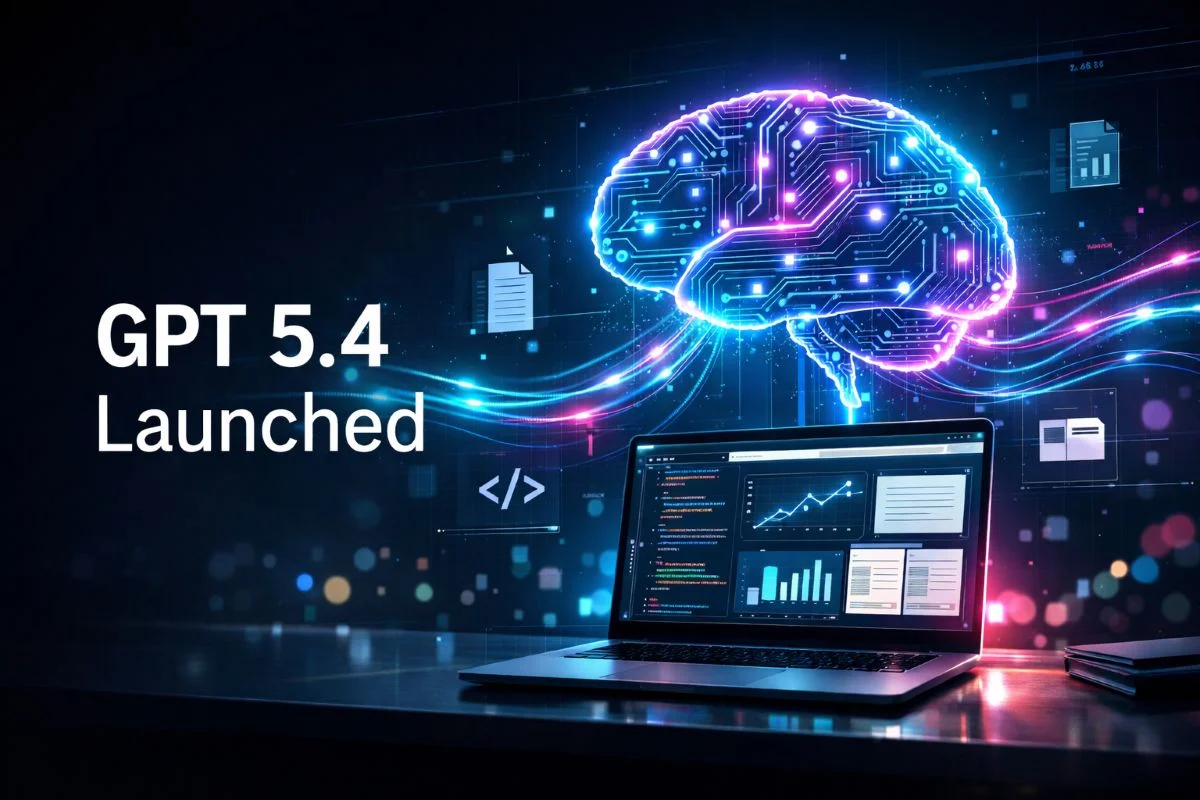
The landscape of artificial intelligence underwent a tectonic shift on March 5, 2026, when OpenAI unveiled GPT-5.4. Moving far beyond the realm of conversational chatbots, this new iteration of the GPT-5 series represents a paradigm shift toward "agentic" AI—systems that don’t just generate text, but actively execute complex, multi-step professional workflows.
For businesses, developers, and researchers, GPT-5.4 serves as more than an upgrade; it is a fundamental reconfiguration of how human intelligence interfaces with machine logic. By synthesizing advanced reasoning, industry-leading coding proficiencies, and deep-level document analysis, OpenAI has positioned GPT-5.4 as the first true "digital collaborator" for the enterprise.
1. Main Facts: The Anatomy of a Frontier Model
GPT-5.4 is built on a sophisticated architecture that prioritizes reliability, reasoning, and instruction-following. While its predecessors focused on fluency and multimodal input, GPT-5.4 is engineered for utility.
Core Pillars of GPT-5.4:
- Deep Reasoning (“Thinking” Engine): The model employs an enhanced reasoning system that performs iterative checks before delivering an output. It breaks down complex queries into sub-tasks, ensuring that multi-step logic remains coherent throughout the execution.
- Agentic Workflow Automation: Unlike previous models that required manual input for every step, GPT-5.4 is capable of chaining operations—such as analyzing a spreadsheet, extracting key performance indicators (KPIs), and drafting a strategic memo based on that data.
- Advanced Coding Architecture: By integrating the specialized capabilities of the GPT-5.3 Codex, the model demonstrates high proficiency in modern programming languages (Python, Rust, TypeScript, Go), including complex debugging and UI/UX component generation.
- 1-Million-Token Context Window: The massive expansion in context memory allows the model to ingest entire technical manuals, massive codebases, or years of financial records without losing track of details.
2. Chronology: The Road to the 5.4 Release
The release of GPT-5.4 is the culmination of a deliberate, iterative release cycle by OpenAI. Understanding the timeline helps clarify why this version is so disruptive:
- 2023: The era of GPT-4 established the baseline for multimodal reasoning (text and image).
- 2025: The introduction of the GPT-5 series brought unified reasoning and extended context, setting the stage for more complex architectures.
- December 2025: OpenAI released GPT-5.2 (Thinking), which introduced the "Thinking" paradigm, focusing on factuality and reducing "hallucinations" through iterative verification.
- February 2026: The release of GPT-5.3 Codex demonstrated a massive jump in agentic programming capabilities, specifically tailored for automated software development.
- March 5, 2026: The official launch of GPT-5.4. This model unified the "Thinking" capabilities of 5.2 with the coding prowess of 5.3, while adding native computer control and enhanced workflow automation.
As of March 5, 2026, GPT-5.4 has become the default "high-intelligence" tier for ChatGPT Plus, Team, and Pro users. The legacy GPT-5.2 model has been relegated to a sunset period, with full deprecation scheduled for June 5, 2026.
3. Supporting Data: Comparative Performance
To understand the leap in capability, one must look at how GPT-5.4 stacks up against its lineage. The following table highlights the evolution of the series:
| Model | Primary Focus | Key Differentiator |
|---|---|---|
| GPT-4 | General Multimodal | First mainstream multimodal deployment. |
| GPT-5 | Unified Reasoning | Foundation for long-context interaction. |
| GPT-5.2 | Factuality/Stability | Introduced the "Thinking" protocol. |
| GPT-5.3 | Speed/Coding | Optimized for agentic dev workflows. |
| GPT-5.4 | Professional Agency | Full integration of Reasoning, Coding, and Computer Use. |
The metrics provided by OpenAI indicate that GPT-5.4 shows a 40% increase in multi-step task success compared to GPT-5.2, and a 25% improvement in code-base refactoring accuracy compared to the GPT-5.3 Codex specialized model.
4. Official Responses and Deployment Strategy
OpenAI’s strategy for the rollout of GPT-5.4 has been characterized by "controlled enterprise empowerment." Unlike previous open-ended rollouts, this model was designed to integrate into existing organizational IT structures.
Enterprise and Education Integration
OpenAI has provided administrative tools that allow CTOs and IT leads to granularly control how GPT-5.4 accesses internal documents. The model features "Data Siloing," which ensures that while the model learns from the context of an enterprise’s private documents, that information does not leak into the general training corpus.
In a press statement, an OpenAI spokesperson noted:
"With GPT-5.4, we aren’t just giving users a smarter chatbot; we are providing a foundation for the autonomous enterprise. By enabling the model to handle structured workflows—from HR document processing to complex software architecture planning—we are drastically reducing the cognitive load on human professionals."
5. Implications: A New Professional Paradigm
The arrival of GPT-5.4 has profound implications across multiple sectors. We are entering a phase where the "AI assistant" is no longer a passive participant but an active member of the workforce.
Software Development
Developers are now utilizing GPT-5.4 to handle entire "sprints" of work. The model can parse a GitHub repository, identify technical debt, write the necessary patches, and even draft the documentation for the changes. The ability to switch between frontend UI design and backend API logic makes it a "full-stack" assistant that operates with minimal human oversight.
Business Productivity and Finance
The integration of spreadsheet analysis and document understanding allows finance professionals to perform deep-dive audits. A user can upload a decade’s worth of annual reports and, in seconds, generate a cross-year analysis of liquidity trends or risk exposure. The "Thinking" capability ensures that these calculations are double-checked against the provided source material, mitigating the risk of erroneous financial reporting.
Research and Education
For researchers, the ability to synthesize vast libraries of scientific papers into structured insights is a force multiplier. Students and academics can use GPT-5.4 to test hypotheses against massive datasets, transforming the model from a study aid into a collaborative research partner.
6. Navigating Limitations and Future Outlook
Despite its impressive technical profile, GPT-5.4 is not infallible. OpenAI has been transparent about the ongoing challenges of "probabilistic computation."
Current Limitations:
- Critical Verification: For high-stakes legal or medical applications, the model still requires human-in-the-loop oversight. While it is more accurate than ever, it can still struggle with nuanced, context-dependent ambiguities in highly regulated fields.
- Latency in Deep Thinking: The "Thinking" process, while accurate, introduces a slight delay in response times compared to "Instant" models. This is a trade-off between speed and accuracy.
- Resource Intensity: For API users, the higher reasoning capabilities of GPT-5.4 come at a higher computational cost per token, necessitating a strategic approach to when and how the model is invoked.
The Road Ahead
The trajectory of GPT-5.4 points toward the next logical evolution: Persistent Agency. Future models are expected to act as persistent background agents, running tasks over days or weeks without requiring a user to keep a chat window open.
As we integrate GPT-5.4 into our daily workflows, the definition of "computer literacy" is changing. The skill of the future is no longer just coding or writing; it is AI orchestration—the ability to direct, prompt, and verify a highly capable, autonomous digital collaborator.
The launch of GPT-5.4 confirms that the future of work is not about AI replacing human expertise, but about augmenting it with an intelligence that is as tireless as it is precise. As the boundaries between tool and teammate continue to blur, those who master the nuances of these advanced reasoning systems will undoubtedly define the next decade of professional success.
For more information on integrating GPT-5.4 into your workflow, visit the official OpenAI documentation portal and explore the API developer resources.