










By The Global Technology & Business Desk
Published: October 2026
Main Facts: The Death of the Blue Link and the Rise of AEO
The landscape of digital discovery has undergone a profound, irreversible transformation. When modern buyers turn to platforms like ChatGPT, Perplexity, or Google’s advanced AI Search modes, they are no longer greeted by the traditional, linear catalog of ten blue links. Instead, they receive a single, synthesized response, carefully constructed in real time and anchored by a select handful of citations.
In this new paradigm, visibility is binary. If a brand is included as a citation, it captures immediate attention, organic referral traffic, and instant buyer trust. If it is omitted, the brand remains invisible—relegated to the digital shadows, even if it manages to secure the coveted number-one ranking on a traditional search engine results page (SERP).
This behavioral shift has forced revenue and marketing teams to completely overhaul how they approach digital acquisition. Referral traffic originating from conversational AI platforms has tripled over the past year. Industry metrics reveal that 44% of modern marketers have completed a business purchase based on a brand they first discovered embedded within an AI-generated answer. Nearly a third of these buyers have repeated this path to purchase multiple times. The audience has not vanished; rather, they have moved directly into the answer.
Enter AI Search Optimization—frequently referred to as Answer Engine Optimization (AEO) or Generative Engine Optimization (GEO). This emerging discipline ensures that corporate content is structurally optimized for AI systems to effortlessly retrieve, comprehend, parse, and cite.

Chronology: How We Got Here and Where Search is Heading
The evolution from keyword-driven search engine optimization (SEO) to semantic, AI-powered answer engines did not happen overnight. Understanding this timeline is crucial for digital strategists planning their next fiscal year.
- Pre-2023 (The Keyword Era): Traditional search engines relied strictly on exact-match keywords, backlink profiles, and rigid domain authority metrics to rank web pages. Users typed fragmented, 3-to-4-word queries into search bars and filtered through pages of links manually.
- Late 2023 – 2024 (The Generative Breakthrough): The explosive public adoption of Large Language Models (LLMs) fundamentally altered user behavior. Queries evolved from stilted fragments into conversational, highly contextual prompts averaging over 20 words. Search engines began integrating conversational interfaces, supplementing static indexes with generative summaries.
- 2025 (The Citation Economy): As platforms like Perplexity and OpenAI’s search integrations gained mainstream traction, referral patterns shifted. Similarweb data from late 2025 indicated that AI referrals converted at an astounding 11.4% compared to just 5.3% for standard organic search in global e-commerce, signaling high-intent traffic within AI outputs.
- 2026 (The Institutionalization of AEO): By mid-to-late 2026, AI search optimization matured into a formal enterprise strategy. Major technology firms established clear indexing protocols, explicitly defining how web architecture, structured data, and clean semantic chunking feed modern answer engines. Concurrently, data analytics platforms introduced dedicated AEO tracking tools to measure brand footprint across disparate AI models.
Supporting Data: The Metrics Driving the Pivot
Transitioning traditional marketing budgets toward AEO requires robust empirical validation. Recent studies and enterprise case studies highlight the measurable commercial impact of optimizing for AI answer engines:
- The Conversion Premium: According to recent e-commerce benchmarks, leads and traffic originating from AI-referred citations convert at more than double the rate of conventional organic search traffic.
- Pipeline Acceleration: Enterprises implementing early, aggressive AEO strategies have reported staggering returns. For instance, data from major digital frameworks indicates up to a 1,600% lift in qualified inbound leads derived directly from AI ecosystems within a two-year investment window, coupled with a fourfold increase in brand citation frequency.
- Prompt Complexity: The average traditional Google search query consists of three to four words, whereas the average conversational prompt fed into tools like ChatGPT hovers around 23 words. This length differential provides models with rich contextual parameters, making comprehensive, long-form, and clustered content vastly superior to thin, keyword-stuffed pages.
Under the Hood: How AI Search Engines Operate
To successfully optimize for generative engines, practitioners must understand the underlying mechanics that occur between the moment a user hits "enter" and the generation of an answer. Unlike traditional crawlers that match static indexes to keywords, LLMs rely on complex cognitive architectures—primarily Retrieval-Augmented Generation (RAG) and Query Fan-Out.
Retrieval-Augmented Generation (RAG)
LLMs are initially trained on static datasets, meaning their internal knowledge bases carry inherent risks of obsolescence or hallucination. RAG bridges this gap by marrying the model’s internal processing capabilities with live, external web searches.
When a user poses a question, the system dynamically fetches relevant, up-to-date web pages from the search index to ground its response. This grounding process is the connective tissue that ties a generated statement to factual source material, resulting in the clickable citations users see alongside AI answers. Crucially, Google and other search providers emphasize that a page must be properly indexed and snippet-eligible to participate in this real-time retrieval loop.

Query Fan-Out
While RAG addresses where sources are found, query fan-out addresses why and how user intent is interpreted. A single conversational prompt often triggers dozens of programmatic subqueries across predictable patterns. These include equivalent phrasings, sequential follow-ups, broader or narrower variations, and logically implied contingencies regarding pricing, timelines, or technical specifications.
Because generative engines synthesize these multi-layered subqueries into a unified response, content that addresses a cohesive cluster of related topics enjoys vastly superior retrieval rates compared to single-topic, isolated pages.
Official Responses and Industry Guidelines
As the tension between web publishers and AI developers evolves, major technology gatekeepers have released formal documentation to guide content creators.
- Google’s Stance on Files and Architecture: Despite widespread industry speculation regarding specialized files like
llms.txt, Google’s official guidance clarifies that traditional search engines and AI features do not require or read such files (though limited developer tooling exists for Chrome agentic browsing). Publishers are advised to focus their resources on clean crawlability, robust information architecture, and core technical SEO foundations rather than chasing unverified machine-readable file formats. - Structured Data and Schema: Major search providers maintain that structured data—such as FAQPage or Author schema—serves to clarify semantic ambiguity, but it cannot act as a shortcut for low-quality content. Schema labels relationships for machines; it does not manufacture authority for thin or unverified passages.
- Crawler Management: Digital strategists are increasingly forced to choose whether to allow or restrict AI discovery crawlers (
GPTBot,OAI-SearchBot,ChatGPT-User, andGoogle-Extended). While some enterprises restrict training crawlers to protect intellectual property, experts universally caution against accidentally blocking citation-and-search bots, as doing so actively guarantees total exclusion from AI-generated answers.
Strategic Implications: Classic SEO vs. AI Search Optimization
AEO does not render classic SEO obsolete; rather, it introduces a vital new structural layer designed for machine comprehension and extraction.
| Classic SEO Focus | AI Search Optimization (AEO) Focus |
|---|---|
| Ranking individual pages for specific keywords. | Maximizing mentions, entity recognition, and citations across topics. |
| Earning clicks via top SERP placement. | Securing inclusion within synthesized, zero-click answer blocks. |
| Optimizing for brief, fragmented search queries. | Structuring content to answer complex, multi-variable conversational prompts. |
| Focusing heavily on traditional Domain Authority scores. | Building robust entity authority, author credibility, and third-party validation. |
Actionable Frameworks for Content Structure
To transform traditional web pages into extractable assets that AI models trust and cite, content teams should implement three foundational disciplines:

- The Claim-Then-Evidence Pattern: Begin sections with a direct, self-contained claim statement, immediately followed by data, empirical evidence, or a named expert attribution. This mirrors the exact architecture of a grounded AI answer, making the block exceptionally easy for an LLM to reuse and cite.
- Intent-Driven Subheadings: Frame H2 and H3 subheadings as real questions that users ask aloud. Answer those questions directly within the opening two to three sentences of the subsequent paragraph.
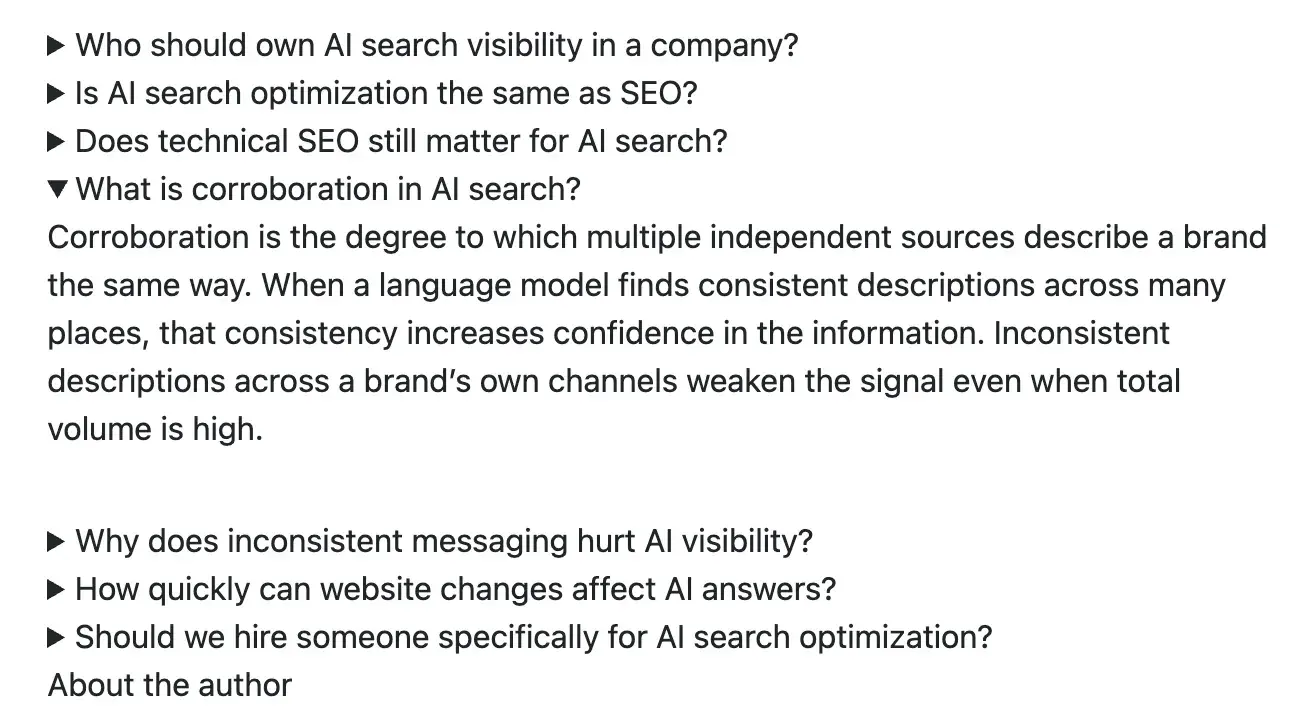
- Entity Standardization: Establish a single, canonical description for your brand, leadership team, and subject-matter experts. Ensure that this exact descriptive language is replicated consistently across corporate websites, social media profiles, press releases, and third-party review channels to solidify recognizable entity graphs within LLM training data.
Measuring Success in the Age of AI
Because traditional rank-tracking tools no longer capture the nuance of zero-click conversational answers, marketing leaders must establish a modernized measurement framework.
- Share of Model (SoM): Tracking how frequently a brand is cited relative to competitors when standardized prompt batteries are executed across engines like ChatGPT, Claude, Gemini, and Perplexity.
- Assisted Referral Quality: Monitoring downstream pipeline conversion metrics for traffic arriving via AI citations, evaluating user engagement and enterprise deal velocity.
- Entity Footprint Audits: Periodically assessing third-party citations, industry roundups, community discussions (such as active, authentic participation on platforms like Reddit), and knowledge graph consistency.
Conclusion
The transition toward AI-driven search represents the most significant structural evolution in digital marketing history. Brands that cling exclusively to legacy keyword metrics risk digital obscurity. By embracing the principles of Retrieval-Augmented Generation, crafting extractable content blocks, standardizing corporate entities, and focusing on genuine authority, revenue teams can position themselves not just to survive the shift, but to command the conversation wherever modern buyers search.



