Seven and a half years after the Gutenberg block editor debuted in core, WordPress has introduced a streamlined developer experience that allows the creation of custom blocks using exclusively PHP—bypassing React, complex build pipelines, and NPM package management entirely.
Main Facts: The Evolution of WordPress Block Development
With the rollout of WordPress 7.0, the core development team has addressed one of the most persistent hurdles in modern WordPress adoption: the steep barrier to entry for custom block creation. Traditionally, developing a custom block required a dual-registration process (once in PHP and once in JavaScript), deep familiarity with React, and the configuration of modern JavaScript build tools like Webpack or Babel.
WordPress 7.0 changes this architecture by introducing an autoRegister flag within the block type registration schema. By leveraging a single PHP function with a render_callback, developers can now register a fully functional block that integrates natively into the block editor and handles basic attribute management directly from the server side.
- Core Innovation: Blocks can now be registered using purely PHP via
register_block_type(). - The Magic Flag: The inclusion of
'autoRegister' => trueinstructs WordPress to auto-generate the necessary client-side registration and editor previews behind the scenes. - Target Audience: Classic theme developers and agencies holding back on block theme adoption due to high migration costs and JavaScript fatigue.
- The Catch: While revolutionary for specific workflows, PHP-only blocks come with structural limitations that make them unsuitable for highly interactive applications.
Chronology: Seven and a Half Years to PHP-First Flexibility
The journey toward bridging the gap between classic PHP development and modern block architecture has been long and iterative.
- December 2018 (WordPress 5.0): The Gutenberg project officially merges into core, introducing the block editor. Developers are immediately forced to learn a JavaScript-centric workflow built on React and Node.js.
- 2019–2024: While block themes mature and Full Site Editing (FSE) becomes the standard, a massive segment of the WordPress ecosystem remains anchored to classic themes. Legacy codebases relying on custom post types, shortcodes, widgets, and custom template files cannot be easily translated into blocks without heavy, expensive rewrites.
- Mid-2026 (WordPress 7.0 Release): WordPress core introduces native PHP-only block registration. For the first time, developers can wrap existing server-side rendering logic into blocks without touching a single JavaScript file, significantly lowering the friction for modernizing legacy codebases.
Supporting Data and Technical Implementation
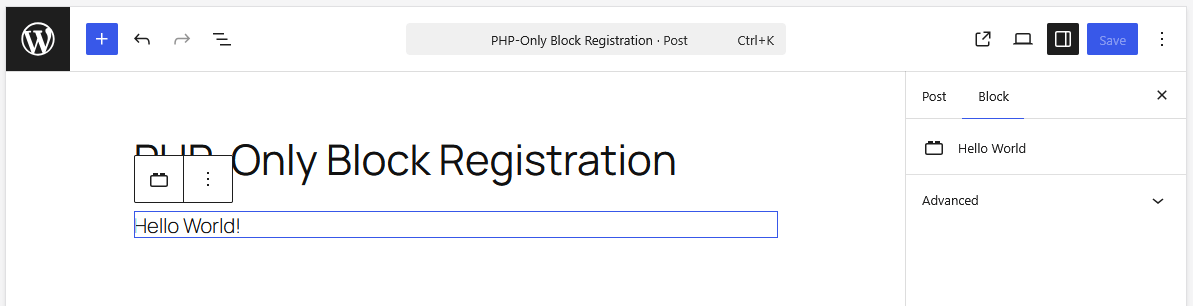
To understand how PHP-only blocks operate under the hood, it is vital to examine the code architecture. The following implementation demonstrates a basic Hello World block registered entirely in PHP:
function css_tricks_hello_world_block()
  register_block_type(
    'css-tricks/hello-world',
      [
        'title' => 'Hello World',
        'render_callback' => function ()
          return sprintf(
            '<div %s>Hello World!</div>',
            get_block_wrapper_attributes()
          );
        ,
        'supports' => [
          'autoRegister' => true,
        ],
      ]
  );

add_action('init', 'css_tricks_hello_world_block');
Managing Attributes and Sidebar Controls
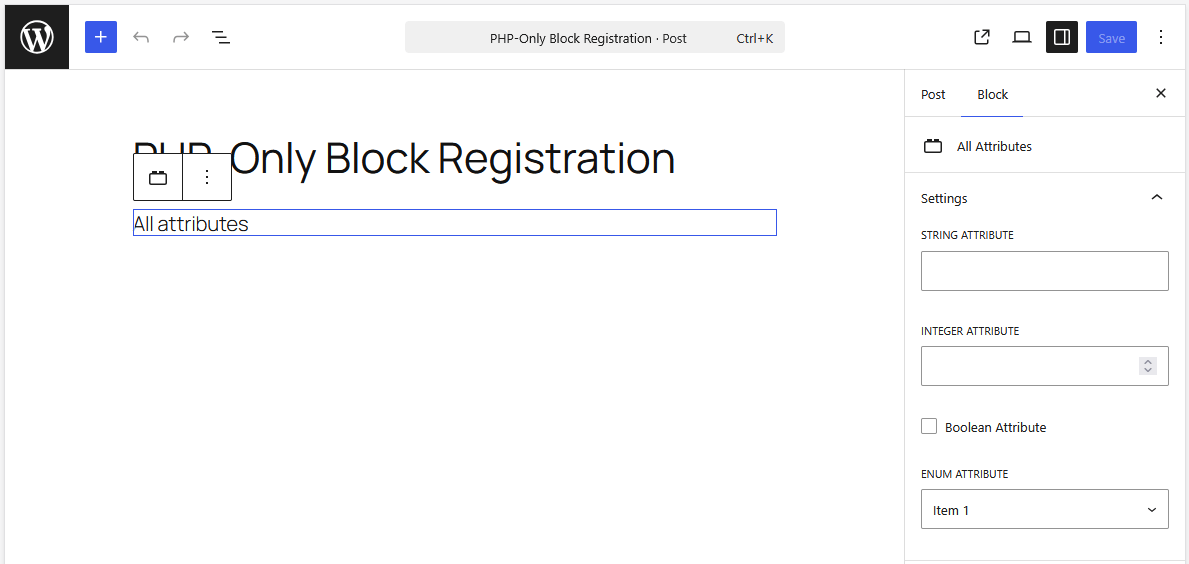
Attributes allow users to customize block behavior. In a PHP-only setup, attributes are declared during registration, which automatically prompts WordPress to generate basic input controls (such as text fields, numbers, checkboxes, and dropdowns) in the block’s settings sidebar:
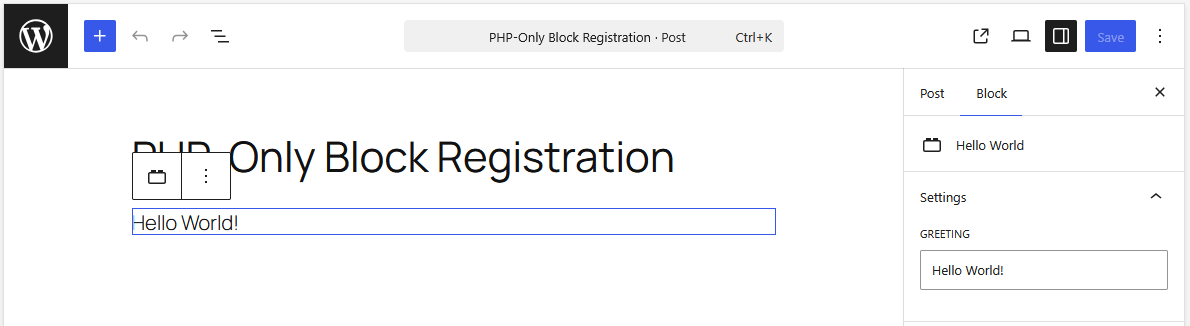
function css_tricks_hello_world_block()

  register_block_type(
    'css-tricks/hello-world',
    [
      'title' => 'Hello World',
      'render_callback' => function ($attributes)
        return sprintf(
          '<div %s>%s</div>',
          get_block_wrapper_attributes(),
          esc_html($attributes['greeting'])
        );
      ,
      'supports' => [
        'autoRegister' => true,
      ],
      'attributes' => [
        'greeting' => [
          'type' => 'string',
          'default' => 'Hello World!',
        ],
    ],
    ]
  );

add_action('init', 'css_tricks_hello_world_block');
Despite this elegance, developers must contend with distinct technical limitations enforced by the feature’s architecture:
- No In-Editor Interactions: Because the editor renders HTML returned by the PHP
render_callbackvia a REST API endpoint, you cannot build rich, in-place editing experiences. All controls are strictly confined to the sidebar. - Stale Data Risks: PHP-only blocks query the database directly upon rendering, bypassing the client-side JavaScript data store. If a user alters the post title or custom fields in the editor, the PHP block will display outdated information until the post is saved and the page is reloaded.
- Stateless REST API Context: REST endpoints are stateless, meaning global variables like
$postand template tags likethe_title()do not inherently resolve inside the editor preview unless explicitly circumvented via custom workarounds (such as extracting post IDs from query parameters during initialization). - Limited Attribute Types: WordPress 7.0 restricts PHP-only attributes to strings, numbers, and booleans, mapping exclusively to basic input elements. Complex interfaces—such as media uploaders, rich text editors, or date pickers—are entirely absent.
Official Responses and Developer Consensus
Reaction from the broader WordPress development community has been mixed yet pragmatic. Advanced JavaScript block builders caution against overusing PHP-only blocks for rich, interactive user interfaces, emphasizing that React remains the undisputed king of native Gutenberg experiences.
However, community consensus firmly points to a singular, undeniable "killer use case": legacy code migration.
For years, agencies and solo developers managing enterprise or high-traffic sites have avoided transitioning to modern block themes because migrating custom shortcodes, dynamic sidebars, and specialized PHP headers required rewriting entire codebases in JavaScript. Official core contributors acknowledge that PHP-only block registration was never designed to replace JavaScript-powered blocks; rather, it serves as a critical bridge. It removes the immediate economic and technical barriers that have kept legacy sites trapped in classic theme architectures.

Implications for the Future of WordPress Development
The introduction of PHP-only block registration in WordPress 7.0 carries profound implications for the platform’s ecosystem and developer workflows.
Accelerating Block Theme Adoption
The most immediate impact will be felt in theme development. By enabling developers to encapsulate existing PHP templates, widgets, and functional snippets into server-side rendered blocks, the time required to migrate a classic theme to a modern block theme drops from weeks of specialized JavaScript development to mere hours of straightforward PHP refactoring.

A Shift Toward Developer Experience (DevEx)
For over half a decade, the developer experience surrounding WordPress block creation has faced persistent criticism for excessive boilerplate, convoluted block.json configurations, and heavy build dependencies. The inclusion of features like autoRegister signals a welcome shift within WordPress Core: a renewed commitment to reducing friction and honoring the skills of traditional PHP developers.
Setting Expectations Moving Forward
Developers must approach PHP-only blocks with clear eyes. They are not a silver bullet. Complex, highly interactive components—such as live calculators, real-time data visualizers, or dynamic filtering grids—will still demand a robust JavaScript and React skill set.

Yet, for structural components, legacy wrappers, and content presentation blocks that only need to look correct on the front end, PHP registration is a game changer. WordPress 7.0 has successfully dismantled the ultimate obstacle keeping legacy developers on the sidelines, opening the door for thousands of sites to finally embrace the full power of modern WordPress.