






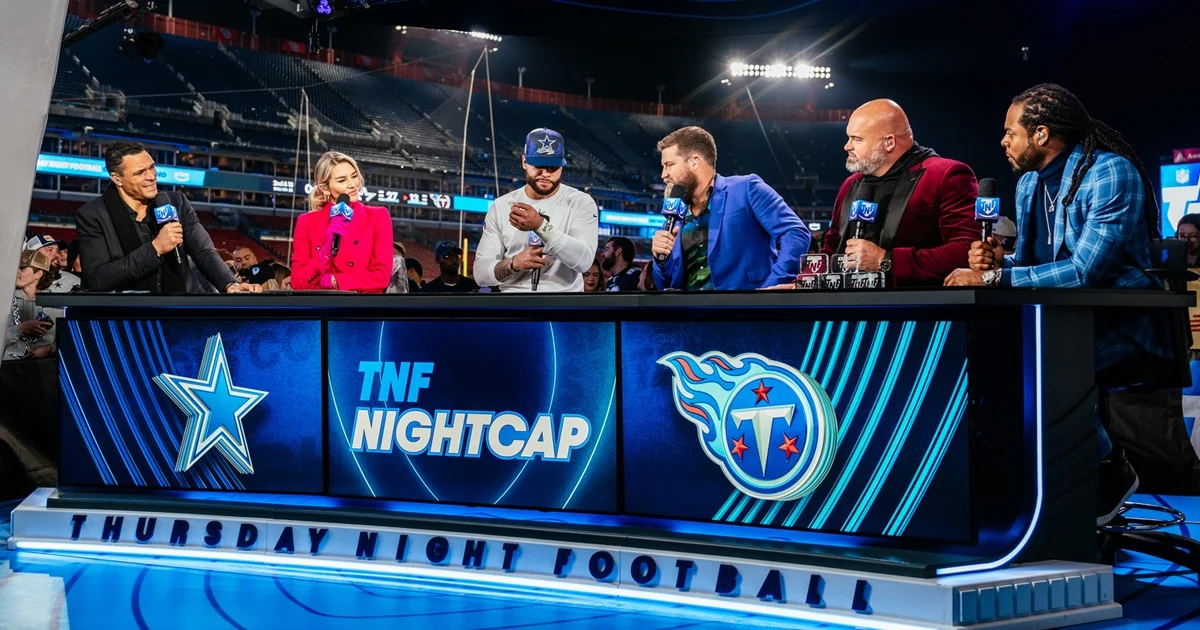
As the NFL’s 2024 season reaches its mid-point, Amazon Prime Video is marking a significant milestone: the fifth year of its landmark 11-year exclusive broadcasting deal for Thursday Night Football (TNF). What began as a bold experiment in streaming exclusivity has evolved into a powerhouse of sports media, one that is fundamentally altering how brands engage with audiences.
With the recent high-stakes clash between the Chicago Bears and the New England Patriots—a 30-24 thriller that kept viewers glued to their screens—Prime Video is not just showcasing its ability to broadcast live sports at scale; it is demonstrating a robust, expanding commercial ecosystem that is attracting a diverse array of new advertisers to the streaming giant.
The Main Facts: A Robust Season of Growth
In an era where linear television ratings are frequently in flux, Amazon’s Thursday Night Football has emerged as a beacon of stability and growth. The latest data from Amazon Ads reveals that the platform is not merely maintaining its audience; it is scaling its commercial impact.
Amazon reports that the total number of advertisers participating in Thursday Night Football has increased by 6% year-over-year. More importantly, this growth is not concentrated in a single sector; rather, it is broad-based. The company has seen double-digit percentage growth in advertising spend across critical industries, including financial services, retail, hardlines, automotive, and travel.
Perhaps most tellingly for the long-term health of the platform, 17% of all advertisers currently featured on Thursday Night Football are entirely new to the Prime Video ecosystem. This influx of fresh capital suggests that Amazon has successfully convinced major brands that the streaming experience offers a unique value proposition that traditional network television simply cannot replicate.
Chronology: From Experiment to Essential
To understand the magnitude of Amazon’s current success, one must look back at the trajectory of the deal.
The Foundation (2017–2020)
Amazon’s initial involvement with the NFL was cautious. In 2017, the company began by simulcasting games that were already airing on CBS or NBC. This period served as a technological stress test, allowing Amazon to build the necessary infrastructure to handle the massive traffic spikes associated with live football.
The Shift to Exclusivity (2021–2022)
The game changed significantly when Amazon secured the exclusive rights to Thursday Night Football starting in 2022. This move was widely viewed as a "big bet" on the future of streaming. Many critics questioned whether viewers would follow the NFL away from cable and onto a subscription-based platform. By the end of the first exclusive season, however, the data silenced the skeptics. Amazon proved that it could deliver a broadcast quality that rivaled legacy networks while integrating real-time shopping and interactive features.
The Expansion Era (2023–Present)
Now in its fifth year overall and its third year of exclusive broadcast, Amazon has moved beyond simple survival. The current strategy is centered on "ecosystem integration." Amazon is no longer just selling a 30-second spot during a game; they are selling a holistic relationship that spans Prime Video, the Amazon e-commerce storefront, and their robust first-party data suite.
Supporting Data: Why Brands are Leaning In
The 6% growth in advertiser volume and the 17% influx of new brands are symptomatic of a deeper shift in marketing budgets.
Cross-Sector Penetration
The double-digit growth in the financial services and automotive sectors is particularly notable. Historically, these categories have been the lifeblood of Sunday afternoon network television. Their shift toward Prime Video signals a maturation of the platform; these are high-stakes, high-budget advertisers who demand measurable ROI, suggesting that Amazon’s ad-tech stack is now sophisticated enough to satisfy the most demanding CMOs.
The First-Party Advantage
Unlike linear broadcasters, who rely on Nielsen ratings and broad demographic estimates, Amazon possesses the most valuable dataset in commerce. Because Prime Video is tied to the Amazon account, advertisers can—in privacy-compliant ways—connect viewership data with purchasing behavior. This "closed-loop" attribution is the primary driver behind the 17% increase in new advertisers. Brands are no longer guessing if their ad worked; they are seeing the conversion data in real-time.
Official Responses: Strategy at the Helm
The strategy behind this growth is guided by a focus on "leaning in." Amy McDevitt, the Head of Live Sports Sales Partnerships at Amazon Ads, emphasizes that the platform’s success is not accidental.
"The latest season is about getting advertisers to lean into Prime Video’s offerings and expand their relationship across the company," McDevitt stated in a recent briefing.
This philosophy underscores a critical pivot: Amazon is trying to dismantle the silos that often exist within large corporations. For a retailer or a travel company, a commercial on Thursday Night Football is now just the "top of the funnel." The middle and bottom of the funnel are handled by Amazon’s sophisticated digital ad tools, which allow brands to target viewers with precision offers immediately following their ad exposure. McDevitt’s team is actively coaching brands to use the broadcast as a springboard for multi-touchpoint campaigns that live on the Amazon homepage, in search results, and within the streaming interface itself.
Implications: The Future of Sports Media
The implications of Amazon’s continued growth in the NFL space are profound for the media landscape.
1. The Death of the "Linear-Only" Mindset
With Amazon proving that streaming can handle the sheer volume of an NFL audience, the justification for holding onto expensive, legacy broadcast infrastructure is weakening. Other platforms, such as Netflix with its foray into live sports, are clearly watching the Amazon playbook. The transition to streaming is no longer a "future trend"; it is the current reality.
2. The Power of "Retail Media"
We are currently witnessing the rise of "Retail Media Networks" (RMNs) as the third great wave of digital advertising. Amazon is the pioneer here. By integrating the viewing experience with the buying experience, Amazon has created a flywheel that is nearly impossible for traditional media conglomerates to replicate. As this model matures, we can expect other retailers with streaming capabilities (like Walmart/Vizio or potentially others) to attempt similar integration strategies.
3. The Democratization of Ad Inventory
The 17% influx of new advertisers is a sign that the barriers to entry for high-profile sports advertising are shifting. While NFL spots were once the exclusive domain of multi-billion-dollar conglomerates, Amazon’s programmatic ad tools allow mid-sized brands to enter the space with more targeted, manageable budgets. This broadens the base of the ad market, making the ecosystem more resilient to the economic cycles that typically impact legacy television budgets.
4. Audience Data as the New Currency
The success of Thursday Night Football on Prime Video is a testament to the power of first-party data. As global privacy regulations tighten and third-party cookies are phased out, the "walled garden" that Amazon has built becomes significantly more valuable. Advertisers are willing to pay a premium to be on Prime Video not just because the content is popular, but because the audience is authenticated and the data is proprietary.
Conclusion: A New Playbook for the Decade
As Amazon approaches the halfway point of its 11-year commitment, the narrative has shifted from "Can they do it?" to "How far can they take it?"
The combination of the Chicago Bears versus the New England Patriots—and the commercial success surrounding that game—serves as a perfect microcosm for the current state of media. The game itself is the hook, the "event" that brings millions together in a fragmented digital world. But the true story lies in the backend: the algorithms, the retail integration, and the evolving relationship between the viewer and the brand.
Amazon’s Thursday Night Football has become the ultimate testing ground for the future of entertainment. By successfully bridging the gap between passive viewership and active consumption, Amazon is not just keeping pace with the NFL; it is defining the next generation of how sports will be watched, analyzed, and monetized for years to come. For brands, the message is clear: if you aren’t leaning into the streaming playbook, you are likely falling behind the rest of the league.