In the rapidly evolving landscape of Large Language Model (LLM) applications, Retrieval-Augmented Generation (RAG) has become the gold standard for grounding AI in proprietary data. However, as organizations transition from proof-of-concept chatbots to mission-critical production systems, the "hallucination problem"—where models confidently present incorrect facts—remains a significant hurdle. A primary culprit is the inherent "lossiness" of traditional vector-based search, which struggles to distinguish between nuanced, atomic facts when those facts share semantic similarity.
In this analysis, we explore the performance differential between a standard vector RAG pipeline and a deterministic 3-Tiered Graph-RAG system. By benchmarking these architectures against a fact-dense, synthetic dataset, we reveal how the intersection of prompt engineering and model capacity dictates the success of modern AI retrieval systems.
The Architecture of Uncertainty: Why Standard RAG Fails
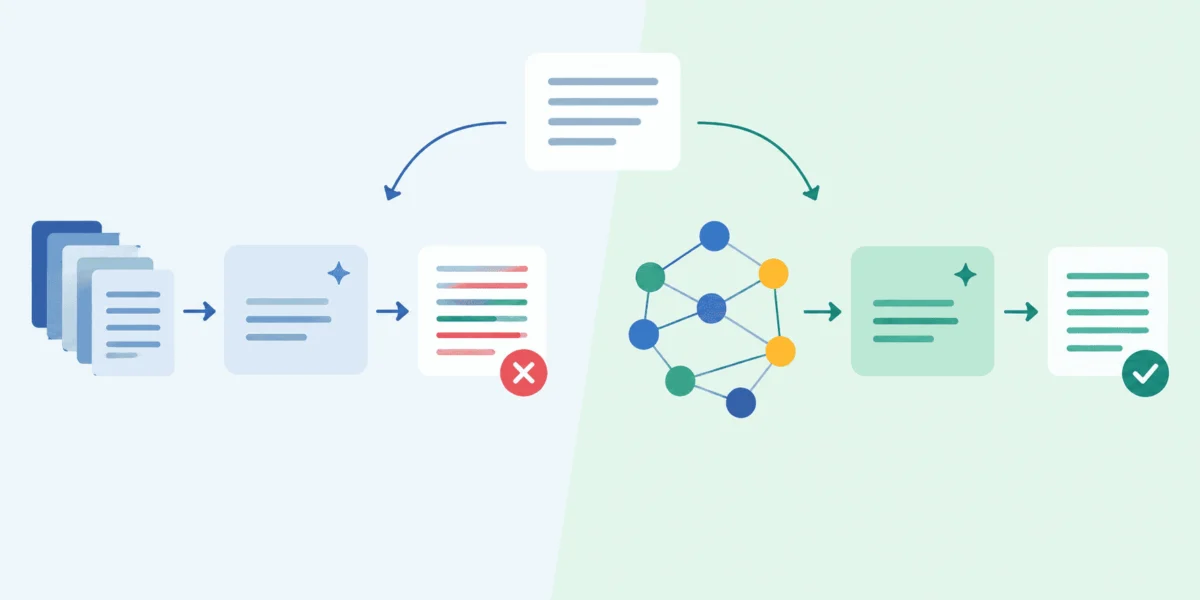
Standard RAG pipelines typically rely on vector databases to perform semantic similarity searches. In this process, text is converted into high-dimensional embeddings. When a user submits a query, the system retrieves the "nearest" chunks of text from the database.
While this is highly effective for retrieving themes or concepts, it is notoriously brittle when handling fact-dense information. If a database contains multiple records for different entities—such as sports players, financial figures, or chemical compounds—the vector search may return chunks that are semantically related to the query but factually incorrect for the specific entity requested. This "context pollution" often leads the LLM to conflate values, resulting in hallucinations.
The 3-Tiered Graph-RAG Alternative
The 3-Tiered Graph-RAG architecture addresses this by introducing a deterministic layer. Rather than relying solely on semantic proximity, it utilizes a Graph-based store—a "QuadStore"—to house verified, atomic facts. By separating "Absolute Truth" (the graph) from "Contextual Background" (the vector database), the system forces the model to prioritize verified relational data, theoretically reducing the frequency of errors.
Methodology: Benchmarking for Accuracy
To evaluate the efficacy of these two approaches, we designed an experimental benchmark using a synthetic dataset of 50 basketball players. This dataset was specifically engineered to induce failure in standard systems by pairing accurate performance statistics with "noisy" surrounding text containing irrelevant or contradictory numbers.
The Setup
We utilized google/flan-t5-base, a 250M-parameter model, to serve as our inference engine. While this model is lightweight and efficient, its smaller parameter count serves as a critical variable in our testing, allowing us to observe how "reasoning capacity" influences the adherence to complex prompt structures.
- Vector DB Component: We employed
chromadbto manage unstructured text. Each document contained a player’s official season average PPG alongside fake, distractor statistics. - Graph DB Component: We implemented a
SimpleQuadStoreto hold the "Ground Truth"—the definitive PPG for each player. - The Retrieval Logic: The standard RAG pipeline performed a top-3 similarity search, while the 3-Tiered Graph-RAG pipeline performed a deterministic lookup in the QuadStore before augmenting the output with the vector-retrieved context.
Chronology of the Evaluation
The evaluation was conducted over 50 iterations, each simulating a real-world query regarding player statistics.
- Phase 1: Data Injection. The system populated both the Graph DB and Vector DB. The Vector DB received intentionally messy, multi-number paragraphs, while the Graph DB received singular, clean data points.
- Phase 2: Retrieval Execution. For every query, we executed two parallel functions:
standard_vector_raganddeterministic_3_tier_rag. - Phase 3: Logic Enforcement. The Graph-RAG prompt was explicitly engineered to force the model to prioritize "Context 1" (the Graph) over "Context 2" (the Vector fallback).
- Phase 4: Comparative Scoring. We measured accuracy based on the model’s ability to output the exact numeric string found in the "Ground Truth" category.
Supporting Data and Observations
| Metric | Standard Vector-RAG | 3-Tiered Graph-RAG |
|---|---|---|
| Accuracy | 96.0% | 92.0% |
| Logic Reliance | High (Contextual) | Moderate (Constrained) |
| Processing Time | Low (Single-pass) | Medium (Dual-pass) |
Contrary to the common assumption that more complex architectures inherently yield better results, the data revealed a counterintuitive trend. The Standard Vector-RAG achieved 96% accuracy, outperforming the 3-Tiered Graph-RAG by 4 percentage points.
The Role of Model Capacity
The discrepancy in results stems from the interaction between prompt complexity and model intelligence. The flan-t5-base model, despite being a capable instruction-follower for simple tasks, struggled to navigate the "conflict resolution" requirements of our Graph-RAG prompt.
The Graph-RAG prompt was structurally more complex, requiring the model to:
- Parse the Graph context.
- Parse the Vector context.
- Execute a conditional logic gate (if Graph is present, ignore Vector).
For a 250M-parameter model, this level of instruction-following consumes significant "cognitive" overhead. The model essentially became "overwhelmed" by the structure of the prompt, leading to minor formatting errors or, in 8% of cases, the accidental selection of the wrong context window.
Implications for Production Engineering
The findings from this benchmark offer three critical takeaways for developers and data engineers building RAG-enabled applications:
1. Matching Model Capacity to Prompt Complexity
The most significant lesson is that prompt complexity must scale with model capability. If an engineering team opts for a sophisticated, deterministic architecture like Graph-RAG, the retrieval system must be paired with an LLM capable of high-level logical reasoning (e.g., Llama 3 70B, GPT-4, or Claude 3.5 Sonnet). For smaller, edge-optimized models, a simpler, "flatter" retrieval architecture may yield more reliable performance.
2. The Fallacy of Over-Engineering
Developers often default to complex RAG architectures to solve hallucinations. However, if the underlying LLM is not intelligent enough to execute the "instructions" provided in the prompt, the complexity introduces new points of failure. In production environments, simplicity is a feature. If a standard Vector RAG is performing at 96%, the marginal utility of migrating to a more complex graph-based system must be carefully weighed against the loss in zero-shot instruction compliance.
3. The "Truth" Isn’t Just in the Data
The study highlights that accuracy is not solely a function of data quality or retrieval method; it is a function of the model’s ability to process the instructions provided at the prompt level. When implementing a Graph-RAG system, engineers must account for the "reasoning tax" that comes with multi-source retrieval.
Future Directions
While the 3-Tiered Graph-RAG underperformed in this specific benchmark, its potential remains high for enterprise-scale data where the complexity of relationships—not just atomic numbers—is the primary driver. Future iterations of this benchmark should investigate the performance threshold at which a model’s capacity allows it to handle complex deterministic constraints without accuracy degradation.
Ultimately, as AI systems move toward greater autonomy, the choice between architectural rigidity (Graph-RAG) and semantic flexibility (Vector RAG) will continue to define the boundaries of reliable, hallucination-free generation. The goal for developers is to find the "sweet spot" where the architecture supports the model’s strengths rather than exposing its limitations.