




In the rapidly evolving landscape of digital experience management, Artificial Intelligence has become ubiquitous. From automated chatbots to predictive analytics, AI is now a standard fixture in the modern marketing stack. Yet, for many optimization teams, a persistent problem remains: AI excels at identifying problems, but it frequently fails to solve them.
The current state of optimization is often characterized by a "dashboard disconnect." AI surfaces patterns in visitor behavior, flags friction points, and suggests strategic pivots. However, these insights are often where the intelligence stops. Turning an insight into a tangible change—a headline update, a CTA adjustment, or a personalized journey—requires a manual, fragmented process that often sees valuable data get lost in the shuffle.
Wingify, a leader in experience optimization, is looking to disrupt this cycle with the launch of Wingz, an "intelligence layer" designed to move beyond the traditional "AI-as-an-assistant" model. By integrating intelligence directly into the workflow, Wingz aims to transform optimization from a series of disjointed tasks into a continuous, self-optimizing loop.
The Core Problem: Why Most AI Efforts Stagnate
To understand the significance of Wingz, one must first understand the structural flaw in how most organizations currently deploy AI.
The "Assistant" Trap
Most marketing software platforms treat AI as a secondary interface—a chatbot or a dashboard widget that provides advice. Ankit Jain, Co-founder and Chief Product & Technology Officer at Wingify, identifies this as a critical limitation.
"Most AI in marketing software is an assistant sitting on top of a product," Jain notes. "It can tell you things, but it cannot do much, and it certainly cannot tell you whether it was right."
When AI functions as a passive observer, it exists outside the workflow. It sees data but lacks the agency to execute. This creates a "handoff" friction: a team receives a recommendation, interprets it, manually configures an experiment, sets up an audience, and launches the test. At every stage of this process, context—the "why" behind the original insight—is eroded.
The Cost of Siloed Intelligence
Optimization is inherently a loop: Understand, Decide, Act, Measure, and Learn. When these steps are handled by different tools or manual processes, they become silos. If an AI suggests a change based on visitor friction, but the team that builds the test doesn’t have a direct line to the rationale behind that suggestion, the quality of the experiment often suffers.
Wingify argues that intelligence must be "native" to the platform. By embedding AI into the workflow, the system doesn’t just suggest a move; it understands the customer journey, accesses the historical data of past experiments, and executes the change within defined safety parameters.
Defining AI-Native Optimization
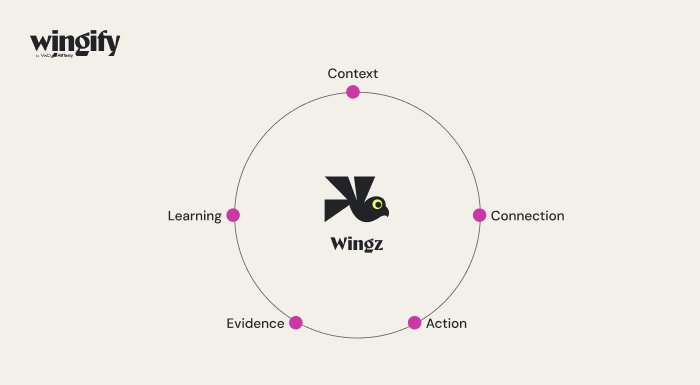
What separates an "AI-enhanced" tool from an "AI-native" platform? According to industry experts, it comes down to four fundamental pillars: Context, Connection, Action, and Evidence.
1. Context: The Foundation of Meaning
In an AI-native system, the AI does not exist in a vacuum. It has access to the full spectrum of customer behavior, past test results, and audience segmentation. By synthesizing these signals, the system builds a richer, more accurate starting point for optimization than a human or a standalone tool could provide in isolation.
2. Connection: Maintaining the Thread
The "Connection" pillar ensures that the reasoning behind an insight is never lost. When an insight leads to a hypothesis, and the hypothesis leads to an experiment, the AI carries the original context through every step. This prevents the "telephone game" effect, where the initial intent is distorted by the time it reaches the deployment phase.

3. Action: Bridging the Implementation Gap
This is perhaps the most significant differentiator. AI-native optimization allows for direct implementation. If the system identifies an opportunity to improve conversion, it can configure the experience, define the audience, and prepare the change for launch as part of one fluid motion.
4. Evidence: The Learning Loop
Finally, an AI-native system measures the outcome of its own actions. By observing the impact of a change, it updates its "knowledge base," making the next cycle more intelligent than the last. This closes the loop, turning every experiment into a data point that refines the entire system.
The Architecture of Wingz: From Concept to Execution
Wingify’s Wingz platform is built to facilitate this flow by using "Agents"—specialized AI entities that handle distinct, repeatable tasks.
The Workflow of an Agentic System
The process typically begins with a single, clear objective. For example, a marketing manager might want to optimize a landing page CTA. Instead of engaging in a complex coding workflow, the user can describe the desired change in plain language, or provide a design artifact such as a Figma link, a screenshot, or a PDF.
Wingz interprets the design intent and builds the variation. This immediately solves the "implementation handoff" problem. Once the base variation is created, the system allows for the work to flow between agents. One agent handles hypothesis generation, another manages the audience segmentation, and a third ensures the test adheres to guardrail monitoring.
The Human-in-the-Loop Philosophy
A common concern regarding AI-driven execution is the loss of control. Alix de Sagazan, Co-founder and CRO at Wingify, emphasizes that "disconnected tools create hidden costs for teams." However, the goal is not to replace human decision-makers, but to empower them.

Wingz offers varying levels of autonomy:
- Propose: The AI suggests an action for human approval.
- Guardrail Execution: The AI acts within strict, user-defined boundaries.
- Autopilot: The AI manages the experiment within pre-set traffic caps and performance metrics.
This tiered approach ensures that companies can maintain governance. Features like "kill switches," permanent holdouts, and approval gates are integrated directly into the system, ensuring that the AI remains a tool for scale rather than a replacement for strategy.
Implications for the Industry
The shift toward agentic experience optimization has profound implications for digital marketing teams.
Increased Velocity and Reduced Errors
By automating the connective tissue of the optimization process, teams can move from idea to execution in a fraction of the time. The reduction in manual handoffs also means fewer configuration errors and a more consistent application of brand guidelines.
Strategic Repositioning of Talent
As the "grunt work" of building variations and configuring tests is offloaded to AI, the role of the optimization professional changes. Instead of spending 80% of their time on execution and 20% on strategy, the ratio flips. Teams are freed to focus on high-level customer experience strategy, creative ideation, and the interpretation of complex, long-term trends.
A New Standard for ROI
When the optimization loop is tight and continuous, the return on investment for experimentation increases. Because every action is measured and fed back into the system, "failing" tests become less of a sunk cost and more of an asset—a data point that narrows the field of possibilities for the next successful breakthrough.
Conclusion: Curiosity that Converts
Ultimately, Wingify’s move toward an AI-native framework is a recognition that the future of digital experience is not found in more AI features, but in better-integrated intelligence.
In a digital world where customer attention is the most scarce resource, the ability to iterate rapidly and intelligently is a competitive imperative. By closing the gap between insight and action, platforms like Wingz are transforming the optimization landscape from one of fragmented effort to one of seamless, agent-driven growth.
For organizations looking to move beyond the dashboard and into the era of agentic optimization, the message is clear: the technology is no longer just about knowing what to change—it’s about the capability to change it, measure it, and learn from it, all in one connected flow. As Wingify continues to refine its suite, the focus will remain on the intersection of machine-driven scale and human-driven curiosity, proving that the best results come when intelligence is not just an advisor, but a partner in the work itself.