








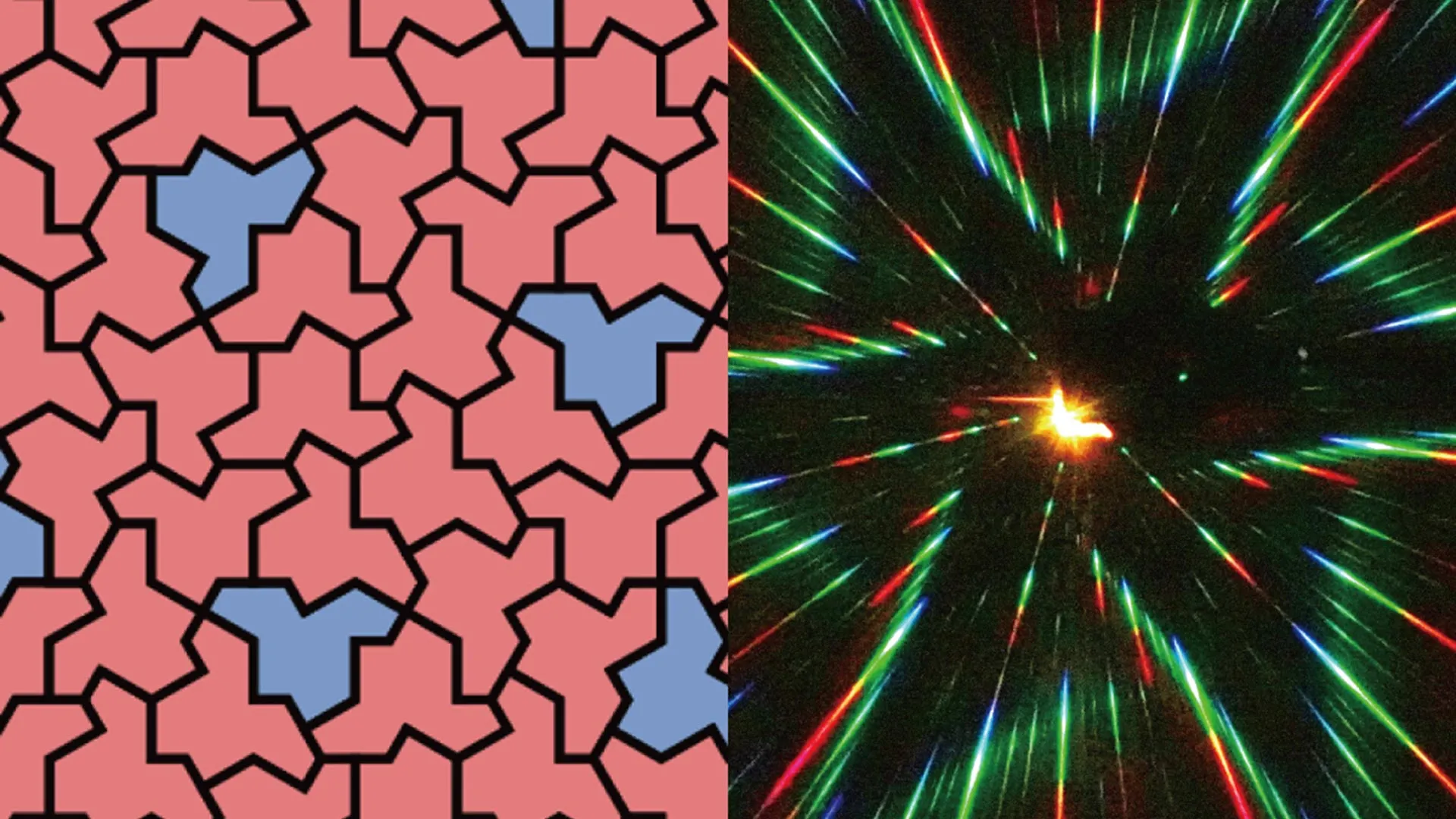
TOKYO — In a striking convergence of abstract geometry and experimental physics, researchers have uncovered an unexpected and profound connection between a mathematical shape that captivated the global scientific community and the behavior of light. Structures engineered from the famous "Smith hat"—a geometric form celebrated for solving a decades-old mathematical riddle—have been shown to force light into unusual, chiral diffraction patterns. This discovery opens unprecedented pathways for exploring how complex aperiodic geometry can manipulate optical behavior at the nanoscale.
The findings, detailed in a recent study published in Nature Communications, were spearheaded by a collaborative team of researchers from the Institute of Industrial Science at The University of Tokyo, alongside partner institutions. By translating a purely mathematical solution into physical, nanoscale silicon nitride structures, the team has demonstrated that the unconventional symmetry—or lack thereof—inherent in the Smith hat can dictate how light scatters, responds to polarization, and exhibits pronounced directional properties.
Main Facts
The core of this breakthrough lies in the physical manifestation of an aperiodic monotile. The Smith hat shape, which recently made headlines for solving the elusive "Einstein problem" in mathematics, possesses a rare property: it can tile an infinite two-dimensional plane completely, without gaps or overlaps, yet never form a repeating, periodic pattern.
When researchers fabricated nanoscale versions of this pattern and illuminated them with laser light, the resulting optical diffraction patterns formed distinct, pinwheel-like geometries. These formations visually betrayed the intrinsic "chirality"—or handedness—of the underlying aperiodic structure. Unlike conventional quasicrystals, which typically display high levels of rotational symmetry, the Smith hat pattern lacks mirror symmetry entirely. Consequently, when light interacts with these structures, it produces a chiral optical response that shifts dynamically depending on the angle of incidence and the polarization state of the incoming beam. Furthermore, mirroring the physical structures physically reverses their optical behavior, proving that the light’s response is inextricably bound to the unique symmetry-breaking properties of the mathematical template.
Chronology of the Discovery
To understand how a mathematical concept migrated into the realm of optical physics, it is necessary to trace the timeline of events that brought the Smith hat from theoretical drafting boards to advanced photonics laboratories.
- The Decades-Long Search: For generations, mathematicians and geometricians wrestled with the Einstein problem, which questioned whether a single, connected shape (a monotile) could tile a flat surface aperiodically. While complex sets of multiple tiles achieving this had been known since the 1970s (such as Penrose tiles), finding a single tile—an "ein Stein," or one stone—remained an elusive holy grail.
- The 2023 Breakthrough: The mathematical landscape shifted dramatically in 2023 when a team of researchers, including David Smith, Joseph Samuel Myers, Craig S. Kaplan, and Chaim Goodman-Strauss, officially discovered the Smith hat. The shape generated immense global excitement, serving as the first true chiral aperiodic monotile capable of paving an infinite plane without repetition.
- Conceiving the Optical Experiment: Shortly after the mathematical community digested the implications of the hat tile, physicists at the University of Tokyo and their collaborators began to look beyond pure geometry. Lead author Yuto Moritake and senior author Masaya Notomi recognized that while the pattern appeared chaotic, it was fundamentally rooted in an underlying honeycomb lattice. They hypothesized that this hidden structural tension might yield unique physical phenomena.
- Nanofabrication and Illumination: Moving from theory to execution, the research team utilized advanced electron beam lithography to etch nanoscale versions of the Smith hat pattern onto high-index silicon nitride films. Upon directing laser light through these fabricated optical structures, the team observed the emergence of striking, pinwheel-shaped diffraction patterns, confirming their theoretical predictions.
Supporting Data and Technical Architecture
The technical execution of the study highlights the precision required to bridge nanoscale engineering with complex mathematical topologies.
[Incoming Laser Light]
        │
        ▼
[Silicon Nitride Film (E-Beam Lithography)]
        │  (Smith Hat Aperiodic Monotile Nanostructure)
        ▼
[Scattering / Diffraction]
        │
        ▼
[Chiral Pinwheel Diffraction Patterns (Symmetry-Controlled)]
The physical samples were meticulously crafted on silicon nitride ($textSi_3textN_4$) membranes—a material chosen for its exceptional transparency and high refractive index in the optical spectrum, making it an ideal platform for nanophotonic investigations. Electron beam lithography enabled the team to pattern features down to nanometer precision, replicating the exact non-repeating boundaries of the Smith hat mosaic across macroscopic areas of the chip.
When subjected to coherent laser illumination, the light waves diffracted off the aperiodic boundaries. Quantitative analysis of the scattering profiles revealed several key data points:
- Absence of Mirror Symmetry: Traditional crystals and many quasicrystals possess inversion or mirror symmetry planes. The diffraction data from the Smith hat structures clearly lacked these axes, directly manifesting the chiral nature of the monotile layout.
- Polarization Sensitivity: The optical response was found to be highly dependent on the polarization state of the incident laser. Adjusting the electric field vector of the incoming light altered the intensity distribution within the pinwheel diffraction orders.
- Reversibility via Spatial Inversion: When the physical silicon nitride structures were flipped or digitally mirrored in analysis, the resulting chiral diffraction signatures inverted symmetrically, confirming a direct causal link between the structural geometry and the optical field’s handedness.
Official Responses and Perspectives
The implications of marrying aperiodic monotiles with optics have drawn enthusiastic commentary from the primary researchers involved in the study, highlighting both the aesthetic and functional surprises of the work.
"What is especially fascinating about the hat tile is that, although the resulting pattern appears irregular at first glance, it is actually constructed from the honeycomb lattice," remarks lead author Yuto Moritake, emphasizing the subtle structural ordering that underpins the mathematics. "We wanted to see whether this unique shape could also produce any unexpected physical phenomena."
Reflecting on the experimental outcomes, Moritake noted the broader horizons opened by the work: "These results open a new direction of research on the fusion of quasiperiodic order and chirality. Monotile patterns provide a platform for exploring optical phenomena that emerge from the interplay of symmetry, chirality, and aperiodicity."
Senior author Masaya Notomi elaborated on the fundamental mechanics driving the optical response, pointing directly to the geometry of the medium. "We found that the diffraction patterns themselves become chiral because the structure lacks mirror symmetry," Notomi explains. "This kind of optical response is fundamentally different from that observed in conventional quasicrystalline materials."
Implications for Future Physics and Technology
While the current research remains within the domain of foundational physics, the long-term technological implications are profound. By demonstrating that abstract, non-repeating mathematical geometries can actively shape and control light, the study establishes a new design paradigm for nanophotonic devices.
Advancing Optical Metamaterials
Traditional optical components rely on periodic gratings or crystalline structures to bend, filter, or polarize light. The introduction of aperiodic monotile structures provides engineers with a vastly expanded design palette. Because the Smith hat pattern avoids repetition while maintaining strict local and semi-global rules, it can scatter light uniformly across complex angles without the unwanted harmonic distortions often introduced by highly periodic lattices.
Polarization and Chiral Control
In modern telecommunications, quantum optics, and sensing technologies, the ability to manipulate the handedness (chirality) of light is critical. Current chiral optics typically rely on complex three-dimensional micro-structures that are difficult to manufacture at scale. The ability of two-dimensional Smith hat arrays to imprint chiral responses onto transmitted or reflected light suggests a simpler, more scalable planar approach to creating circular polarizers, chiral beam splitters, and optical isolators.
Bridging Pure Mathematics and Applied Science
Beyond immediate device applications, this research serves as a poignant reminder of the unpredictable utility of pure mathematics. When David Smith and his co-authors set out to solve the Einstein problem, their motivations were purely geometric—an intellectual pursuit of tiling an infinite plane without a repeating motif. That this pursuit would ultimately provide a novel framework for manipulating electromagnetic waves underscores the deep, underlying symmetries of the natural world.
As researchers continue to explore the optical properties of aperiodic monotiles, the boundary between abstract mathematical theory and applied photonics grows increasingly porous. Future investigations will likely expand into other variants of the hat tile family, testing how modifications to the monotile’s geometry alter its photonic bandgaps, localized resonances, and nonlinear optical interactions. For now, the Smith hat stands not only as a triumph of modern geometry, but as a brilliant new lens through which humanity can study and control the behavior of light.