










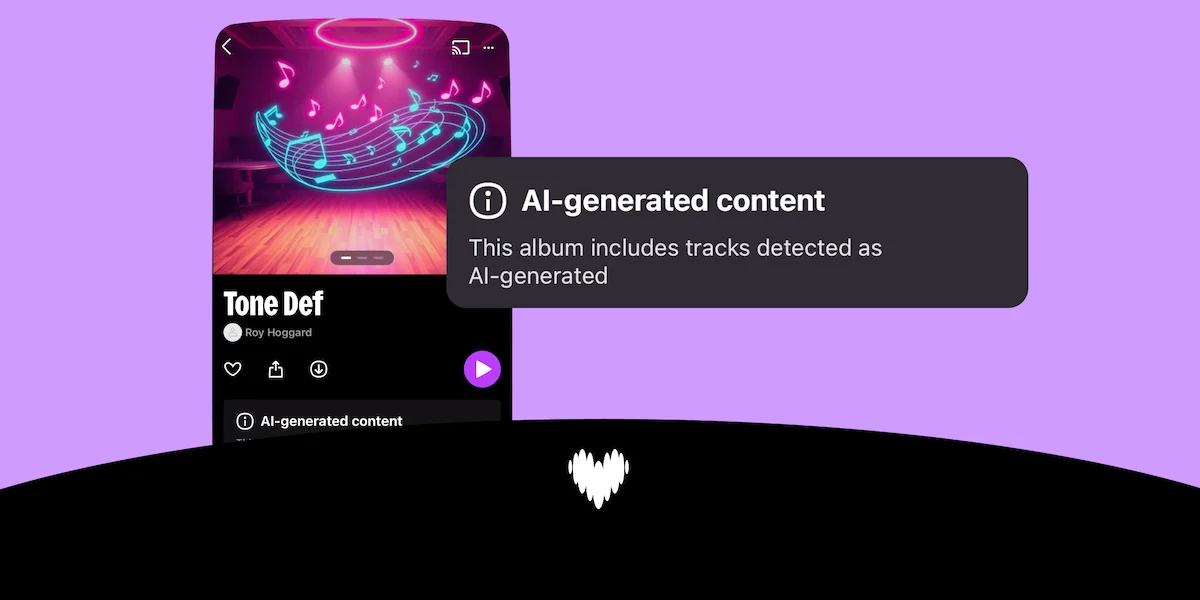
The music industry is currently undergoing a seismic shift, one defined not by the evolution of genres or the rise of new subcultures, but by an algorithmic tidal wave. Deezer, the global music streaming giant, has officially confirmed a staggering milestone: AI-generated tracks now account for more than 50% of the daily music uploads on its platform. This development marks a critical turning point in the streaming era, forcing a confrontation between the convenience of generative AI and the economic sustainability of human artistry.
As the lines between human-composed melodies and synthetic compositions blur, streaming services are scrambling to define their roles as either gatekeepers of quality or repositories of infinite, automated content. Deezer, for its part, has emerged as the industry’s most vocal proponent of stringent AI management, signaling that it is no longer willing to allow its platform to be overwhelmed by the "noise" of synthetic production.
A Chronology of the Synthetic Takeover
To understand the scale of this transformation, one must look at the rapid acceleration of AI uploads over the last two years. The transition from a human-dominated catalog to one increasingly populated by machines has been nothing short of exponential.
- January 2025: The shift was barely a whisper. Deezer reported that AI-generated tracks accounted for approximately 10,000 daily uploads, representing roughly 10% of the platform’s intake.
- April 2025: The figure doubled to 20,000 tracks, or 18% of new uploads, as generative models began to see wider public adoption.
- September 2025: The trajectory steepened, with 30,000 daily AI uploads accounting for 28% of the total volume.
- November 2025: The momentum continued, reaching 50,000 daily uploads (34%).
- January 2026: AI tracks hit 60,000 daily units, or 39% of the total, signaling that the platform was approaching a tipping point.
- April 2026: The surge intensified to 75,000 tracks, or 44% of daily uploads.
- June 2026: The peak of the trend saw a monthly average of 90,000 tracks per day.
- Present Day: The cumulative effect has pushed AI-generated music past the 50% threshold, officially making synthetic audio the majority component of new content arriving on the service.
Supporting Data: The Anatomy of a Market Shift
The data provided by Deezer highlights a sophisticated, and often predatory, landscape. The rise of AI music is not merely a result of hobbyists experimenting with new tools like Suno or Udio; it is increasingly a calculated effort to exploit streaming royalty structures.
The "payment dilution" mentioned by Deezer executives refers to the way streaming royalties are calculated. In most models, a pool of money is divided by the total number of streams. When millions of low-quality, AI-generated tracks are flooded onto the platform, they soak up a portion of the revenue, effectively stealing "market share" from human artists.
Furthermore, Deezer’s internal analytics have identified a correlation between high-volume AI uploads and "fraudulent streams"—a practice where bot farms are used to inflate the play counts of AI tracks to siphon off revenue from the collective royalty pool. By isolating these tracks, Deezer is attempting to sanitize its ecosystem, ensuring that the limited pool of streaming revenue is directed toward legitimate creators rather than automated spam.
The Industry Response: A Fragmented Frontier
The streaming industry is currently a house divided. There is no unified "AI policy," leading to a chaotic landscape where artists and labels are forced to navigate conflicting rulesets.
The Prohibitionists
Some platforms have taken a hardline stance. Bandcamp, known for its focus on independent and artist-centric commerce, moved to ban AI-generated music entirely in early 2026. This move was framed as an essential protection for the platform’s core user base of niche, authentic musicians. Similarly, Tidal has implemented strict measures to cut off monetization for AI-generated tracks, effectively turning them into "ghost files" that generate no income for the entity behind them.
The Moderated Approach
Other giants have opted for a "tagging and labeling" strategy. Apple Music, for instance, has instituted a voluntary AI-tagging system, hoping that transparency will empower listeners to make their own choices. Spotify has pursued a more complex, multi-layered policy that involves labeling content, reducing the visibility of "spam" AI tracks, and developing internal guidelines on how much human intervention is required for a track to be considered "authentic."
Deezer’s Proactive Stance
Deezer has positioned itself as the industry’s "AI auditor." By developing proprietary detection technology capable of identifying tracks generated by models such as Suno and Udio, the company has provided a template for how other streamers might police their platforms. Earlier this year, Deezer took the bold step of making its detection tools available to competitors. While the adoption rate by other major streaming services remains opaque, the release of a tool capable of scanning external playlists on platforms like Spotify and Apple Music indicates that Deezer is prepared to act as an industry watchdog, even if its peers are slow to follow suit.
Implications: Safeguarding the Future of Music
The latest move from Deezer—the decision to purge AI-generated tracks that have received zero streams in the past six months or are linked to fraudulent activity—is a direct intervention in the economics of the platform.
"Deezer has been at the frontline of fighting fraud and reducing payment dilution related to AI music for almost two years," said CEO Alexis Lanternier. "Now that half of all daily uploads are AI-generated tracks, we are taking additional steps to safeguard the rights of artists and songwriters, while maintaining focus on music that fans actually love."
The Economic Consequences
The primary implication is the protection of the "pro-rata" royalty model. If 50% of the library is AI-generated, and those tracks are either being botted or ignored, the financial health of human creators is at extreme risk. By culling these tracks, Deezer is attempting to shrink the "long tail" of content to ensure that human creators aren’t being drowned out by an endless supply of generated filler.
The Creative Erosion
Beyond the economics, there is the existential question of taste. If 50% of new music is generated by algorithms trained on existing copyrighted material, does this lead to a "homogenization" of sound? As AI models continue to train on the same datasets, the risk of a "feedback loop"—where AI generates music based on AI-generated music—becomes a reality. This could lead to a stagnation of musical innovation, where the platform becomes a self-replicating echo chamber of mid-tempo, genre-blending background audio.
The Legal Battleground
The legal status of AI music remains in flux. With major labels like Sony embroiled in high-profile lawsuits against developers of generative AI, the status of the tracks being uploaded today remains legally precarious. If courts eventually rule that AI-generated music infringes on the copyright of the artists used in the training data, platforms like Deezer could be sitting on millions of tracks that are essentially liabilities.
Conclusion: The Path Forward
The situation at Deezer is a microcosm of the broader crisis facing the creative industries. Technology has democratized the ability to create, but it has also commodified the output to such an extent that the value of an individual song is plummeting.
As Deezer moves forward, its success will depend on its ability to balance technological innovation with the preservation of human craft. The company’s willingness to remove non-performing and fraudulent AI tracks is a necessary, albeit reactive, step. However, the true challenge lies in whether the music industry can build a sustainable future where human expression remains the primary driver of culture, or if the "AI deluge" will permanently reshape the way the world consumes, pays for, and values music.
For now, the battle lines are drawn. As the percentage of AI uploads continues to climb, the industry is entering an era where human listeners will become the final, and most important, line of defense against the total automation of the soundtrack of our lives.