By Tomáš Foltýn | September 28, 2026
In the modern digital workspace, the "red flags" we were once taught to look for—clumsy grammar, suspicious URLs, and pixelated logos—are rapidly becoming relics of a bygone era. Today’s phishing landscape is defined by precision, psychological sophistication, and the seamless integration of Artificial Intelligence. As cyber-adversaries harness these tools, the traditional reliance on human intuition as the primary line of defense is proving insufficient.
For modern enterprises, the question is no longer whether an employee will encounter a sophisticated phishing attempt, but how effectively the organization can detect and contain the inevitable breach.
The Evolution of the Phishing Vector
The contemporary threat actor no longer relies on the "spray and pray" approach of the past. Thanks to the proliferation of the cybercrime-as-a-service economy, high-quality, ready-made phishing kits are available to anyone with the intent to harm. AI has further commodified these attacks, providing criminals with the ability to research targets at scale, mimic specific corporate tones, and automate the creation of highly personalized lures.

The Death of the "Obvious" Tell
Bad grammar, once the hallmark of a fraudulent email, has been effectively eradicated by generative AI. Attackers can now produce flawless, culturally nuanced correspondence that mirrors the internal communications of a target organization. Even more concerning is the shift toward long-game social engineering; bad actors now use AI to build rapport with their targets over days or weeks, waiting for the optimal moment to "go in for the kill."
The QR Code "Device Hop"
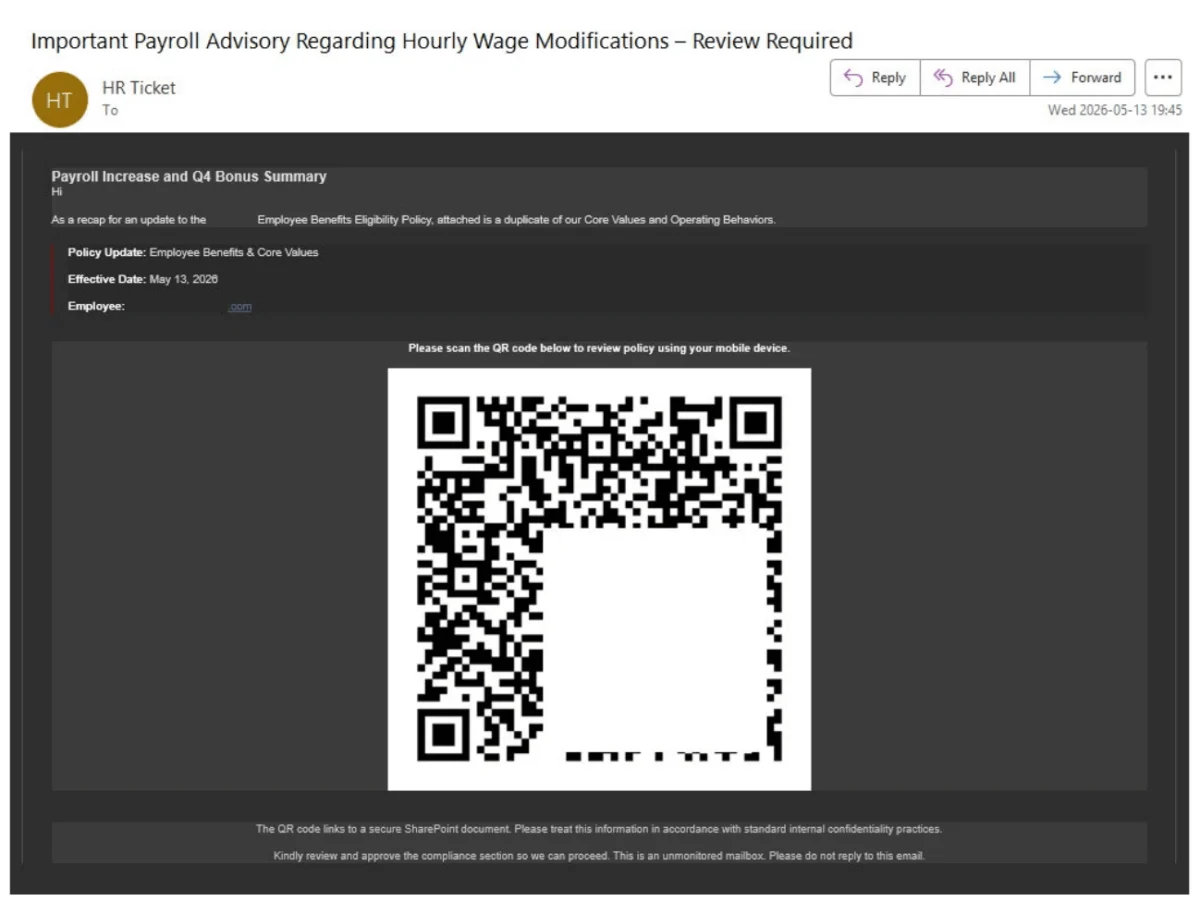
Perhaps the most disruptive innovation in recent years is the use of QR codes to bypass traditional endpoint security. By embedding malicious links within QR codes, attackers circumvent the security controls embedded in company-issued laptops. Because the scan occurs on a personal mobile device, the "device hop" obscures the attack path, making it difficult for IT departments to monitor or block the destination. According to ESET’s telemetry, QR code phishing accounted for one in nine detected phishing attempts in the first half of 2026, solidifying its position as the fastest-growing email-based attack vector.
Chronology of Modern Tactics: From Click to Compromise
To understand the severity of these threats, one must examine the progression of modern social engineering tactics that have rendered traditional MFA (multi-factor authentication) and awareness training partially obsolete.
- The ConsentFix Paradigm: Rather than using a fake login page, attackers now use legitimate platforms. A victim is directed to a compromised, yet legitimate, website. A fake CAPTCHA prompt forces the user through a genuine Microsoft sign-in flow. The attacker then extracts an OAuth authorization code, effectively bypassing the need for a password or an MFA prompt. Once the session is active, the attacker captures the session token, gaining access without ever needing to know the user’s password.
- ClickFix and Terminal Exploits: The "ClickFix" method—which tricks users into running malicious commands in their own terminal—is reaching new levels of efficacy. Variants like "AI-fix" inject fake troubleshooting instructions directly into legitimate domains (such as those belonging to Anthropic or OpenAI).
- The CrashFix Delay: A newly identified fake ad blocker dubbed "CrashFix" directs targets to the official Chrome Web Store. Crucially, it waits an hour after installation before triggering a bogus alert. This delay is a calculated move designed to disconnect the user’s mental link between the installation of the software and the subsequent security compromise.
Supporting Data: The Scale of the Threat
Data from the 2026 threat landscape highlights a disconnect between perceived risks and actual exposure.

- Incident Timing: ESET MDR telemetry reveals that approximately 70% of security incidents occur during standard business hours, with 90% falling on weekdays, proving that attackers are intentionally blending in with normal operational rhythms.
- Investigation Duration: The ESET SMB Cyber Readiness Index found that incident investigation is a major operational drain. While 41% of investigations are resolved within a fortnight, 34% take between two and six weeks. For a small to medium-sized business (SMB), this represents a massive disruption that can lead to significant financial loss.
- The Reporting Gap: A critical finding from the Q1 2026 MDR report is that many employees do recognize phishing attempts, but fail to report them simply because they lack a clear channel to do so. This silence deprives the organization of the opportunity to analyze the threat and strengthen defenses against similar future attacks.
The Deepfake Crisis: When Seeing Isn’t Believing
The maturation of audio and video synthesis has introduced the "Deepfake Factor" to corporate environments. We have moved past the era where a phone call or a video conference could be considered a source of truth.
The incident involving a finance employee who transferred $25 million following a call populated by deepfake versions of senior colleagues remains the benchmark for this threat. Even imperfect imitations can be devastatingly effective when the context is sufficiently plausible. Employees, caught in the middle of their daily tasks, rarely have the time or the tools to scrutinize video frames for synthetic artifacts. When the "who" in "who is asking" can be fabricated, the reliance on human verification must be replaced by institutional verification protocols.
Official Perspective: Beyond "Human Error"
It is a common mistake to label a breach as a result of "human error." While an employee’s click may be the catalyst, the responsibility for the crisis lies in the architecture of the company’s security posture.
According to ESET’s analysis, focusing solely on user training is a defensive dead-end. While awareness is vital, it cannot compensate for an attack that is designed to look legitimate. The focus must shift toward preventive controls and rapid containment.

"The employee’s click gives the attacker an opening," notes the recent ESET MDR report, "but the eventual damage depends on what happens in the minutes and hours following that click."
Implications for the Future of Enterprise Security
1. Verification over Trust
In a world where digital identity can be forged, organizations must move to a "Verify, Don’t Trust" model. For any high-stakes transaction—such as a wire transfer or a system configuration change—multiple independent channels of verification are now non-negotiable. This should involve a secondary human approver and a distinct, verified communication path (e.g., a phone call via a known internal extension rather than a response to an email).
2. The Rise of MDR (Managed Detection and Response)
For SMBs, the disparity between the growing attack surface and available IT resources is widening. Small teams cannot realistically maintain 24/7 monitoring while simultaneously managing day-to-day operations. Managed Detection and Response (MDR) services offer a solution by providing the investigative prowess and capacity to turn disparate, low-level network artifacts into a coherent threat picture. By automating the correlation of data across accounts and devices, MDR allows companies to identify an attack before it reaches the "exfiltration" phase.
3. Institutionalizing the Feedback Loop
Companies must establish robust, friction-less reporting mechanisms. When an employee spots a phish, the act of reporting it should be rewarded and treated as a critical data point. This information allows the security team to map the scope of a campaign and alert the rest of the workforce, turning a singular "near miss" into a company-wide hardening event.
4. Phishing-Resistant Authentication
The shift from credential theft to session token theft necessitates a move toward phishing-resistant authentication methods, such as FIDO2-compliant hardware keys. These methods ensure that even if a user is tricked into providing credentials or interacting with a malicious page, the attacker cannot hijack the active session.
Conclusion
The evolution of phishing is not just a technological challenge; it is a fundamental shift in the psychology of cyber warfare. By weaponizing the mundane—the QR code, the browser extension, the OAuth flow—attackers are forcing a transition from reactive, user-dependent security to proactive, system-wide resilience.
To survive the next wave of AI-driven threats, companies must acknowledge that the "human firewall" is porous. The focus must remain on limiting the blast radius of any single error, ensuring that the detection and containment mechanisms act with a speed that matches the automated nature of the threats themselves. In 2026 and beyond, security is not defined by preventing the first click, but by managing the chaos that follows.