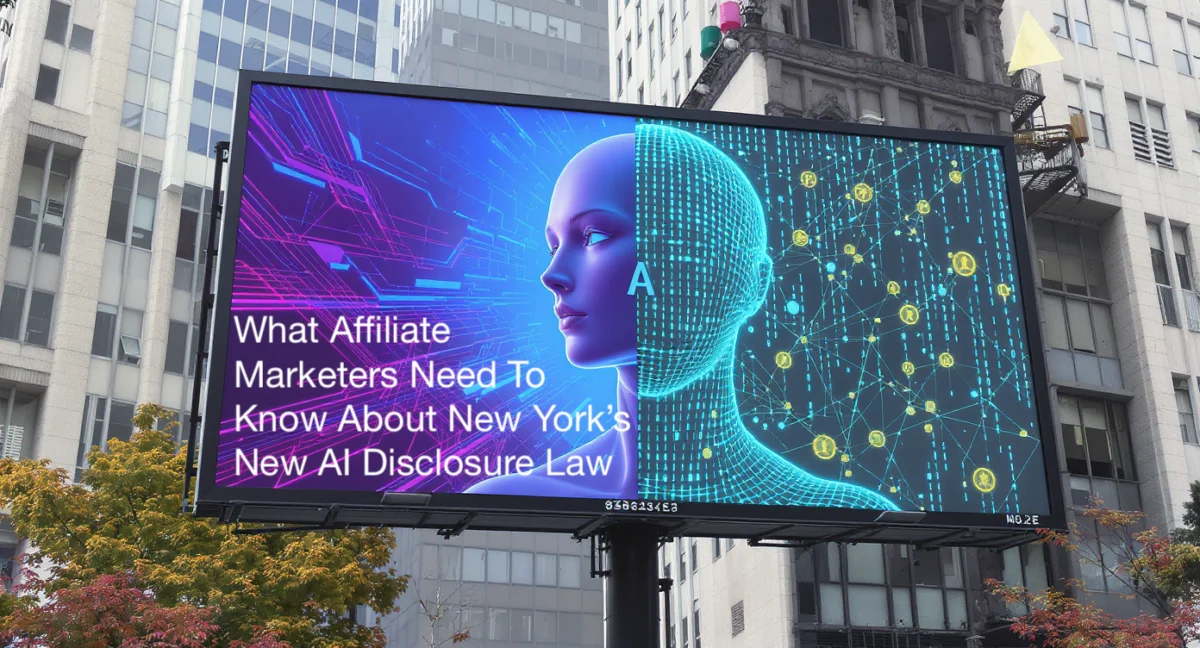
The rapid evolution of generative artificial intelligence has transformed the landscape of digital advertising, offering brands unprecedented creative capabilities. However, with this technological leap comes a complex web of regulatory challenges. As of December 11, 2025, New York State has taken a decisive step toward transparency, enacting legislation that fundamentally alters how AI-generated human likenesses can be used in commercial advertising.
For digital marketers, affiliate networks, and brand agencies, this is not merely a technical update; it is a significant shift in legal liability. As New York leads the charge in regulating "synthetic performers," industry stakeholders must prepare for a new era of mandatory disclosure, potential civil penalties, and rigorous internal auditing.
Main Facts: Understanding the Synthetic Performer Mandate
At the heart of the new New York legislation (S.8420-A/A.8887-B) is a clear requirement for transparency. The law mandates a "conspicuous disclosure" whenever a commercial advertisement distributed within New York features a "synthetic performer."
Defining the "Synthetic Performer"
The statute defines a synthetic performer as a digitally created asset—generated or modified by AI or sophisticated algorithms—that mimics a human performer. Crucially, this applies to audiovisual or visual performances where the character is not a recognizable, identifiable natural person. If a brand uses an AI-generated spokesperson that appears to be a real human but was synthesized in a digital laboratory, the law applies.
The Requirement of Conspicuousness
The law does not mandate specific phrasing, but it sets a high bar for implementation. The disclosure must be "conspicuous." This means it cannot be hidden in a footer, obscured by fine print, or relegated to a "Terms and Conditions" page that users rarely read. It must be prominent, unavoidable, and clearly noticeable to the average consumer viewing the advertisement.
Chronology: The Road to Implementation
The timeline for this legislative shift is aggressive, leaving little room for complacency among marketing teams.
- December 11, 2025: Governor Kathy Hochul signs S.8420-A/A.8887-B into law, establishing the first-of-its-kind transparency framework for synthetic media in commercial advertising.
- December 2025 – May 2026: The "Grace Period." While the law is officially on the books, advertisers are given time to audit their creative pipelines, update contractual agreements with influencers and AI vendors, and integrate disclosure mechanisms into their workflows.
- June 2026: The official compliance deadline. From this point forward, any commercial advertisement containing a synthetic performer distributed to New York consumers must include the required disclosures or risk immediate civil penalties.
Supporting Data and Financial Implications
The financial stakes for non-compliance are significant. The law is designed to be self-enforcing through the threat of escalating civil penalties:
- First Violation: $1,000 fine.
- Subsequent Violations: $5,000 per instance.
In the world of high-volume digital advertising, where a single campaign might reach millions of impressions across dozens of platforms, these fines can aggregate with terrifying speed. Furthermore, the "cost" of non-compliance extends beyond the civil penalties. Brands face the prospect of litigation, negative PR, and potential intervention from state attorneys general.
The Right of Publicity Parallel
It is also critical to note that this AI disclosure law is accompanied by an enhanced right of publicity statute (S.8391/A.8882). This law addresses the unauthorized use of "deceased personalities." If a brand uses AI to create a "digital replica" of a deceased person without the express consent of their estate, they face statutory damages of $2,000 or a share of the profits—whichever is greater—plus the threat of punitive damages.
Official Responses and Regulatory Tensions
The passage of this law occurred against a backdrop of national policy friction. President Trump recently signed an executive order aimed at fostering U.S. AI innovation, which notably includes language intended to preempt state-level regulations that might conflict with federal policy.
Legal experts, such as Richard B. Newman, an eCommerce attorney at Hinch Newman LLP, point out that this sets up a potential "preemption battle." While New York has established these rules, there is an ongoing question of how federal courts will reconcile state-level disclosure mandates with federal initiatives that prioritize a more permissive, innovation-first environment. Despite this, for the immediate future, businesses operating in New York must treat these state laws as binding.
Implications for Digital Marketers and Agencies
The transition to this new regulatory environment requires a multi-faceted approach. Agencies, influencers, and brands can no longer operate under the "move fast and break things" philosophy that characterized the early adoption of AI.
1. Auditing Creative Pipelines
Companies must implement an internal audit process. Before any AI-generated asset is cleared for distribution, legal teams should determine:
- Does this asset qualify as a "synthetic performer"?
- Is the disclosure sufficiently "conspicuous" based on the medium (e.g., video vs. static image)?
- Does the disclosure remain visible across different device screen sizes?
2. Contractual Liability Shifts
Agencies and brands must revisit their vendor agreements. If an AI vendor provides an asset that leads to a violation, the contract should clearly define who bears the liability. Furthermore, influencer marketing agreements must now include strict provisions regarding the use of AI tools, ensuring that creators understand their disclosure obligations under New York law.
3. Understanding Exclusions
The law is not a blanket prohibition. It provides necessary carve-outs for:
- Expressive Works: Motion pictures, television, documentaries, and video games are generally exempt, provided the synthetic performer is used consistently with the nature of the work.
- Translation Tools: AI used strictly for language localization is excluded.
- Distributors: There is a narrow exemption for certain media platforms that merely publish or distribute the advertisements, though this should be reviewed carefully by counsel to ensure the platform’s conduct does not cross into the "creation" or "production" of the ad.
4. Strategic Legal Consultation
Given the nuances of the law—such as what constitutes "actual knowledge" of a synthetic performer—marketers should engage with counsel experienced in FTC and state-level regulatory defense. Understanding how these rules apply to first-party versus third-party marketing campaigns is essential to mitigating the risk of class-action litigation.
Conclusion: The Path Forward
New York’s latest legislative effort serves as a bellwether for the rest of the United States. As other states monitor the efficacy of these rules, it is highly probable that we will see a patchwork of similar AI disclosure laws emerge.
For the digital marketing industry, the message is clear: transparency is the new currency of trust. While the integration of AI allows for rapid content scaling and innovative personalization, it must be balanced with a commitment to consumer clarity. By proactively adopting these disclosure standards, brands can not only avoid the stiff penalties associated with the new law but also build long-term credibility with a public increasingly concerned about the authenticity of the content they consume online.
As the June 2026 deadline approaches, the most successful brands will be those that view these regulations not as a barrier to innovation, but as a framework for responsible, sustainable digital growth.
Disclaimer: This article is provided for informational purposes only and does not constitute legal advice. Readers should consult with qualified legal counsel regarding their specific business practices and regulatory compliance needs. This content may be considered attorney advertising.