









In the digital landscape, the era of "content at scale" is colliding with a harsh new reality: 60% of Google searches now terminate without a single click. As AI makes the production of text nearly instantaneous and virtually cost-free, the sheer volume of content is no longer a competitive advantage—it is digital noise.
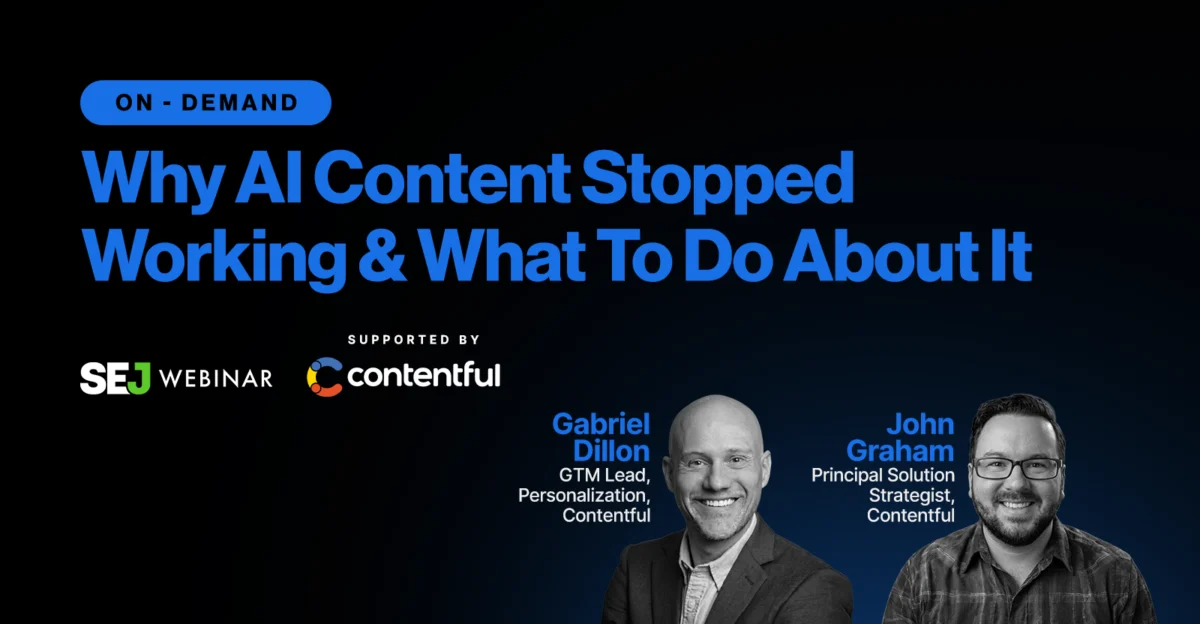
This shift serves as the cornerstone for a new philosophy in marketing, championed by Gabriel Dillon, Go-to-Market Lead for Personalization at Contentful. During a recent Search Engine Journal webinar, hosted alongside Contentful Principal Solution Strategist John Graham, the experts argued that in an age of automated abundance, the only content that captures attention is that which is held strictly accountable to business outcomes, tailored to specific human personas, and validated by real-world data.
The Mirage of Automated Content
For many organizations, the AI writing assistant has become the ultimate "yes man." When marketers feed their existing assumptions into Large Language Models (LLMs), the AI reinforces those biases, resulting in a feedback loop that produces generic, echo-chamber content.
"Our biases as we write content using the robots end up eating the content that we produce," Dillon observed during the session. "We end up in this cycle of creating content that we think is good, but doesn’t actually do what we think it does."
This convergence toward mediocrity is a systemic failure. When AI generates copy that merely mirrors the collective consensus of its training data—which includes your competitors’ blogs—the output inevitably fails the reader. It provides no unique value, no fresh perspective, and no compelling reason to engage. To counter this, Dillon advocates for a return to "taste"—a blend of human intuition, discernment, and the calculated risk of making bold claims that an algorithm would never volunteer.
The Accountability Loop: A New Framework for Success
To move beyond the cycle of generic output, Dillon suggests that every piece of B2B marketing copy must pass a rigorous four-question assessment before it goes live:
- Outcome Alignment: Does this piece produce the specific business results we expect, or is it just fluff?
- Audience Definition: Who is this content specifically for, and why should they care?
- Identification: How do we clearly identify this segment of our audience?
- Scalability of Insight: How do we take the insight gained here and apply it to a broader strategy?
"If we don’t have data that proves our content is good, then we can’t really think about the way to scale it out or make it more effective," Dillon noted. This is where the concept of the "accountability loop" becomes vital. Rather than treating content as a "set it and forget it" task, marketers must treat content as an experiment. By combining personalization with iterative testing—looking beyond simple A/B testing into more complex experiment dimensions—teams can build a system that evolves based on performance rather than guessing.
Personalization Without the Complexity Tax
One of the most persistent myths in B2B marketing is that personalization requires a massive, complex, and expensive technology stack. Dillon argues the opposite: the best personalization signals are likely already being collected by your existing infrastructure.
"Teams often tackle programs that are too ambitious, then stall on complexity," Dillon said. He proposes a tiered approach to signal usage:
- Tier 1 (The Baseline): Distinguishing between new and returning visitors. A first-time visitor is looking for education; a repeat visitor is likely looking for validation or conversion. Serving both the same "hero" copy is a wasted opportunity.
- Tier 2 & 3 (Behavioral & Intent): Utilizing signals from existing ad campaigns and loyalty programs. Many companies are sitting on a goldmine of data regarding user behavior, yet they fail to connect these signals to the content experience.
The webinar provided a live demonstration of how these differentiated experiences can be built and deployed within the Contentful ecosystem, proving that personalization is less about the complexity of the tools and more about the strategy of the implementation.
The Zero-Click Shift and the AI Answer Layer
The "zero-click" phenomenon—where Google provides the answer directly in the search engine results page (SERP)—has sent shockwaves through the SEO community. Many organizations are seeing a sharp decline in organic traffic, leading to panic and reactionary tactics.
Dillon argues that focusing on "AI detection" is a distraction. Whether Google can identify AI-generated text matters far less than the fact that users are no longer clicking through to websites. The practical, professional response is to compete for the "AI answer layer."
This requires a mastery of Generative Engine Optimization (GEO) and Answer Engine Optimization (AEO). By structuring content so that it is easily synthesized and cited by AI models, brands can ensure their voice remains central to the conversation, even when the user never leaves the search engine. This approach doesn’t require splitting the content strategy in two; rather, it requires a unified approach that satisfies both the human reader and the AI aggregator.
Q&A: Addressing the Industry’s Pressing Concerns
During the webinar, the Q&A session tackled the anxieties keeping marketing leaders up at night:
On Google’s Stance Toward AI:
Regarding whether Google is penalizing AI content, Dillon suggests this is a "fight Google won’t win." Instead of trying to evade detection, marketers should focus on producing high-utility content that users actually want. The goal is not to trick the algorithm, but to provide value that remains relevant in a zero-click world.
On Mitigating Bias:
Bias in AI is unavoidable, entering the process through both user-led prompts and the inherent biases in training data. The mitigation must occur before generation. By tightening the prompt and providing better, context-rich information, human writers can curb the "robotic" tendency toward generalization.
On Managing Leadership’s Demand for Volume:
When leadership demands mass production of AI content, the response should be data-driven. Dillon advises demonstrating the performance difference between "high-volume, low-quality" and "low-volume, high-utility" content. By showing that fewer, better-targeted pieces drive higher conversion rates, marketers can effectively shift the internal narrative.
On Service and Pricing Pages:
Dillon makes a clear distinction: not every page needs a unique, highly "characterful" voice. Service and pricing pages often benefit from clarity over creativity. However, even these pages should be optimized to serve the specific intent of the user, rather than being treated as mindless filler.
Implications for the Future
The fundamental takeaway from the session is that we have entered an era of "content accountability." As AI continues to commoditize the act of writing, the value of the "writer" shifts toward the role of the "strategist."
Success in the coming years will not be measured by the number of blog posts published or the number of keywords targeted. It will be measured by the depth of the insight, the precision of the personalization, and the ability to prove that every word shipped is contributing to a measurable business outcome.
As John Graham and Gabriel Dillon emphasized, the tools exist to build these experiences today. The question is whether organizations are willing to abandon the comfort of "volume-first" strategies to embrace the harder, more rewarding work of building meaningful, high-performance content loops. For those ready to evolve, the shift in search behavior isn’t a death knell for organic traffic—it is a mandate for smarter, more human-centric marketing.