







In an era where artificial intelligence and cloud computing are no longer merely auxiliary tools but the backbone of national infrastructure, government agencies and regulated industries face a profound paradox. They are under immense pressure to modernize and adopt cutting-edge AI capabilities, yet they are simultaneously bound by stringent mandates regarding data residency, operational autonomy, and geopolitical security.
For leaders in government, critical infrastructure, and highly regulated sectors, the priority has shifted: the goal is no longer just "cloud adoption," but "sovereign adoption." Microsoft is addressing this challenge head-on with an evolved strategy for its Sovereign Cloud, designed to provide a flexible continuum of control that allows organizations to innovate without compromising the rigorous requirements of their most sensitive operations.
Main Facts: A Continuum of Control
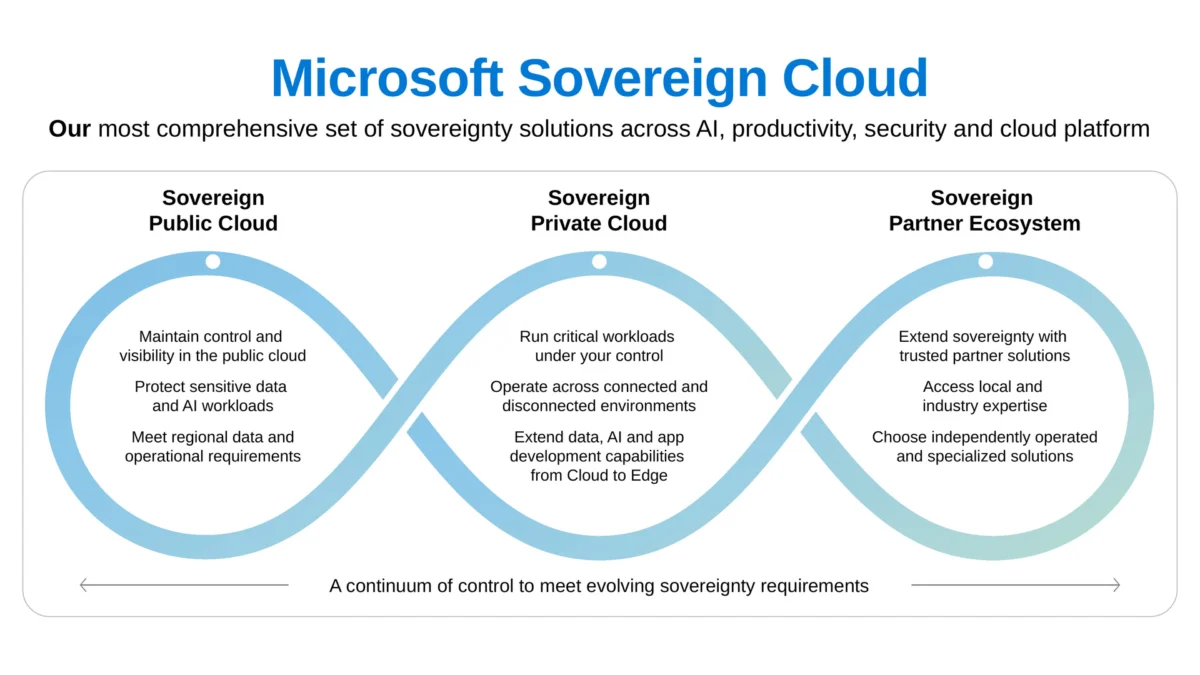
Microsoft’s latest strategy moves away from the "one-size-fits-all" deployment model, acknowledging that every workload—from a public-facing portal to a classified national security system—carries a unique risk profile. The Microsoft Sovereign Cloud is now structured around a three-pillar "continuum of control":
- Sovereign Public Cloud: Designed for organizations that require the scale and innovation of Azure but demand additional transparency, residency controls, and operational safeguards.
- Sovereign Private Cloud: Built on Azure Local, this pillar extends cloud capabilities directly into customer-operated environments, enabling both connected and disconnected operations for mission-critical systems.
- Sovereign Partner Ecosystem: A collaborative network of national clouds, independent operators, and specialized technology partners that provide localized expertise and distinct ownership models, such as Bleu in France and Delos in Germany.
By integrating these pillars, Microsoft allows organizations to treat digital sovereignty as a granular strategy rather than a binary choice. An organization can run non-sensitive workloads on the public cloud while maintaining highly sensitive AI models and data within a physically isolated, customer-controlled private environment.
Chronology of Sovereign Evolution
The journey toward this comprehensive sovereign framework has been marked by a series of strategic milestones:
- Initial Launch (Previous Year): Microsoft first introduced the Microsoft Sovereign Cloud, signaling a departure from standard commercial offerings to address the specific needs of public sector and regulated customers.
- Expansion of Governance: Following the launch, the company focused on building practical, tangible capabilities, including enhanced data residency tools and stronger operator-access controls.
- The Ignite Milestone: At Microsoft Ignite, the company unveiled its next stage, including the public preview of the Sovereign Control Panel and the general availability of GitHub Enterprise Local and Foundry Local.
- Ongoing Implementation: The current phase involves a phased rollout of advanced security features, such as the Production Touch Ledger and the integration of Data Guardian oversight in the EU and EFTA regions.
Supporting Data and Technical Capabilities
The technical underpinnings of this strategy are designed to provide both security and, crucially, the demonstrability of that security.

Enhanced Visibility and Access Control
The new Sovereign Control Panel acts as the command center for sovereignty. It provides a unified view of an organization’s sovereignty posture, allowing IT leaders to identify gaps and risks in real-time. Complementing this, Microsoft has introduced:
- Just-in-Time Access and Customer Lockbox: Providing granular control over who can access environments and when.
- Data Guardian: A landmark feature for EU and EFTA customers, introducing oversight by trusted local partners for remote engineer access.
- Production Touch Ledger: A tamper-evident record-keeping system that ensures every interaction with a production environment is audited and immutable.
Hardware-Level Security
For organizations that cannot trust shared hardware, the general availability of External Key Management with Azure Managed HSM is a breakthrough. It allows customers to retain the root encryption keys on their own hardware, physically outside of Microsoft’s infrastructure. Furthermore, Azure Confidential Computing and Confidential Virtual Machines ensure that data is encrypted in memory and protected by hardware-based isolation, even during the processing phase.
Localized Application Lifecycle
Recognizing that sovereignty extends to the tools developers use, Microsoft has expanded the "Local" ecosystem:
- Foundry Local: Provides an expanded model catalog (including open-source and partner models) for local inference and agentic retrieval.
- Microsoft 365 Local: Now in preview, this brings SharePoint and Exchange functionality to locally operated servers, keeping productivity data behind the customer’s firewall.
Official Responses and Executive Perspective
Douglas Phillips, who leads global engineering for Microsoft’s specialized, sovereign, and private clouds, frames this initiative as a response to the "amplification effect" of AI.
"AI is amplifying both the opportunity and the impact of technology choices," Phillips noted. "As AI systems and agents interact with sensitive data, business processes, and essential infrastructure, they expand the security considerations organizations need to manage. We are providing a continuum of control so organizations can innovate with cloud and AI while maintaining the operational authority their most important workloads require."
Microsoft’s commitment is also echoed by its partner ecosystem. By enabling partners like Accenture, Dell, HPE, and NVIDIA to co-innovate, Microsoft is decentralizing the cloud experience, ensuring that regional regulatory nuances—whether in European data laws or local infrastructure standards—are met with localized solutions rather than generic global ones.

Implications for the Future
The implications of Microsoft’s sovereign strategy are far-reaching, affecting both the geopolitical landscape and the future of digital innovation.
Regulatory Compliance and Geopolitics
As nations move toward greater digital protectionism, Microsoft’s model provides a pathway for global technology firms to operate within national borders. By allowing for "disconnected operations" and localized management, Microsoft is mitigating the risk of service disruption caused by geopolitical instability or network failure. This "resilience by design" is becoming a prerequisite for any organization managing critical national assets.
The Democratization of AI
Perhaps the most significant implication is the democratization of AI for the public sector. Previously, agencies might have shied away from generative AI due to fears of data leakage or loss of control. With tools like Foundry Local and Confidential Virtual Machines, these organizations can now leverage state-of-the-art AI models—grounded in their own, locally hosted data—without that data ever leaving their premises.
A New Standard for Enterprise IT
This shift marks the end of the era where "cloud" meant "someone else’s computer." The new reality is a hybrid model where the customer dictates the terms of the infrastructure. As Microsoft continues to evolve its Sovereign Cloud, the standard for enterprise technology will no longer be determined solely by cost or performance, but by the ability to balance the two with absolute, transparent control.
In conclusion, Microsoft is successfully positioning itself as the bridge between the high-octane pace of AI innovation and the cautious, security-first requirements of the public sector. By providing a clear, audit-ready, and technologically advanced path to sovereignty, they are ensuring that the digital future remains under the control of those who serve the public good.