By Swati Khandelwal
September 17, 2026
Executive Summary & Main Facts
In a critical security advisory published on Wednesday, maintainer NLnet Labs announced the immediate release of Unbound DNS resolver version 1.26.1. This emergency update addresses a severe, high-severity heap overflow vulnerability—tracked as CVE-2026-81642—alongside eight other security flaws affecting every iteration of the software released prior to this version.
The most alarming flaw, CVE-2026-81642, resides within Unbound’s Domain Name System Security Extensions (DNSSEC) validator. According to maintainers and security analysts, an unauthenticated remote attacker who controls a malicious zone can trigger this heap overflow by simply forcing a vulnerable resolver to query their domain. If successfully exploited, the vulnerability can lead to a Denial of Service (DoS) and, under specific conditions, pave the way for Remote Code Execution (RCE).
While automated monitoring and early threat intelligence feeds—including entries by the Cybersecurity and Infrastructure Security Agency (CISA)—indicated "none" for active exploitation at the time of the advisory, security teams worldwide are scrambling to update their infrastructure. The potential for arbitrary code execution via core network infrastructure components makes this a top-tier priority for enterprise network administrators, Internet Service Providers (ISPs), and cloud architects.
Alongside the primary DNSKEY flaw, version 1.26.1 resolves a total of nine distinct vulnerabilities. Among them is CVE-2026-82717, a heap corruption bug tied to Canonical Name (CNAME) synthesis reported independently by security researcher Ben Morris of Anthropic. Like the primary vulnerability, CVE-2026-82717 can potentially result in remote code execution under specific system configurations and compiler settings.
Technical Deep Dive: Mechanics of the Flaws
To understand why these vulnerabilities pose such a substantial risk, security practitioners must examine how Unbound parses complex DNS payloads.

The DNSSEC Validator Heap Overflow (CVE-2026-81642)
Rated with a vendor-assigned critical severity score of 9.1 (CVSS 4.0 vector), CVE-2026-81642 does not require user interaction or prior authentication. The attack vector is strictly network-based.
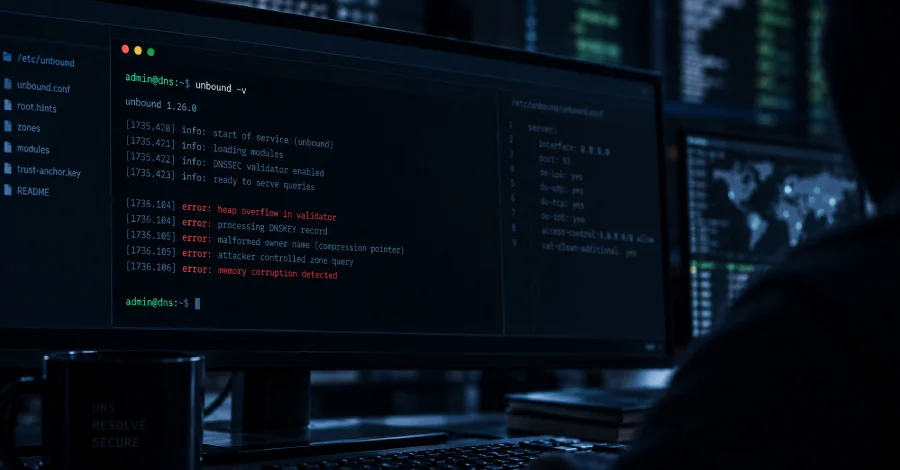
The flaw itself is triggered during the validation phase when Unbound processes a malicious DNSKEY record. Specifically, the vulnerability manifests when the owner name of the record is dynamically crafted as a compression pointer pointing directly into the record’s own internal data structures. When the validator attempts to digest this malformed input, memory bounds checks fail, resulting in a heap overflow.
While NLnet Labs officially classifies the primary impact as a Denial of Service—typically crashing the resolver daemon—the integrity of the heap is sufficiently compromised to allow sophisticated threat actors to inject and execute arbitrary machine code, provided they can reliably manipulate memory layouts through specially crafted payloads.
Heap Corruption in CNAME Synthesis (CVE-2026-82717)
Disclosed by Ben Morris of Anthropic and rated as a high-severity threat, CVE-2026-82717 targets the way Unbound handles CNAME synthesis during upstream responses. Under certain system environments and compilation options, the improper handling of memory allocations during synthesis leads to severe heap corruption. Like its counterpart, this flaw exposes systems to potential remote code execution pathways.
Comprehensive Overview of the Nine Fixes in Version 1.26.1
The 1.26.1 release notes detail a sweeping security audit that addresses nine unique vulnerabilities, ranging from critical heap overflows to low-severity protocol weaknesses. The complete breakdown of these flaws, their affected versions, trigger conditions, and impacts is compiled in the table below:
| CVE Identifier | Severity | Affected Versions | Trigger Condition / Prerequisite | Impact |
|---|---|---|---|---|
| CVE-2026-81642 | Critical | Up to and including 1.26.0 | An attacker controlling a malicious zone who successfully lures a vulnerable resolver into querying it. | Denial of Service, potential Remote Code Execution. |
| CVE-2026-82717 | High | Up to and including 1.26.0 | CNAME synthesis occurring during an upstream response under specific system/compilation configurations. | Denial of Service, potential Remote Code Execution. |
| CVE-2026-81634 | High | Up to and including 1.26.0 | Processing a 255-length query name paired with a massive TCP response originating from a compromised nameserver or tampered stream. | Denial of Service. |
| CVE-2026-77955 | Medium | 1.13.2 up to and including 1.26.0 | Zones utilizing zonemd-check: yes situated below—but not directly at—a configured trust anchor. |
Denial of Service; temporary window where altered zone data is served prior to validation completion. |
| CVE-2026-78227 | Medium | 1.22.0 up to and including 1.26.0 | Unbound instances compiled with the --with-libngtcp2 flag and having quic-port explicitly configured. |
Denial of Service. |
| CVE-2026-80225 | Medium | Up to and including 1.26.0 | A sustained, high-volume stream of distinct, uncached names channeled over a single TCP or DoT (DNS-over-TLS) connection. | Service degradation and resource exhaustion. |
| CVE-2026-82720 | Medium | 1.12.0 up to and including 1.26.0 | Instances built using --with-libnghttp2 with https-port enabled (impact characterized by NLnet Labs as limited). |
Denial of Service. |
| CVE-2026-85501 | Medium | Up to and including 1.26.0 | Malicious zones leveraging algorithmic complexity attacks known as ReTrap (including TagTrap, DelegationTrap, NsecTrap, and AdditionalTrap). | Severe service degradation. |
| CVE-2026-77860 | Low | 1.20.0 up to and including 1.26.0 | Abuse of the serve-expired code path, bypassing countermeasures originally engineered to mitigate the DNSBomb vector. |
Potential participation in pulsing DoS amplification campaigns. |
Configuration and Default Behavior Changes
In addition to patching code-level memory handling bugs, the ReTrap vulnerability remediation (CVE-2026-85501) introduces a notable shift in Unbound’s default behavior. Going forward, the configuration parameter val-clean-additional is set to off by default. Consequently, Unbound will no longer waste processing cycles attempting to validate DNSSEC data located within the additional section of a standard DNS response unless explicitly overridden by the administrator.

Chronology of Discovery and Disclosure
The timeline surrounding the identification and remediation of these flaws highlights a highly collaborative and efficient vulnerability disclosure lifecycle between independent researchers and software maintainers:
- August 11, 2026: Researchers Yuqi Qiu and Xiang Li, operating out of Nankai University’s AOSP Lab, officially discover the core DNSSEC validation issue. They report their findings directly to NLnet Labs in accordance with coordinated vulnerability disclosure standards.
- August 12, 2026: Recognizing the gravity of the report, NLnet Labs engineers develop a functional mitigation patch within 24 hours of notification.
- August 13, 2026: The original reporters at Nankai University test and verify the effectiveness of the developer patch.
- May to August 2026 Context: It is vital to note that this flaw is entirely distinct from earlier security updates. For instance, the critical validator bug patched back in May 2026 under CVE-2026-33278 (addressed in version 1.25.1) and subsequent summer updates like version 1.25.2 (released in July) and version 1.26.0 (released on August 4) do not protect against this newly disclosed chain of exploits. Every version from the earliest releases up to and including 1.26.0 remains vulnerable.
- September 17, 2026: Following thorough internal regression testing and preparation of complementary security fixes (such as Ben Morris’s CNAME patch), NLnet Labs publicly drops the advisory alongside the official production release of Unbound 1.26.1.
- September 18, 2026: Major Linux distributions begin processing the updates. Debian’s security tracker notes that while version 1.26.1-1 has been marked as fixed in unstable distributions, stable and testing branches (including Bookworm, Trixie, and Forky) remain exposed pending downstream package maintainer approval.
Official Responses and Maintainer Policy
NLnet Labs operates under a strict security policy dictating that for vulnerabilities that have not yet achieved broad public awareness, the organization aims to deploy comprehensive software patches "in the order of weeks." True to this commitment, the five-week turnaround from private verification in mid-August to the mid-September public drop kept critical vulnerability details out of the hands of opportunistic cybercriminal syndicates during the preliminary patching window.
However, maintainers have emphasized that no specific configuration can completely shield legacy versions. Unlike certain software packages where disabling a particular feature renders a vulnerability inert, NLnet Labs has issued no explicit guidance stating that disabling DNSSEC validation eliminates exposure to CVE-2026-81642. Therefore, patching remains the only viable defensive posture.
Implications, Mitigation, and Remediation Strategies
The discovery of multiple RCE-capable vectors in a widely deployed recursive DNS resolver underscores the fragility of core internet plumbing. Because DNS sits at the foundational layer of virtually all modern network communication, a successful, widespread campaign targeting unpatched Unbound instances could result in catastrophic cascading failures, widespread traffic hijacking, or enterprise-wide denial of service.
Immediate Action Items for Administrators
- Upgrade Immediately: The definitive remediation is upgrading to Unbound 1.26.1. Source tarballs complete with cryptographic checksums and PGP signatures, alongside pre-compiled Windows binaries and installers, are available directly via the NLnet Labs Download Portal.
- Apply Source Patches (If Upgrades Are Impractical): For enterprise environments where an immediate binary upgrade cycle introduces unacceptable downtime or testing delays, NLnet Labs has made standalone patches for CVE-2026-81642 and CVE-2026-82717 available. These patches have been verified to apply cleanly and function properly against version 1.26.0 source trees.
- Monitor Downstream Package Repositories: Linux system administrators utilizing Debian, Ubuntu, Red Hat, or other enterprise distributions should closely monitor their respective security trackers to apply official package updates as soon as backported builds clear quality assurance pipelines.
- Audit Configuration Files: Review current Unbound configurations to ensure that experimental or resource-heavy features—such as aggressive QUIC or HTTPS ports (
--with-libngtcp2/--with-libnghttp2)—are strictly limited to trusted interfaces, reducing the attack surface against secondary flaws like CVE-2026-78227 and CVE-2026-82720.
As threat actors routinely scan the global IPv4 and IPv6 space for newly disclosed network-facing vulnerabilities, system administrators are urged to treat the deployment of Unbound 1.26.1 as an urgent, mission-critical operational requirement.