










By Cybersecurity Desk | October 2026
1. Main Facts: The Anatomy of the GhostAction Resurgence
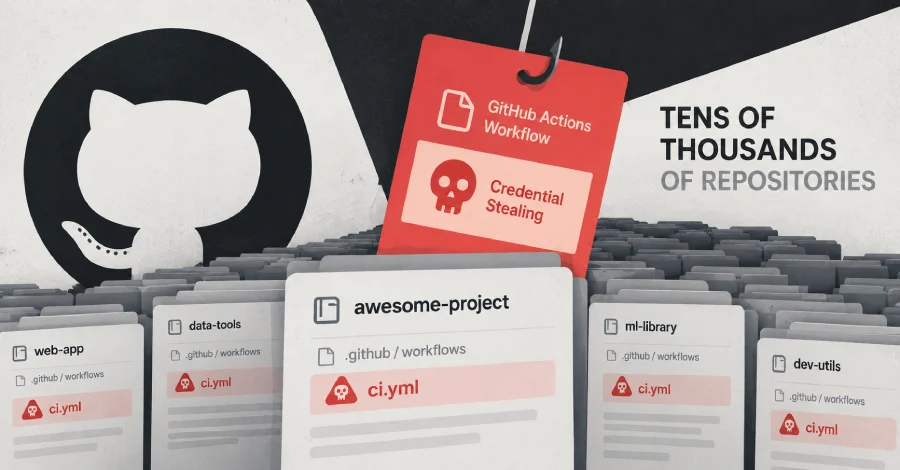
A massive, highly coordinated credential-theft and software supply chain campaign known as GhostAction has escalated its operations, compromising high-profile open-source maintainer accounts to covertly inject malicious GitHub Actions workflows into hundreds of repositories.
According to threat intelligence findings released by cybersecurity firms StepSecurity and Socket, the ongoing campaign leverages compromised developer profiles to push malicious automated routines—disguised as routine security audits—into active codebases. The ultimate objective of these threat actors is the large-scale exfiltration of sensitive development credentials, cloud infrastructure keys, CI/CD secrets, and proprietary API tokens.
The vector of choice for the GhostAction collective involves abusing legitimate CI/CD (Continuous Integration/Continuous Deployment) automation pipelines. By taking over accounts belonging to respected open-source contributors, the attackers can bypass standard gatekeeping mechanisms, committing malicious code directly to main branches, tags, and associated forks without immediately raising suspicion.
Key facets of the campaign include:
- The Attack Mechanism: Injected workflows are typically named
security-audit.ymlorgithub_actions_security.yml. Designed to execute on standard events likeworkflow_dispatchor unfiltered pushes across any branch or tag, these workflows perform deep recursive checkouts (fetch-depth: 0) of the repository’s entire Git history. - Data Exfiltration: Harvested materials are transmitted over plain HTTP directly to a hard-coded external IP address (
193.32.204[.]199). - Scope of Compromise: The malicious scripts sweep working trees and complete version-control timelines for thousands of distinct secret patterns, ranging from cloud environment variables and database passwords to cryptographic keys and artificial intelligence service tokens.
2. Chronology: A Timeline of Escalating Breaches
The GhostAction campaign is not an isolated incident but part of a persistent, evolving threat landscape targeting software supply chains. Understanding the chronology of the attacks reveals a methodical expansion in both scale and operational tempo.

September 2025: The Initial Discovery
GhostAction first materialized on the cybersecurity radar in September 2025. Initial analyses by firms monitoring software supply chain integrity revealed that attackers had successfully compromised 327 distinct GitHub users, impacting 817 repositories. During this foundational wave, the campaign successfully exfiltrated 3,325 unique secrets, including high-value distribution tokens for major package managers like PyPI (Python Package Index), npm (Node Package Manager), and DockerHub.
August 31 – September 30, 2026: The Late-Summer Surge
Activity surged again as GitGuardian reported a coordinated wave of attacks between late August and late September 2026. During this period, the threat actors pushed malicious workflows into 772 public repositories belonging to 373 separate GitHub users and organizations. Notably, during this phase, researchers observed threat actors expanding beyond simple credential harvesting; in at least one notable incident on August 30, 2026, attackers altered the repository kuafuai/DevOpsGPT to embed an XMRig cryptocurrency miner directly into the project’s Docker container images.
October 2026: High-Profile Maintainer Takeovers
The campaign reached a critical operational milestone in October 2026, shifting toward high-visibility targets within the open-source ecosystem:
- Takashi Kitao: On October 7, 2026, starting at 13:20 UTC, the account of Takashi Kitao—author of the popular 18,400-star game engine pyxel—was leveraged to push the malicious workflow to 27 repositories.
- Henry Wu (
henrywoo): Just eight hours later, the account of Henry Wu, original author of Uber’s athenadriver, was compromised. In a compressed, highly efficient 16-minute window between 21:10 and 21:26 UTC, the attackers used Wu’s credentials to push the exact same malicious workflow to 318 distinct repositories. - Broad Ecosystem Impact: By October 9, 2026, monitoring data compiled by Socket indicated that more than 500 individual GitHub accounts had committed the malicious workflow to tens of thousands of repositories since the beginning of the month.
3. Supporting Data: The Expanding Threat Matrix
The danger posed by GhostAction stems from the sheer volume and sensitivity of the data its automated scripts are programmed to capture. Security researchers analyzing the recovered workflow configurations have cataloged an exhaustive list of targeted assets.
The Targeted Secret Categories
The malicious workflows do not merely search active environment files; they inspect the repository’s historical commit logs, making previously deleted or rotated secrets vulnerable if they ever shared space within the project’s version control history. The injected scripts systematically target 2,577 distinct secret patterns, which include:
- Cloud & Infrastructure Credentials: Amazon Web Services (AWS) access keys, Google Cloud Platform (GCP) and Firebase credentials, Microsoft Azure secrets, and generic SSH private keys.
- Container & Package Registries: DockerHub, GitHub Container Registry (GHCR), npm, and PyPI publishing tokens.
- Database & Server Access: Database connection strings, FTP credentials, and remote server access keys.
- Developer Collaboration & CI/CD Tokens: GitHub and GitLab personal access tokens, along with bot tokens for communication platforms such as Telegram, Slack, and Discord.
- AI & SaaS Integration Keys: Modern infrastructure relies heavily on third-party intelligence APIs. The campaign specifically hunts for API keys associated with OpenAI, Anthropic, OpenRouter, and Cloudflare services.
Reconnaissance and Footprinting
Beyond direct credential theft, security analysts from Socket noted a sinister tactical choice by the campaign operators: every single execution of the malicious workflow returns a unique repository identifier back to the command infrastructure, regardless of whether any high-value secrets were successfully discovered. This operational design ensures that the threat actors maintain an up-to-date, comprehensive map of reachable execution contexts and vulnerable infrastructure, independent of immediate financial or credential-stuffing payoffs.

4. Official Responses and Industry Guidance
As details of the GhostAction resurgence circulate within the developer community, cybersecurity organizations, repository hosts, and independent researchers have scrambled to issue clear remediation guidelines and defensive recommendations.
Immediate Action for Maintainers and Developers
Security researchers emphasize that any organization or developer utilizing open-source components—particularly those managing software pipelines—must act decisively. The official recommendations include:
- Audit Repositories for Rogue Workflows: Development teams should immediately inspect their GitHub repositories for the presence of either
security-audit.ymlorgithub_actions_security.yml, specifically checking commit histories dating back to August 31, 2026. - Assume Complete Compromise: If either workflow file is discovered within a project, the affected organization must operate under the assumption that all local secrets, history logs, and environment variables have been compromised.
- Revoke and Rotate: Compromised GitHub tokens, cloud API keys, and deployment credentials must be immediately revoked and systematically rotated across all connected environments.
- Purge Malicious Workflows: Administrators must scrub the malicious workflow files from all active branches, tags, and historical references where feasible.
The Hidden Danger of Forks and Downstream Mirrors
A particularly insidious aspect of the GhostAction campaign involves the weaponization of repository forks. For instance, the compromise of Henry Wu’s account infected 279 individual forks in the henrywoo namespace, each carrying the rogue workflow file.
Socket experts warn that downstream forks represent a severe vector of risk:
"If Actions are enabled, subsequent pushes can trigger credential harvesting. Downstream forks are also at risk if they inherit the malicious workflow, either when newly created or by synchronizing with the affected upstream repository. Private forks and downstream mirrors are the most exposed, because private repositories are where committed credentials are actually found."
5. Implications for the Open-Source Ecosystem
The GhostAction campaign serves as a glaring wakeup call regarding the inherent vulnerabilities of modern software supply chains. Open-source software (OSS) forms the foundational bedrock of global enterprise technology, yet it relies heavily on the goodwill, voluntary labor, and personal security hygiene of individual maintainers.

The Single Point of Failure
When an attacker bypasses traditional perimeter defenses simply by compromising a single developer’s personal account credentials—via phishing, reuse of leaked passwords, or endpoint malware—the trust model of the entire ecosystem fractures. A developer who maintains a popular utility library may inadvertently become an unwitting vector for thousands of downstream corporate consumers.
Moving Toward Zero Trust in CI/CD
In the wake of GhostAction, industry analysts argue that organizations can no longer blindly trust third-party GitHub Actions or automated workflows without strict pinning, provenance verification, and least-privilege permission models. Security practices must evolve to include:
- Granular Token Permissions: Restricting GitHub Actions tokens from accessing broader organizational secrets unless explicitly required.
- Secret Scanning Enforcement: Utilizing automated scanning tools that prevent secrets from ever entering codebases or git histories in the first place.
- Enhanced Maintainer Authentication: Mandating robust hardware-based multi-factor authentication (MFA) and passkeys for all maintainers holding write access to open-source and enterprise repositories.
As the GhostAction campaign continues to probe the boundaries of open-source infrastructure, the developer community faces an urgent mandate to fortify its automated pipelines against adversaries who treat developer workflows as their primary hunting grounds.



