







The evolution of a modern enterprise is rarely linear, but for manufacturing unicorn Zetwerk, the path has been defined by a deliberate, aggressive shift from a digital aggregator to an industrial powerhouse. Founded in 2018 by Amrit Acharya, Srinath Ramakkrushnan, and Vishal Chaudhary, the company has officially transitioned from the private startup ecosystem to the public markets, listing on Friday, October 23, 2026.
While the listing did not command the astronomical premiums associated with some of the more speculative "new-age" tech stocks of previous years, the valuation is secondary to the deeper narrative: Zetwerk is testing the viability of a "full-stack" manufacturing model in a country that is positioning itself as the next global hub for industrial supply chains.
A Chronology of Transformation: From Marketplace to Full-Stack Player
The seeds of Zetwerk’s current identity were sown in August 2021, when the company secured $150 million from D1 Capital Partners. This funding occurred during a historic peak for Indian startups, which collectively raised $42 billion that year. However, unlike many of its peers who used capital to burn through customer acquisition costs, Zetwerk took a different route.
Between 2021 and 2022, the company executed a series of strategic acquisitions—most notably the $39 million purchase of the US-based Unimacts. This signaled the end of its life as a simple intermediary. What began as a digital platform connecting vendors and suppliers evolved into a comprehensive manufacturing play.
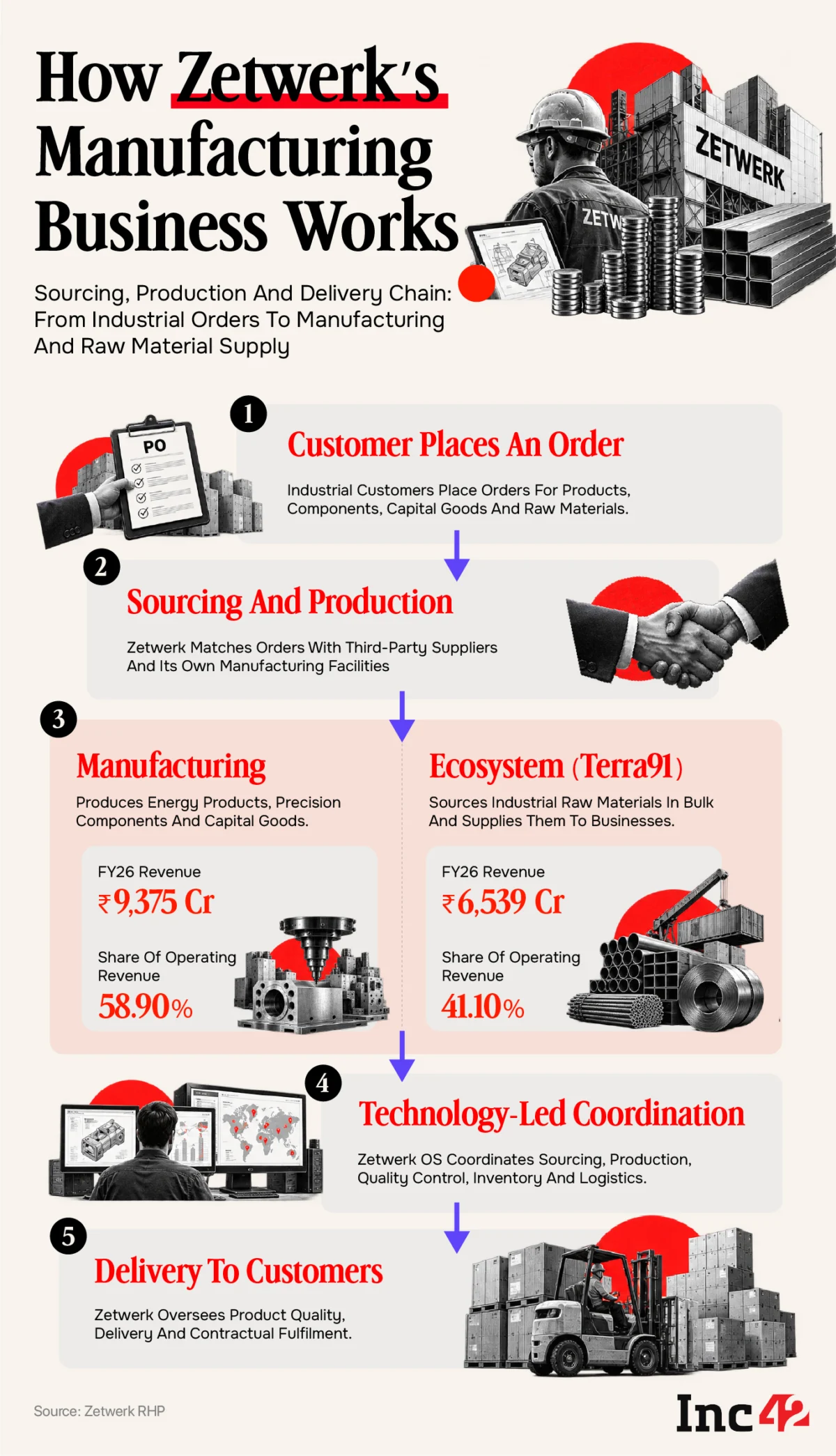
Today, Zetwerk no longer positions itself as a mere marketplace. Its pitch to the public markets is that of a vertically integrated operator managing the entire lifecycle of industrial production: from raw material procurement and complex manufacturing specifications to quality control and final delivery. This transition was necessary to capture the burgeoning demand for localized component sourcing, particularly in sectors like electric vehicles (EVs) and precision-machined parts, where supply chain reliability is paramount.

Financial Performance: The Paradox of Growth and Losses
The financial data for Fiscal Year 2026 (FY26) reveals a company experiencing rapid scaling, yet grappling with the fundamental friction of the manufacturing sector.
Revenue and Net Losses
Zetwerk’s revenue from operations reached INR 15,913 Cr, a robust 40.4% increase over the previous fiscal year’s INR 11,331 Cr. However, this top-line expansion was overshadowed by a widening consolidated net loss, which ballooned to INR 1,606 Cr from INR 371 Cr in FY25.
Crucially, this loss is not purely operational; it includes an exceptional charge of INR 836 Cr from continuing operations and a significant INR 453 Cr impairment charge tied to the discontinuation of its civil infrastructure business. While the impairment represents a strategic pruning of underperforming assets, it underscores the volatility inherent in heavy-industry pivots.
The Margin Reality
For investors, the most critical metric remains the Adjusted EBITDA. At INR 421 Cr, the company’s Adjusted EBITDA margin sits at a thin 2.65%. In a business model that relies on massive procurement volumes, such low margins leave little room for error. Any fluctuation in commodity prices or logistics costs can threaten the company’s path to profitability.
The Two Pillars: Manufacturing and Ecosystem
To understand Zetwerk’s financial engine, one must distinguish between its two primary revenue streams.

1. The Manufacturing Segment
Accounting for 58.9% of total revenue (INR 9,375 Cr), this segment is the heart of the company’s value proposition. Zetwerk fulfills orders across energy products, precision-machined components, and capital goods. Its earnings are determined by the "take rate"—the difference between the price charged to the client and the cost of third-party supplier payments and materials.
The manufacturing segment reported a standalone EBITDA of INR 565 Cr, translating to a margin of 6.03%. This segment is where the "full-stack" promise holds the most weight, as the company leverages both its own facilities and a curated network of vendors to meet high-precision requirements.
2. The Ecosystem Segment (Terra91)
Operating under the brand name Terra91, this segment focuses on the aggregation and distribution of industrial raw materials such as steel, copper, aluminum, and bitumen. Contributing 41.1% of revenue (INR 6,539 Cr), this business functions on a high-volume, low-margin basis. With an Adjusted EBITDA of roughly INR 81 Cr, its margin is a razor-thin 1.24%. This segment is highly susceptible to market volatility in global commodity pricing, making it a "volume-first" play rather than a "margin-first" play.
Operational Realities: The Burden of Procurement
Zetwerk’s business model is fundamentally procurement-heavy. In FY26, the company spent INR 9,880 Cr on the purchase of stock-in-trade and INR 3,964 Cr on materials consumed. Together, these two line items accounted for nearly 86% of the company’s total expenses of INR 16,142 Cr.
This concentration of expenditure highlights the "principal" nature of the business. Unlike a pure-play marketplace that simply takes a commission, Zetwerk acts as the principal contractor. It assumes the risk for sourcing, quality, and delivery, which allows it to report the full value of goods as revenue but exposes it to the full brunt of supply chain inflation and inventory carrying costs.

Cash Flow and the Working Capital Trap
Perhaps the most significant red flag for analysts is the cash flow cycle. While the company’s manufacturing order book grew by 43.4% to INR 12,370 Cr, this growth has yet to translate into liquid cash. Net cash outflow from operating activities widened to INR 682 Cr in FY26, up from INR 386 Cr the previous year.
The "Order Book Paradox" is evident here: while a large order book provides revenue visibility, it demands significant upfront investment. Zetwerk must pay for raw materials and logistics long before the customer settles the invoice. As the company scales, the requirement for working capital increases exponentially, tying up cash in trade receivables and inventory. In FY26, trade receivables increased by INR 336 Cr, further highlighting the difficulty of converting order growth into cash flow.
Official Stance and Strategic Future
Cofounder and CEO Amrit Acharya has previously emphasized that Zetwerk does not view its income as a simple "commission." Instead, the company frames its revenue as a "take rate for services," where rates fluctuate based on the technical complexity of the work performed.
To combat thin margins and cash flow pressure, the company is pivoting toward higher-value work:
- Original Design Manufacturing (ODM): In FY26, ODM contracts accounted for 13.93% of the manufacturing segment’s Gross Merchandise Value (GMV). By taking on design and engineering responsibilities, Zetwerk can command higher margins and build "stickier" customer relationships.
- In-House Capacity: While the company continues to leverage a third-party vendor network, it is incrementally increasing its own manufacturing footprint. As of June 2026, it operated 26 facilities across four countries. Reducing reliance on external capacity is expected to improve control over production timelines and quality, though it increases the company’s fixed-cost burden.
Implications: Can Scale Solve the Margin Problem?
As Zetwerk embarks on its journey as a public entity, the central question remains: Is scale sufficient to transform thin margins into robust profitability?

The company’s strategy hinges on the belief that by controlling the procurement side of the business, it can eliminate middle-men markups and optimize logistics through AI and tech-driven supply chain management. However, the sheer size of its inventory-related expenses suggests that any systemic inefficiency will be magnified by the company’s scale.
For investors, the next few quarters will be a litmus test. They will look for signs that Zetwerk can successfully transition away from low-margin commodity trading in the "Ecosystem" segment toward more complex, high-margin precision manufacturing. Furthermore, the company must prove that it can manage its working capital cycle to prevent the "growth-induced cash crunch" that has historically plagued manufacturing scale-ups.
Zetwerk has successfully built a sprawling industrial infrastructure in an remarkably short time. Whether that infrastructure can generate the consistent, cash-generative returns required by the public markets is the defining challenge of its next phase of growth. The transition from a startup to a public industrial bellwether is rarely smooth, but for Zetwerk, the industrial floor is set, and the production line is running. Now, the company must prove that it can deliver the margins, not just the volume.