










By Daniel Imber, Cybersecurity Writer, Specops Software — An Outpost24 Company
Main Facts
The operational model of the UK’s National Health Service (NHS) relies heavily on a fluid, highly mobile workforce. Staff members frequently transition between different hospital trusts, administrative departments, clinical wards, and remote healthcare settings. Furthermore, the reliance on locums, agency nurses, and temporary contractors introduces a continuous stream of transient workers who often arrive on-site with little advance notice. While this high degree of flexibility is indispensable for maintaining uninterrupted patient care and adapting to shifting local healthcare demands, it introduces profound structural vulnerabilities into identity and access management (IAM).
Chief among these vulnerabilities is the modern IT service desk. Across all industries, the service desk functions as a prime target for cybercriminals because help desk agents possess the administrative authority to execute password resets and unlock compromised accounts. In critical infrastructure sectors like healthcare, successfully exploiting these support workflows can grant threat actors unauthorized access to core clinical networks, electronic patient record (EPR) systems, and administrative databases—ultimately threatening patient safety and hospital operations.
Compounding this human-element risk is the rapid weaponization of artificial intelligence by sophisticated threat actors. According to intelligence assessments from the UK’s National Cyber Security Centre (NCSC), cybercriminals are actively leveraging generative AI and machine learning tools to supercharge their reconnaissance and social engineering campaigns. Rather than inventing entirely novel attack vectors, bad actors are using AI to radically refine and scale traditional intrusion techniques. Consequently, healthcare organizations face a landscape where malicious actors can effortlessly mimic organizational terminology, exploit locum onboarding gaps, and execute hyper-realistic vishing (voice phishing) and spear-phishing attacks against overworked service desk staff.
Chronology of the Evolving Service Desk Threat Landscape
To understand how healthcare IT security arrived at its current precarious juncture, it is helpful to trace the evolution of service desk exploitation alongside the development of digital identity management in the public sector:
- Early 2000s – The Perimeter Era: Healthcare cybersecurity focused almost exclusively on physical network perimeters and perimeter firewalls. Service desks verified user identities using rudimentary, static methods, such as asking for a caller’s employee ID number, date of birth, or home address. Social engineering was largely crude and localized.
- The 2010s – The Mobile Workforce and Cloud Adoption: As NHS trusts began digitizing medical records and adopting cloud-based administrative platforms, staff mobility surged. Clinicians demanded access to systems across multiple hospital sites. Concurrently, data breaches across retail, financial, and public sectors began leaking vast amounts of personal identifiable information (PII) online, rendering traditional knowledge-based authentication (KBA) increasingly obsolete.
- 2020 to 2022 – The Remote Work Paradigm Shift: The COVID-19 pandemic forced a massive decentralization of healthcare administration. Service desks experienced an unprecedented surge in remote password reset requests. Threat actors quickly capitalized on this friction, utilizing targeted spear-phishing and phone-based social engineering to exploit help desks experiencing high ticket volumes and reduced operational oversight.
- 2023 to Present – The Generative AI Boom: The public democratization of large language models (LLMs) and advanced audio synthesis tools transformed the threat landscape. Threat actors transitioned from poorly phrased phishing emails and easily detectable voice impersonations to polished, context-aware communications and convincing AI voice clones. Service desks became primary battlegrounds for credential harvesting, forcing organizations to rethink static verification models entirely.
- Looking Forward (2025–2027 Projections): The NCSC projects that AI-driven reconnaissance and automated social engineering will continue to escalate through 2027. Healthcare organizations are racing to implement robust, multi-factor authentication (MFA) enforcement at the help desk tier to preempt systemic compromises before attackers can scale their operations further.
Supporting Data and Threat Analysis: The AI Multiplier Effect
The vulnerability of healthcare service desks is deeply intertwined with the sheer volume of personnel churn and the technical sophistication of modern cyber threats. Detailed analysis from cybersecurity researchers highlights several converging risk factors:
1. The Proliferation of Stolen Personal Data
Knowledge-based authentication (KBA)—such as asking users for their mother’s maiden name, first pet, or date of birth—has been thoroughly compromised by the modern data economy. Billions of personal records circulate on underground forums. An attacker targeting an NHS employee can easily scrape professional networking sites, public social media profiles, and historical data breach dumps to compile an exhaustive dossier on a target. When a help desk agent asks routine verification questions, the attacker can answer with absolute confidence.
2. AI-Powered Phishing and Contextual Engineering
Historically, service desk agents could spot malicious inquiries or phishing tickets by identifying grammatical errors, unnatural phrasing, or a lack of familiarity with internal organizational structures. Generative AI has eliminated these telltale signs. Attackers can now generate flawless, context-aware communications that accurately cite internal NHS reporting lines, specific departmental acronyms, and regional healthcare policies.
Furthermore, AI can automate reconnaissance. An attacker can map out an entire hospital trust’s hierarchical structure in minutes, identifying which staff members are currently acting as locums or moving between sites. This specific contextual knowledge allows scammers to fabricate entirely plausible narratives during service desk interactions—such as claiming to have lost a mobile device while temporarily deployed to a new clinical ward.
3. Voice Cloning and the Rise of Advanced Vishing
Phone-based social engineering (vishing) remains one of the most effective ways to manipulate human gatekeepers. The introduction of AI voice cloning has drastically lowered the barrier to entry for high-end audio impersonation. By harvesting a mere three to five seconds of public audio—sourced from a local news interview, a recorded conference presentation, an online medical seminar, or a corporate video—threat actors can synthesize a remarkably accurate digital clone of an NHS clinician or senior manager.
Crucially, service desk calls possess inherent operational vulnerabilities that play directly into the strengths of voice cloning:
- Brevity: Help desk interactions are typically brief, fast-paced, and transactional.
- Imperfect Audio Quality: Poor mobile connections, background hospital noise, and compressed VoIP codecs naturally distort audio, masking minor artifacts introduced by AI voice generators.
- Lack of Personal Familiarity: Help desk agents service hundreds of distinct users a week and rarely know every staff member personally, making it difficult for them to independently verify the acoustic nuances of a caller’s voice.
Official Responses and Regulatory Guidance
In light of these escalating threats, cybersecurity authorities and regulatory bodies have intensified warnings regarding the security posture of critical national infrastructure (CNI) service desks.
The National Cyber Security Centre (NCSC) has consistently emphasized that identity verification is the foundational pillar of enterprise security. In its recent threat reports, the agency underscores that defensive strategies must evolve beyond perimeter defenses and endpoint detection to secure the administrative choke points of the organization. When an attacker successfully subverts a service desk agent, they bypass advanced technical controls like endpoint detection and response (EDR) agents because they are logging in with legitimate, verified credentials.
Healthcare regulatory frameworks across the UK and Europe increasingly mandate strict identity verification controls, particularly when dealing with systems containing sensitive patient data. Traditional reliance on informal approvals, peer verification ("I know Dave from accounts, just reset his password"), or memory-based security questions no longer satisfies modern auditing standards. Security leaders within NHS trusts are now required to demonstrate demonstrable, auditable proof that every identity recovery action is preceded by robust, uncompromised verification checks.
Implications for Healthcare Operations and Patient Safety
The intersection of workforce mobility, AI-driven social engineering, and weak service desk verification poses profound implications for the healthcare sector:
1. Compromise of Electronic Patient Records (EPR)
If an attacker successfully manipulates a service desk agent into resetting credentials for a clinician or administrative staff member, they gain unfettered access to internal networks. Within healthcare environments, this access often extends to electronic patient record systems. Unauthorized actors can exfiltrate sensitive medical data, alter patient histories, or deploy ransomware that encrypts critical operational databases, directly jeopardizing patient safety and delaying emergency treatments.

2. Operational Paralysis and Administrative Bottlenecks
Conversely, overcorrecting security without the right tooling can cause severe operational friction. If an NHS trust institutes cumbersome, manual verification processes that lack technological backing, service desk queues grow exponentially. Clinicians waiting on password resets are left unable to access patient charts, leading to delayed clinical workflows, frustrated staff, and compromised healthcare delivery. Security must therefore be achieved without introducing unnecessary administrative drag.
3. The Compliance and Reputational Toll
A successful cyber intrusion originating from a service desk compromise carries severe regulatory penalties and reputational damage. Public sector organizations operate under intense public scrutiny. Data breaches resulting from avoidable social engineering vulnerabilities erode public trust and invite rigorous investigations by data protection authorities.
Technological Solutions: Securing the Service Desk with Specops
To bridge the gap between operational mobility and ironclad security, healthcare organizations are turning to specialized identity management platforms designed to eliminate human error and social engineering vulnerabilities at the help desk.
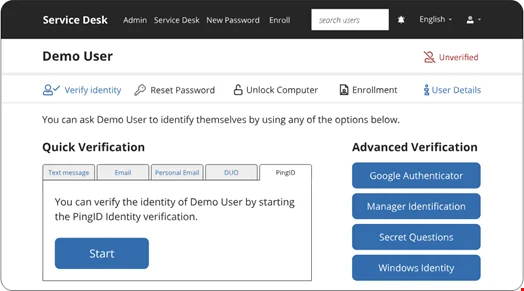
One leading solution in this space is Specops Secure Service Desk, a tool engineered to replace vulnerable, knowledge-based verification checks with forced, multi-factor user authentication. Rather than relying on an agent’s subjective judgment or static security questions, the platform enables help desk personnel to authenticate callers using existing multi-factor authentication (MFA) factors and third-party identity services—including Duo, Okta, PingID, and Symantec VIP.
Key Architectural Benefits for Healthcare Environments:
- No Complex End-User Enrolment Required: Specops Secure Service Desk leverages existing identity data already stored within Active Directory or Microsoft Entra ID. This eliminates the friction of forcing busy, mobile NHS workers to enroll in entirely new security systems.
- Extensive MFA Factor Support: The platform supports more than 15 different MFA factors. This flexibility is vital for healthcare environments, accommodating diverse user types—including permanent clinicians, remote administrators, and temporary locums who may not have standard corporate mobile devices issued to them.
- Secure Execution of High-Risk Actions: Once a caller has been rigorously verified through automated MFA challenges rather than vulnerable verbal questioning, agents can securely execute sensitive workflows, such as password resets and account unlocks, with minimal risk of social engineering bypass.
- Enhanced Audit Trails and SIEM Integration: Specops Secure Service Desk protects agent-facing access with MFA and exports detailed verification events via the Specops Event API. This provides security operations center (SOC) teams and IT auditors with a clear, immutable audit trail. Verification activity can be seamlessly piped into Security Information and Event Management (SIEM) and analytics workflows, ensuring compliance and rapid threat detection.
Conclusion
The modern healthcare workforce is defined by its mobility and agility. As NHS staff seamlessly transition across trusts, departments, and clinical settings to deliver vital patient care, their supporting IT infrastructure must adapt accordingly. However, this operational flexibility must never come at the expense of robust identity verification.
With cybercriminals increasingly weaponizing artificial intelligence, deepfakes, and automated reconnaissance to exploit human gatekeepers, traditional service desk safeguards—such as knowledge-based questions and informal approvals—are dangerously obsolete. Healthcare organizations must adopt automated, MFA-driven verification processes that secure the digital frontline without impeding clinical workflows. By implementing specialized solutions like Specops Secure Service Desk, NHS trusts can effectively neutralize social engineering threats, protect sensitive patient data, and maintain operational integrity in an increasingly complex digital landscape.



