








By Cybersecurity Investigative Desk
Published: March 2025
Some of the most devastating cyber-attacks in recent corporate history did not begin with a sophisticated zero-day exploit, a maliciously crafted payload dropped via phishing email, or a complex cryptographic breach. They started with something far more mundane, routine, and fundamentally human: a phone call or chat message to the internal IT service desk.
In the crosshairs of modern threat groups, the corporate help desk has evolved from an operational necessity into the primary soft underbelly of enterprise security. Leading this charge is the notorious cyber-crime collective known as Scattered Spider (also tracked as UNC3944, Octo Tempest, or Storm-0874). By mastering the art of human manipulation, these threat actors have routinely weaponized legitimate account-recovery workflows to bypass multi-million-dollar defense architectures, turning corporate support staff into unwitting accomplices.
Main Facts: The Anatomy of Service Desk Compromise
The core thesis of modern adversary tactics is simple: Why hack when you can log in?
When an organization invests heavily in robust perimeter defenses, Endpoint Detection and Response (EDR) solutions, next-generation firewalls, and context-aware Multi-Factor Authentication (MFA), its security posture appears formidable. However, these technical controls often operate downstream from the identity lifecycle management process.
Scattered Spider targets the administrative upstream: the service desk.
- The Core Vector: Attackers bypass advanced technical login controls by exploiting the human-operated processes used to provision or recover credentials.
- The Impersonation Playbook: Utilizing exhaustive Open Source Intelligence (OSINT), threat actors gather detailed corporate telemetry on specific employees—ranging from organizational charts and direct reports to internal jargon, office locations, and personal histories.
- The Weaponized Recovery: Armed with this data, operatives manufacture high-urgency crises (e.g., lost smartphones, broken hardware tokens, locked accounts ahead of board meetings) to trick support agents into resetting passwords or swapping MFA registration devices.
- The SSO Pivot: Once a service desk agent validates the fake user and issues a temporary credential or registers a new MFA token, the attacker gains full control of the account, leveraging Single Sign-On (SSO) environments to cascade access across cloud and on-premise infrastructure.
Chronology: A History of Help Desk Heists
The evolution of Scattered Spider’s service desk campaigns highlights an escalating threat landscape that has repeatedly caught major global enterprises off guard.
- Late 2022 to Early 2023 — The Rise of UNC3944: Security researchers began tracking a loosely organized collective of predominantly young, English-speaking hackers moving away from traditional ransomware encryption toward extortion through data theft, SIM swapping, and persistent social engineering.
- September 2023 — The MGM Resorts and Caesars Incidents: Scattered Spider launched high-profile attacks against major Las Vegas hospitality and entertainment giants. By calling corporate help desks, the threat actors successfully impersonated employees, prompting service desk staff to reset credentials. This breach crippled hotel operations, slot machines, and digital room keys, resulting in tens of millions of dollars in losses and severe reputational damage.
- The 2025 UK Retailer and Co-op Attacks: Moving aggressively across international borders, Scattered Spider expanded its targeting to prominent UK retail brands and cooperative societies. These incidents demonstrated that the vector was not a localized anomaly but a globally exportable playbook capable of breaching well-defended corporate IT ecosystems.
Supporting Data and Regulatory Warnings
Intelligence agencies and cybersecurity authorities have issued repeated warnings regarding the vulnerability of identity verification pipelines.
According to advisory documentation from the U.S. Cybersecurity and Infrastructure Security Agency (CISA) alongside the Federal Bureau of Investigation (FBI)—specifically CISA Advisory AA23-320A—Scattered Spider relies heavily on "vishing" (voice phishing) and SMS phishing to target IT help desks. The advisory notes that threat actors systematically exploit weak fallback authentication mechanisms, convincing agents to transfer MFA tokens or rebind authentication methods to attacker-controlled devices.
Furthermore, post-incident investigations reveal critical systemic failures in how corporate identity is verified:
- The "Knowledge-Based" Flaw: Traditional identity checks rely on static data points that are easily scraped from public profiles (LinkedIn, corporate websites, data broker leaks)—such as employee ID numbers, manager names, office locations, and historical project details.
- The Speed-Over-Security Metric: Service desk Key Performance Indicators (KPIs) often prioritize ticket resolution speed and customer satisfaction (CSAT) scores over rigorous verification, unintentionally incentivizing agents to clear authentication blocks quickly under pressure.
Official Responses and Parliamentary Scrutiny
The gravity of these attacks has drawn the attention of lawmakers and regulatory bodies worldwide.
When major organizations fall victim to identity-based compromises, corporate leadership is increasingly required to account for security deficiencies before legislative committees. For instance, following high-profile disruptions affecting UK consumer cooperatives, Chief Digital and Information Officers (CDIOs) have been forced to give direct testimony to parliamentary panels.
During hearings regarding the Co-op cyber incident, CDIO Rob Elsey detailed how attackers meticulously mimicked real colleagues, successfully navigated multi-part security challenge questions, and coerced support personnel into executing a full account reset. Within roughly one hour of the authorized reset, malicious anomalous activity was flagged—illustrating the narrow window between unauthorized access and total system compromise.
Regulators are increasingly signaling that organizations must treat identity recovery infrastructure with the same regulatory seriousness applied to core data protection and perimeter security. Failing to implement cryptographic or out-of-band verification for account resets is increasingly viewed as a failure of basic organizational governance.
Implications for Enterprise Security
The success of Scattered Spider underscores a profound philosophical shift required in modern defensive strategy. Organizations must realize that security is only as strong as its weakest administrative verification loop.
1. The Fallacy of "Strong" Logins
An organization can mandate hardware-backed FIDO2/WebAuthn security keys for every daily login. However, if an attacker can call the help desk and register a new, attacker-owned SMS or app-based MFA token by answering three easily researched security questions, the hardware key becomes useless. The account recovery process effectively acts as a master key that bypasses all underlying authentication safeguards.

2. The Cultural Challenge of Service Desks
Help desk personnel are naturally conditioned to be helpful. Their primary charter is to assist distressed employees who are locked out of critical systems. Retraining them to adopt a "zero-trust until proven otherwise" mentality requires fundamentally altering operational metrics, removing the pressure to rush through identity verification in the name of efficiency.
How to Secure Your Service Desk Against Social Engineering
Mitigating the threat posed by Scattered Spider and copycat syndicates requires a blend of process overhaul, cultural realignment, and technological enforcement. Organizations must adopt a comprehensive defense-in-depth strategy for identity lifecycle management:
- Eliminate Static Knowledge-Based Verification: Stop using easily searchable personal data (date of birth, home address, manager’s name, employee ID) as verification vectors.
- Implement Out-of-Band Secondary Checks: Require any high-privilege action—such as password resets or MFA device re-enrollments—to be validated via an independent, pre-established secure channel (e.g., an encrypted push notification to a verified corporate mobile application or manager sign-off).
- Enforce Strict Cooling-Off Periods: Introduce mandatory time delays for sensitive account changes, alerting the user via secondary channels (like personal email or SMS) that an account recovery attempt is underway, giving them time to halt unauthorized changes.
- Redefine Service Desk KPIs: Shift metrics away from pure speed and volume toward security compliance and verification accuracy.
Strengthening Identity Verification with Specops Secure Service Desk
Recognizing that human training alone cannot completely eliminate social engineering risks, organizations are increasingly turning to automated software solutions designed to secure the help desk tier.
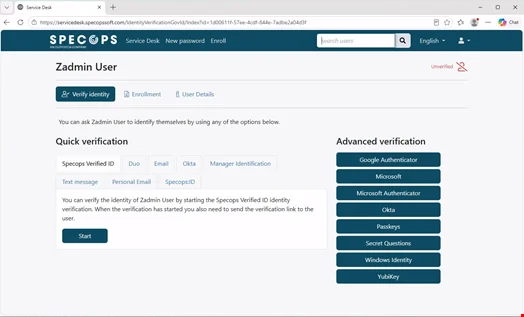
Specops Secure Service Desk is engineered precisely to address this vulnerability. By embedding rigorous identity verification directly into password reset and account unlock requests, the platform ensures that service desk teams can cryptographically confirm whether the person asking for access is genuinely who they claim to be.
Key architectural benefits include:
- Multi-Factor Verification Before Reset: Organizations can mandate that users pass robust challenges—such as MFA prompts, directory attribute matching, or custom out-of-band authentication checks—before a request is permitted to proceed. This renders traditional social engineering tactics (like guessing static biographical data) obsolete.
- Granular Role-Based Access Controls (RBAC): Restrict which service desk personnel can execute high-risk administrative overrides, ensuring proper segregation of duties.
- Comprehensive Audit Trails: Maintain immutable logs of every password reset and authentication change request, providing compliance teams with the visibility needed for rapid incident forensics.
As threat groups like Scattered Spider continue to refine their social engineering playbooks, securing the service desk is no longer an optional IT optimization—it is an existential imperative for modern enterprise cybersecurity.