








LONDON — In a major escalation against the subterranean infrastructure fueling the Kremlin’s wartime economy, the United Kingdom has levied sweeping economic sanctions against Cryptomus, a notoriously elusive cryptocurrency payment processor. For years, financial intelligence experts and blockchain investigators have tracked Cryptomus as a primary conduit for global cybercrime, funneling illicit funds from ransomware deployments, narcotics trafficking, darknet marketplaces, and online fraud while actively helping Russian entities bypass international financial restrictions.
The October 8 sanctions target not only Cryptomus—which has operated under various corporate guises including Certa Payments and Xeltox Enterprises—but also a cluster of parallel virtual payment networks, notably VexPay, TokenSpot, and the Tsunami Payments service. Under the U.K. measures, any assets held by Cryptomus within British financial institutions are immediately frozen, and U.K. companies and citizens are strictly prohibited from entering into business, virtual or otherwise, with the targeted platforms.
According to prominent blockchain analytics firm Chainalysis, these sanctions are a decisive blow directed squarely at the financial plumbing sustaining illicit Russian networks. However, the designation is more than just a localized regulatory penalty; it represents a rare and aggressive maneuver by a Western superpower against an operational nexus that has masterfully exploited jurisdictional loopholes, shell corporations, and even fictional regulatory bodies in disputed territories to launder billions of dollars.
2. Chronology of a Chameleonic Operation: From Vancouver Shells to Russian Hubs
To understand how Cryptomus managed to evade global enforcement for years, it is necessary to retrace its evolution through a labyrinth of corporate renamings, regulatory evasion, and shifting digital storefronts.
- 2022: Cryptomus emerges onto the digital landscape, quickly establishing itself as a favored payment processor for dozens of Russian cryptocurrency exchanges and underground websites hawking specialized cybercrime-as-a-service tools.
- December 2024: An investigative deep-dive titled "How Cryptocurrency Turns to Cash in Russian Banks" exposes how Cryptomus shared a modest Vancouver, Canada address with dozens of other foreign currency dealers and money transfer businesses—none of which maintained a physical presence at the location. At this time, its parent company, Certa Payments, is tied to a web of shell entities.
- Late 2025: Following mounting international scrutiny, Canada levies a record-breaking CAD $176 million fine against Cryptomus for severe anti-money laundering (AML) violations. Rather than folding, the platform appeals the penalty, institutes cursory "know your customer" (KYC) rules that cause its primary transaction volume to crater, and launches a parallel, no-KYC operational offshoot dubbed "Heleket."
- April 2026: Data compiled by blockchain intelligence firm TRM Labs reveals that since its inception in 2022, Cryptomus has processed upwards of $7 billion in total transaction volume. This staggering sum includes financial flows linked to child sexual abuse material (CSAM) vendors, international terrorist financing networks, and human trafficking operations.
- October 8, 2026: The United Kingdom officially issues economic sanctions against Cryptomus, VexPay, TokenSpot, and Tsunami Payments. Within hours, support agents and automated Telegram bots for Cryptomus and Heleket begin frantically responding to customer inquiries by announcing that the platform is suddenly and indefinitely unable to process transactions.
3. Supporting Data and Scale of Illicit Activity
The sheer volume of illicit capital moving through Cryptomus and its derivatives has stunned compliance officers and blockchain sleuths alike. While traditional crypto mixers have long been viewed as the primary engines for washing dirty digital currency, platforms like Cryptomus operated on an entirely different industrial scale, functioning as legitimate-seeming payment gateways for illegal enterprises.
In a comprehensive analytical blog post published alongside the U.K. sanctions, Chainalysis outlined the alarming trajectory of these platforms:
"Cryptomus and Heleket have emerged as major payment hubs for illicit activity. Together, these services received more illicit funds across tracked categories than the mixers in our dataset, and the number of illicit counterparties surged to more than 900 in a single month in late 2025."
TRM Labs corroborated this assessment, noting that Cryptomus acted as an indispensable clearinghouse for a diverse cross-section of the global underworld. Ransomware gangs deployed Cryptomus payment gateways to automatically process extortion demands from victims, while darknet vendors utilized the platform to seamlessly convert volatile digital assets into fiat currency routed through Russian financial institutions.

Even when regulatory pressure forced the platform to implement tokenistic KYC protocols—which initially depressed its metrics—the operators simply pivoted. By spinning up Heleket as a sister platform, they maintained an uninterrupted pipeline for high-risk and outright criminal clientele seeking anonymity.
4. Official Responses and Industry Analysis
The international response to the U.K. sanctions has highlighted a stark realization among financial crime experts: traditional monetary fines are often utterly useless against transnational cryptocurrency operations, whereas targeted state-level sanctions can be lethal.
Richard Sanders, a veteran blockchain analyst and investigator who spent months painstakingly mapping Cryptomus’s convoluted payment infrastructure and interacting undercover with its customer base, emphasized the vital distinction between penalties and sanctions. Following the U.K.’s announcement, Sanders took to LinkedIn to underscore why this regulatory step changes the game:
"A fine doesn’t stop a cryptocurrency payment processor from processing payments. Sanctions kill the operation. The distinction matters."
Sanders noted that Canada’s landmark CAD $176 million fine, while historic in its nominal value, was ultimately unenforceable and uncollectible given that the corporate entities behind Cryptomus possessed minimal tangible assets within Canadian borders and easily dissolved or mutated into new brands like Heleket.
Furthermore, Sanders highlighted a groundbreaking geopolitical milestone embedded within this enforcement action: this is the first known instance of a "Five Eyes" nation (comprising Australia, Canada, New Zealand, the United Kingdom, and the United States) sanctioning a cryptocurrency operation formally incorporated within another Five Eyes jurisdiction.
Despite Cryptomus maintaining paper registrations in Canada and operating through North American shell setups, British authorities bypassed jurisdictional hand-wringing to choke off the network’s access to Western banking channels, effectively cutting off its life support.
5. Implications and the Phony Regulatory Web of Western Sahara
Perhaps the most bizarre and illustrative aspect of the Cryptomus saga is how the platform manufactured its perceived legitimacy. When international watchdogs or banking partners questioned the regulatory standing of Certa Payments and Cryptomus, the companies pointed to an elaborate, self-contained bureaucratic fiction.

An investigation into the corporate ownership of Cryptomus revealed that the sole shareholder of its parent company, Certa Payments, was a 25-year-old Ukrainian woman. Alongside Cryptomus, she also headed several other corporate entities, including the WS Management and Advisory Corporation.
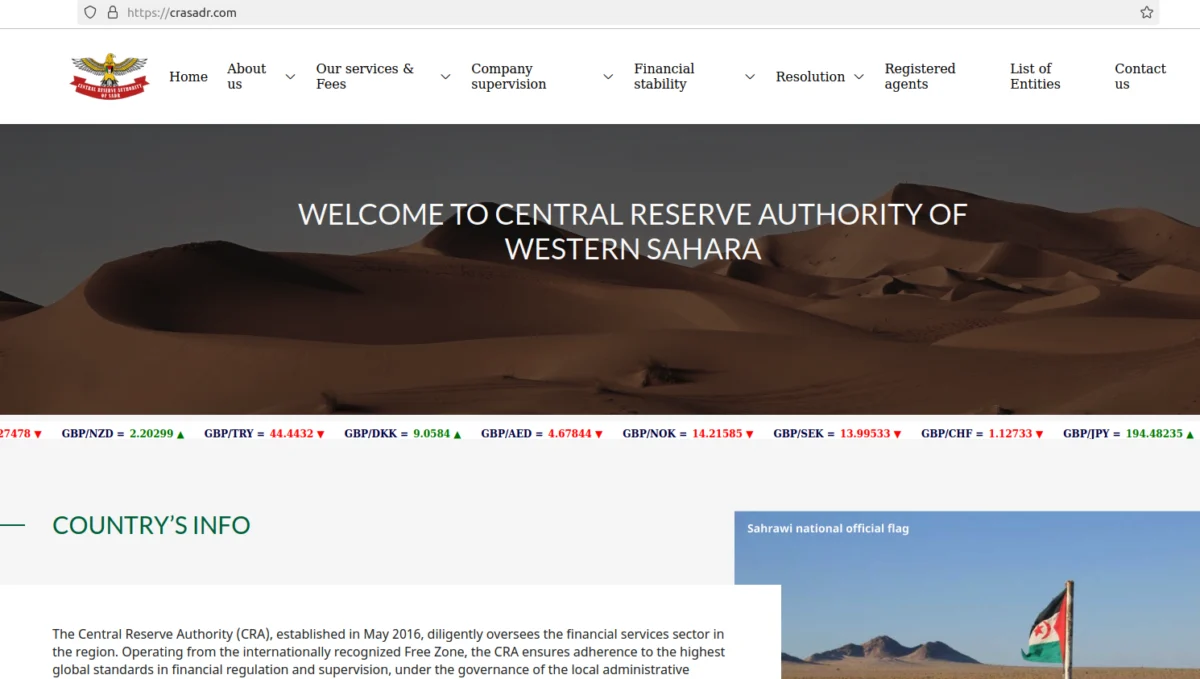
This advisory firm marketed itself aggressively as an official, exclusive regulatory body charged with issuing licenses for cryptocurrency operations, foreign exchange (forex) brokers, and online gaming businesses. However, there was a monumental catch: the regulatory jurisdiction it claimed to represent was the Western Sahara—a disputed territory in northwest Africa that lacks widespread international recognition as a sovereign nation.
The regulatory website managed by this network (crasadr.com) offered prospective high-risk financial businesses a streamlined path to bank setups, corporate formation, and legal licensing under the auspices of the Central Reserve Authority of the Western Sahara. Technical footprints left by the fraudsters exposed deeper connections; one of Certa Payments’ former web properties (certa.website) shared a physical server domain with twelve other suspicious websites, including rasd-state.ws, the digital home of this phantom central reserve authority.
By fabricating a regulatory body inside a disputed geopolitical zone, the architects of Cryptomus created a synthetic veneer of compliance that allowed them to pass basic onboarding checks with various global payment aggregators and banking partners before their underlying criminality was fully unmasked.
The Fallout and Future Outlook
As the dust settles on the October 8 sanctions, the immediate operational collapse of Cryptomus and Heleket—evidenced by their frozen Telegram support bots and abrupt transaction halts—demonstrates the devastating efficacy of coordinated international pressure.
Yet, cybersecurity and financial intelligence experts warn that the hydra-like nature of modern cybercrime infrastructure means new iterations will inevitably rise from the ashes. The closure of Cryptomus serves as both a landmark victory for Western regulatory enforcement and a sobering reminder of the boundless ingenuity of transnational criminal networks operating in the shadows of the digital economy.