By [Your Name/Staff Reporter]
Published in Business & Technology Insights
For digital marketers and brand strategists, the past few years have been defined by a relentless chase: optimizing for AI visibility. After investing heavily in Generative Engine Optimization (GEO), the hard work finally pays off. When prospective buyers prompt a frontier Large Language Model (LLM) about the market, your company’s name appears in the conversation. You are officially in the running.
Then comes the pivotal, high-stakes follow-up question from the user: “Do you recommend them?”
Suddenly, the tone shifts. Instead of acting as an advocate, the AI system surfaces a handful of isolated, historical customer complaints, frames them without operational scale or context, issues a stark warning, and steers the prospective customer straight to a competitor. All those months of meticulous AI visibility work are undone in a matter of seconds, turning a hard-earned introduction into a lost opportunity.
This phenomenon—where AI systems transform from helpful guides into overly cautious critics—highlights a critical vulnerability in how modern LLMs process brand reputations. To survive and thrive in an AI-driven commercial landscape, businesses must learn how to supply models with the missing context that transforms a red flag into a complete, balanced narrative.
The Main Facts: Why AI Fails Contextual Nuance
At the core of the problem is a fundamental limitation in how frontier models process data. Makers of top-tier AI systems instruct their models to aggressively mitigate recommendation risk—particularly in high-stakes domains, sensitive consumer sectors, and YMYL (Your Money or Your Life) categories.
To avoid the liability of endorsing a flawed business, LLMs often deploy an over-correction mechanism. They scrape the web for virtually every negative review, forum post, or Better Business Bureau (BBB) complaint they can find. If any negative history exists—no matter how minor, isolated, or statistically insignificant—the AI frequently weaponizes it, issuing caution flags and advising users to look elsewhere.
The root cause of this algorithmic bias is an imbalance between the numerator and the denominator.
Consider a real-world case study examined by optimization firm AnswerShare. When evaluated by AI models, a client’s brand faced severe pushback due to a handful of public grievances. Looking closer, the company possessed more than 75 positive reviews, but also five negative reviews and two BBB complaints.
Viewed in a vacuum against a tiny pool of 20 customers, seven complaints look like a systemic red flag. However, when placed against the company’s actual operating scale—serving 35,000 customers over a 13-year history—those seven complaints represent a customer satisfaction rate of 99.98%, a metric most legacy businesses would proudly showcase.

Because the AI ingested the complaints (the numerator) without understanding the operational volume (the denominator), it misread the data, penalizing a reliable brand for standard, low-volume friction inherent in long-term commercial operations.
Chronology of a Breakthrough: The Three-Day Pivot
Recognizing that traditional SEO tactics were failing to alter how LLMs interpreted negative sentiment, researchers set out to test a hypothesis: If AI systems are given the full, unvarnished context behind a company’s complaints—including operational volume, longevity, and formal responses—would they stop warning buyers away?
The experimentation followed a strict methodology, querying frontier AI systems via APIs using neutral, unbiased prompts to eliminate sycophancy and leading questions. The timeline of the results revealed a striking capacity for AI models to correct their own assessments when properly informed:
- Day 0 (Before Added Context): Initial reputation checks across multiple LLMs routinely surfaced the small set of public complaints, framed the business as a high-risk gamble, and recommended preferred market competitors.
- Day 3 (Initial Correction): After deploying a newly engineered method of delivering brand context directly to machine crawlers, researchers observed an immediate shift. AI responses began incorporating balanced assessments, acknowledging the company’s operating history alongside historical grievances.
- Day 14 (Full Stabilization): After two weeks of continuous exposure to the complete brand narrative, 100% of the tested AI prompts resulted in direct company recommendations. While the historical complaints remained part of the discussion, they were accurately contextualized, and warning flags dropped to zero.
Supporting Data: Before and After Optimization
Empirical data gathered across multiple industries confirms that this contextual adjustment is repeatable. Below is a breakdown of a 14-day study measuring AI behavioral shifts before and after implementing edge-delivered brand context:
| Signal in the AI Answer | Without Context | With Edge Context |
|---|---|---|
| Concerns raised at all | 64.3% (27 of 42) | 100% (40 of 40) |
| Concerns given scale or context | 2.38% (1 of 42) | 100% (40 of 40) |
| Guidance that warns users away | 64.3% (27 of 42) | 0.0% (0 of 40) |
| Guidance that explicitly recommends | 23.8% (10 of 42) | 100% (40 of 40) |
Additional trials across varied, highly competitive sectors yielded identical stability. For a major regional full-service advertising agency, recommendation rates on commercial intent prompts climbed from 50% to 100% within 15 days, with zero warning flags. Similarly, a luxury boutique resort in the intensely competitive Phoenix/Scottsdale market achieved a 100% recommendation rate within 10 days of implementing the strategy.
Official Methodology: Workers, Billboards, and the Machine Layer
To solve the problem of AI misinterpretation, businesses cannot simply rely on waiting for traditional web crawlers to index deep-buried FAQ pages. Instead, advanced optimization strategies leverage the architecture of Content Delivery Networks (CDNs) through tools known as "workers."
Step 1: Deploying Edge Workers
A "worker" is a piece of code executing at the CDN edge that intelligently routes traffic—sending human users and traditional search engine bots (like Googlebot) to the visual website, while presenting specialized machine-readable files (such as llms-full.txt) directly to AI crawlers.
In testing, while standard LLM files were crawled a modest 154 times over two months, edge-deployed workers were accessed 744,566 times. This massive disparity leverages a well-documented psychological and computational principle: repetition works. Just as human consumers respond to repeated advertising exposure, frontier LLMs use repeated, high-frequency ingestion of structured data to weigh brand narratives during Retrieval-Augmented Generation (RAG).
Step 2: Constructing AI "Billboards"
By treating these edge workers as "billboards" for AI, brands can present their complete, unvarnished story to every machine crawler that visits. Rather than hiding negative information, these billboards confront public complaints head-on.
For example, if a company has historical BBB complaints regarding aggressive sales tactics by a single former employee, the billboard explicitly details the nature of the complaint, its date, the limited scope of the issue, and the concrete management actions taken (such as employee counseling and increased internal controls). When subsequent AI models ingest this data, they either drop the mention of the complaints entirely or accurately frame them as historical anomalies rather than systemic operational failures.

Addressing the "Cloaking" Concern
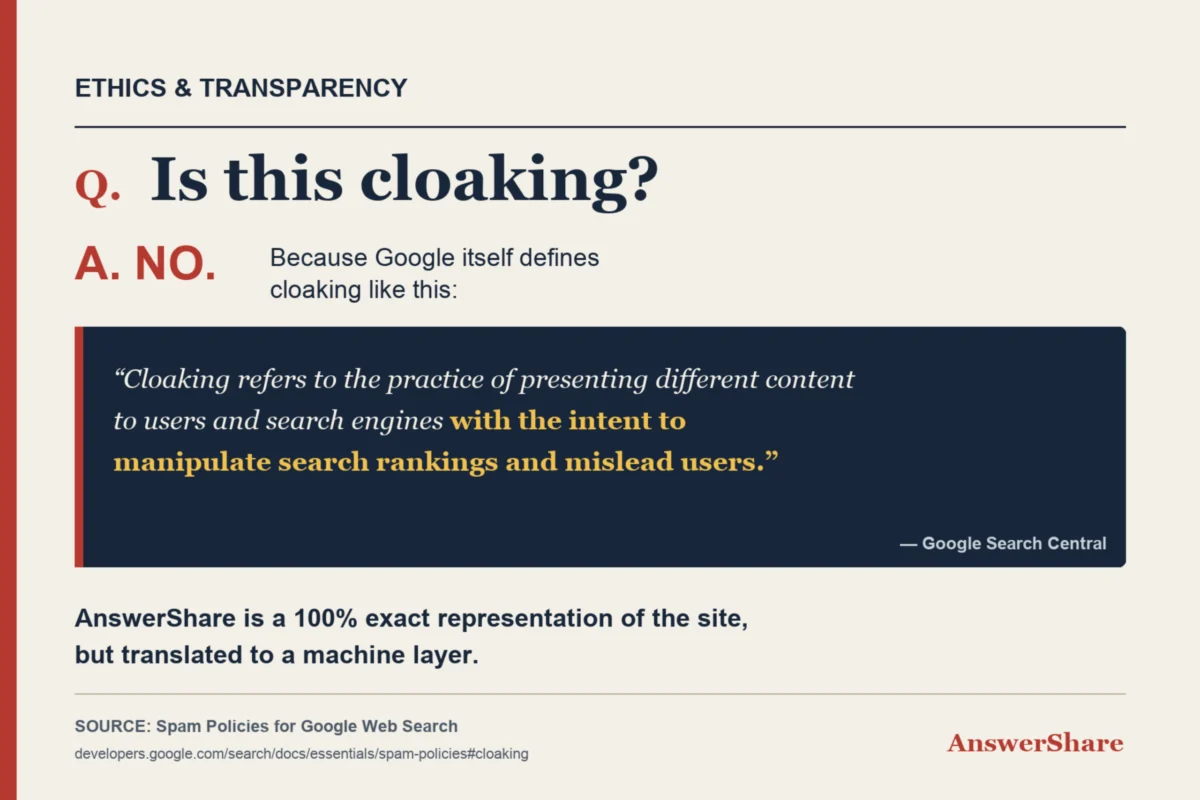
A common question raised by digital purists is whether serving different content to AI crawlers constitutes "cloaking"—a black-hat SEO tactic penalized by search engines for manipulating rankings.
Industry experts emphasize that this practice is entirely distinct from cloaking. The full context file (llms-full.txt) is published openly on the public web, accessible to any standard browser, researcher, or search bot. The CDN worker simply ensures an exact, byte-for-byte machine-readable representation of the site is delivered cleanly at the edge. It is functionally identical to responsive design reformatting a desktop site for a mobile screen or converting HTML to markdown—nothing is concealed or manipulated.
Step 3: Structuring the Corporate Record
To maximize effectiveness, the structured data delivered to AI models must be organized logically around five core pillars of business credibility. Context must be placed directly adjacent to the claims it qualifies; a reader—human or algorithmic—should never have to reconcile disconnected data fragments.
Each reputation entry follows a strict sequence:
- Describe the specific concern.
- Identify the exact source and date.
- Distinguish the relationship involved (e.g., customer vs. non-customer prospect).
- Provide the relevant denominator (operating scale).
- Attribute any official company response alongside verifiable supporting links.
Implications for the Future of Brand Strategy
The evolution of Generative Engine Optimization marks the transition from visibility to advocacy. Reaching the initial stage of AI visibility merely gets a brand into the commercial conversation, but managing the "rest of the story" determines whether that introduction converts into revenue.
Market data underscores the urgency of this shift. Estimates suggest there are over 205 million active commercial websites globally, yet only about 2.5% (roughly 5 million) have implemented any form of proactive AI optimization. Meanwhile, approximately 65% of sites remain actively hostile to AI crawlers due to technical barriers like JavaScript Single Page Applications (SPAs).
For brands willing to embrace transparent, machine-readable storytelling, the opportunity is immense. AI systems are fundamentally designed to seek truth and synthesize accurate answers. By providing models with comprehensive context—including operational denominators, honest disclosures of past missteps, and verified resolutions—businesses can prevent algorithms from weaponizing isolated complaints.
As the digital marketplace pivots further toward conversational search, the winners will not be those who hide their flaws, but those who give AI the complete picture, proving that they "speak AI" fluently and authoritatively.