






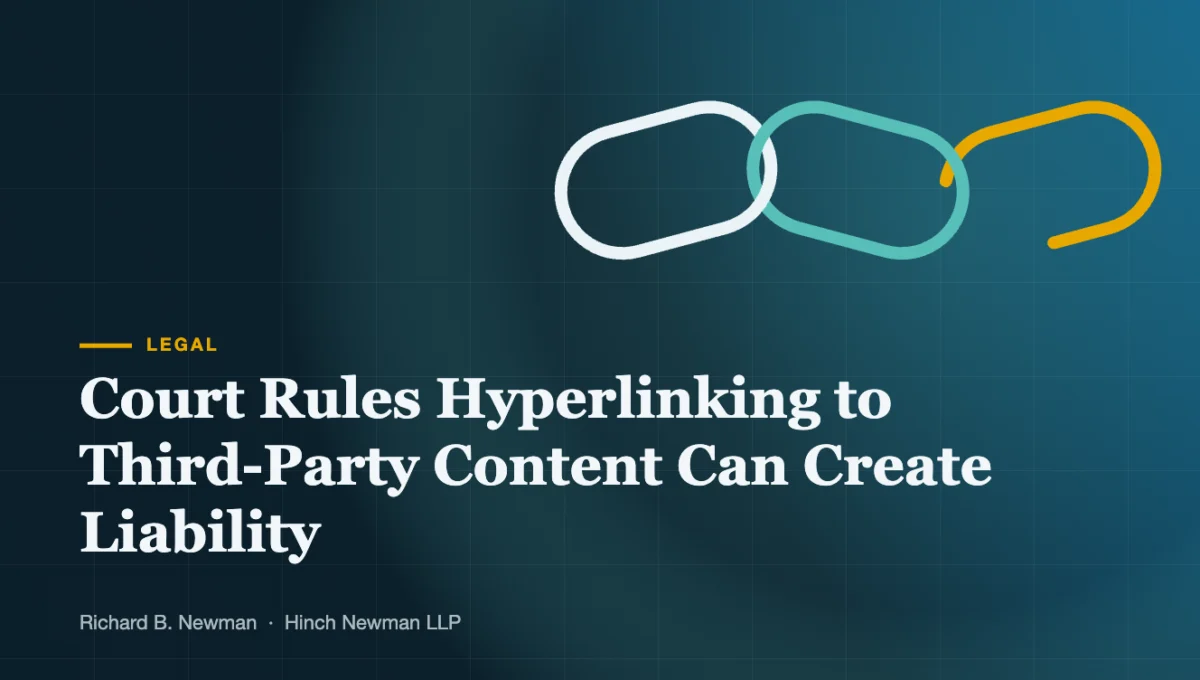
In the interconnected landscape of modern digital marketing, the hyperlink has long been considered a neutral bridge—a mere navigational tool connecting one digital island to another. However, a seismic shift in legal precedent has fundamentally altered this perception. A recent decision by the U.S. Court of Appeals for the Tenth Circuit in KetoNatural Pet Foods, Inc. v. Hill’s Pet Nutrition, Inc. (No. 24-3185, July 14, 2026) has dismantled the traditional “hands-off” approach to external content.
The court’s ruling establishes a critical new standard: third-party materials accessed via hyperlinks embedded on a corporate website can, under specific circumstances, be classified as "commercial speech." For businesses, this means that the content you link to may now be legally tethered to your own marketing claims, potentially exposing companies to liability under the Lanham Act for false advertising.
Main Facts: The "Integrated Message" Doctrine
At the heart of the KetoNatural decision is the concept of "intentional incorporation." The Tenth Circuit held that when a company deliberately directs consumers toward third-party content as part of a cohesive promotional strategy, that linked content can no longer be viewed in isolation.
Instead, the court suggests that the hyperlinked material becomes an extension of the primary website’s promotional message. If a company uses a link to support a specific product claim, and that third-party source contains false or unsubstantiated information, the directing company may be held legally accountable for the content of the destination page.
This ruling effectively moves the goalposts for digital compliance. Previously, companies often relied on the defense that they were not responsible for the veracity of external sources. The Tenth Circuit has now signaled that if the link is used as an instrument of persuasion—functioning as a piece of a company’s marketing narrative—the distinction between "our site" and "their site" dissolves.
Chronology of the Dispute
The legal battle between KetoNatural Pet Foods and Hill’s Pet Nutrition did not emerge in a vacuum. It represents the culmination of years of friction regarding how scientific studies and third-party endorsements are utilized in the pet food industry.
- Initial Allegations: KetoNatural initiated the dispute by challenging the advertising claims made by Hill’s Pet Nutrition, arguing that the latter utilized misleading scientific references to bolster their market position.
- District Court Proceedings: The lower court initially faced questions regarding the extent to which Hill’s could be held liable for the content found on the external websites they referenced via links. The debate centered on whether the Lanham Act—which prohibits false or misleading descriptions of fact in commercial advertising—could reach beyond the literal text of a defendant’s website.
- Tenth Circuit Ruling (July 14, 2026): In a definitive move, the Tenth Circuit Appellate Court provided clarity, ruling that the “pathway” of the consumer’s journey—from the primary site to the linked site—creates a unified commercial message. The court emphasized that the defendant’s intent to use the linked content to validate their own promotional claims was the deciding factor.
Supporting Data and Legal Context
To understand the weight of this decision, one must look at the evolution of the Lanham Act. Section 43(a) of the Lanham Act provides a broad mechanism for challenging false advertising. Historically, however, courts have struggled with the "boundary" of an advertisement.
In the digital age, where content is curated and synthesized, the Tenth Circuit’s decision mirrors an increasing regulatory interest in how information is presented to consumers. The Federal Trade Commission (FTC) has long maintained that disclosures must be clear and conspicuous. This ruling effectively expands the "clear and conspicuous" requirement to include the accuracy of the entire ecosystem of links provided to the consumer.
The court noted that when a corporation curates a selection of links, they are effectively "endorsing" the content within those links. By providing the hyperlink, the company is making an implied assertion that the linked content is relevant, credible, and supportive of the company’s own claims. If the linked study or article is later found to be fraudulent or misleading, the "curator" of those links has effectively disseminated that misinformation.
Official Responses and Industry Impact
While the parties involved continue to navigate the aftermath of the ruling, legal experts have been quick to react. Richard B. Newman, an advertising practices attorney at Hinch Newman LLP, highlights that this is a "watershed moment" for digital marketers.
"This decision is not merely about pet food; it is about the fundamental architecture of the internet," says Newman. "For years, companies assumed that linking to a scientific study or an influencer’s blog provided a layer of insulation. The Tenth Circuit has removed that insulation. If you choose to lead a consumer down a specific path to convince them to buy your product, you are responsible for every stop along that path."
Industry trade groups are reportedly reviewing the implications for affiliate marketing, where links to third-party reviews and product comparisons are standard practice. The consensus among legal counsel is that the era of "passive hyperlinking" is over.
Implications for Digital Marketing and Compliance
The repercussions of the KetoNatural decision are far-reaching and necessitate an immediate audit of digital marketing practices.
1. The Death of "Passive" Referencing
Marketers can no longer blindly link to articles, studies, or third-party endorsements. Every link must be vetted as if it were original content written by the company itself. If a link leads to a source that makes unsubstantiated claims, that source is now a potential liability.
2. The "Pathway" Analysis
Courts will now look at the "promotional pathway." If a company’s website uses a hyperlink to guide a user toward a specific conclusion—such as a link that says "See why our product is better than the rest"—the linked content will be scrutinized as part of the company’s commercial speech.
3. Generative AI and Automated Content
The ruling also has significant implications for generative AI. If an AI agent or a chatbot embedded on a website provides links to support its claims, the company deploying that AI may be liable for the content within those links. This effectively forces companies to train their AI models to link only to highly verified, reputable sources.
4. Regulatory Vigilance
It is highly probable that the FTC and state Attorneys General will use this precedent to broaden their enforcement actions. The ability to argue that a company is "incorporating" third-party lies into its own marketing message gives regulators a powerful new tool to pursue companies that hide behind external sources.
Strategic Recommendations for Compliance
In light of this ruling, businesses must adopt a proactive stance to mitigate risk:
- Hyperlink Audit: Conduct a comprehensive review of all external links on your website. Remove links that lead to questionable, non-peer-reviewed, or potentially misleading third-party content.
- Contextual Disclaimers: While not a "get out of jail free" card, clearly labeling external links as "Independent Third-Party Content" and explicitly stating that the company does not endorse or verify the accuracy of such content may provide some level of protection.
- Scientific and Influencer Vetting: Ensure that any scientific studies or influencer testimonials linked in your marketing materials are backed by rigorous data. If an influencer’s content is linked, ensure that the content complies with all FTC guidelines regarding disclosures and truth-in-advertising.
- Legal Review of Marketing Paths: Engage with experienced FTC compliance counsel to map out your digital marketing "pathways." Understand how a consumer moves from your landing page to your conversion point, and identify the risks at every step.
Conclusion
The KetoNatural Pet Foods, Inc. v. Hill’s Pet Nutrition, Inc. decision serves as a stark reminder that in the eyes of the law, digital marketing is an integrated, holistic experience. The convenience of the hyperlink is no longer a shield against liability.
As digital landscapes continue to evolve—incorporating AI-driven insights and complex affiliate ecosystems—the responsibility for accuracy remains squarely on the shoulders of the company that initiates the marketing message. By failing to police the links they provide, companies are not just sending traffic; they are importing legal risk. Moving forward, the most successful companies will be those that treat every external link as a critical component of their own brand promise and legal compliance strategy.
Disclaimer: This article is for informational purposes only and does not constitute legal advice. The legal landscape surrounding digital advertising is complex and subject to change; businesses should consult with qualified legal counsel regarding their specific circumstances and advertising practices.