







WASHINGTON — In the murky underbelly of the global cybercrime ecosystem, the lines separating those who defend networks from those who pillage them have grown dangerously blurred. A sweeping U.S. federal investigation into the notorious ShinyHunters hacking syndicate—which recently escalated its campaign by targeting the FBI itself—has exposed an alarming nexus between corporate cybersecurity executives and high-stakes cyber extortionists.
According to federal investigators, sources close to the probe, and leaked digital communications, executives at prominent ransomware negotiation and consulting firms have maintained unusually cozy, and potentially criminal, relations with the extortion group. In at least one instance, a U.S.-based executive is accused of helping operate a public shaming and extortion website on behalf of the hackers.
The sprawling investigation has already triggered international arrests, unraveled an alleged murder-for-hire plot, and drawn intense scrutiny to the lucrative, unregulated market of ransomware negotiation.
The Main Facts: The Rise of "Rey" and the FBI Breach
The ShinyHunters syndicate has cast a long shadow over cybersecurity since 2019, originating as a collective primarily operated by cybercriminals in France. As law enforcement dismantled the original roster, command of the brand eventually coalesced around "Rey," identified last year by researchers and law enforcement as a teenage hacker based in Amman, Jordan. According to estimates from the FBI, ShinyHunters has successfully extorted upward of $70 million from corporate and public-sector victims in 2026 alone.
The group’s brazenness reached a fever pitch in late September, when hackers aligned with ShinyHunters infiltrated fbijobs.gov, the official recruitment website of the Federal Bureau of Investigation. To taunt law enforcement, the syndicate threatened to publish a trove of deeply sensitive personnel records stolen from the site, reportedly including Social Security numbers, home addresses, medical and psychological evaluations, and specifics regarding employees’ specialized units.

The breach of a federal law enforcement portal spurred an aggressive, rapid-fire response from the bureau. Federal agents have moved swiftly to detain and interrogate anyone worldwide who maintained digital lines of communication with Rey or his associates. On October 3, Reuters reported that Rey had been captured by Jordanian authorities and was actively cooperating with the FBI.
Rey’s ascent to leadership, however, was only possible due to a major law enforcement breakthrough in Europe weeks prior. On the evening of September 15, 2026, Dutch police executed a high-stakes raid in the Netherlands, deploying flash-bang grenades to apprehend Pepijn van der Stap, a convicted hacker and suspected senior member of ShinyHunters, just as he was actively logged into his digital accounts.
Chronology of an Investigation
The arrest of Van der Stap served as the linchpin that unlocked the broader conspiracy. Seized while actively using his Signal messaging application, Van der Stap’s device provided investigators with a real-time ledger of his frequent contacts, including ransomware negotiators stationed in Canada and the United States.
The Key Milestones:
- September 15, 2026: Dutch police arrest Pepijn van der Stap, recovering active Signal chats that expose close coordination with Western ransomware negotiators.
- Late September 2026: ShinyHunters hacks fbijobs.gov, threatening to leak confidential personnel records.
- October 3, 2026: Reuters reports that ShinyHunters administrator "Rey" has been detained in Jordan and is cooperating with the FBI.
- October 7, 2026: The U.S. Department of Justice charges MonsterCloud CEO Zohar Pinhasi with wire fraud and conspiracy for secretly paying hackers behind his clients’ backs.
- October 9, 2026: The FBI arrests 54-year-old Canadian cybersecurity executive Edward Dubrovsky, charging him with extortion and interfering with interstate commerce.
- October 16, 2026: The "shinywire[.]com" extortion website—allegedly operated with the assistance of a U.S. consulting executive—goes offline after months of hosting breach demands for nearly 100 organizations.
According to sources close to the probe, Van der Stap’s chat logs contained explosive revelations. The Dutch hacker communicated frequently with Edward Dubrovsky, a Canadian cybersecurity executive, and executives at a major U.S.-based consulting firm. Disturbingly, investigators discovered that these negotiators often possessed intimate details regarding new ShinyHunters victims before the victim organizations even realized they had been breached. Furthermore, records indicate Dubrovsky knew the FBI’s servers had been compromised long before public threats were made, yet failed to notify the bureau.
The fallout extended beyond digital extortion. Sources revealed that Van der Stap’s messages pointed to a nascent murder-for-hire plot directed abroad. While no attacks were ultimately carried out, Dutch media outlet RTL reported that Van der Stap allegedly issued the orders.

Supporting Data: The Anatomy of "Shinywire" and Insider Links
Federal investigators believe that at least one executive at a prestigious U.S.-based consulting firm—one boasting over 1,000 associates—played an active operational role in maintaining shinywire[.]com.
Active from May 3 until October 16, 2026, the Shinywire platform served as an aggressive pressure valve for the cybercrime group. It listed nearly 100 corporate and institutional victims, displaying samples of stolen files and warning that data would be dumped on the Tor-based ShinyHunters shaming blog if ransom demands were not met within seven days. Among the high-profile victims cataloged on the site was American medical technology giant Intuitive Surgical, which suffered a credential-compromise breach in March 2026.
The Ghostbyte Connection
The web of associations deepens when examining historical hacker monikers. Interviews with former colleagues of Daniel Tobok, former CEO of the Toronto-founded cybersecurity firm Cypfer, reveal that as far back as 2018, Tobok was known among ransomware purveyors by the alias "Ghostbyte."
In 2018, a Canadian company targeted by the Russian-language Dharma ransomware affiliate program requested assurances that the hackers would keep their word if a ransom was paid. In an email response, a Dharma representative advised the victim to contact an IT firm through the email address [email protected], noting: "This IT company often solves such problems in Canada."
Threat intelligence platform Constella Intelligence later linked an email address frequently used by Tobok ([email protected]) to online accounts bearing the username "ghostbyte." Additionally, Constella tied the Dharma representative’s wallet to a cryptocurrency address that processed roughly 43 Bitcoin (valued at approximately $3.5 million).

Tobok has not responded to multiple requests for comment regarding the Ghostbyte alias. Meanwhile, Cypfer issued a statement distancing itself from the controversy, emphasizing that the company does not facilitate ransomware payments, had no prior knowledge of Dubrovsky’s arrest, and operates independently from related entities like CyberSteward Inc. Cypfer was recently acquired by the Apros Group, a holding company led by former FBI special agent Jason Hogg.
Official Responses and Industry Conflict of Interests
The revelations have ignited a fierce debate regarding the ethics and legality of the cyber extortion remediation industry. While paying a ransom is not inherently illegal in the United States—provided the threat actor is not a sanctioned entity under Treasury Department guidelines—the business model of ransomware negotiation is rife with structural conflicts of interest.
Mark Camillo, CEO of cyber insurance industry group CyberAcuView, pointed out that many remediation firms charge a percentage of the total ransom paid rather than a flat retainer fee.
"This makes no sense if they are also the negotiator," Camillo said. "There needs to be more transparency in the process, as no one in the ecosystem should be profiting purely on the size of the ransomware transaction or payment itself."
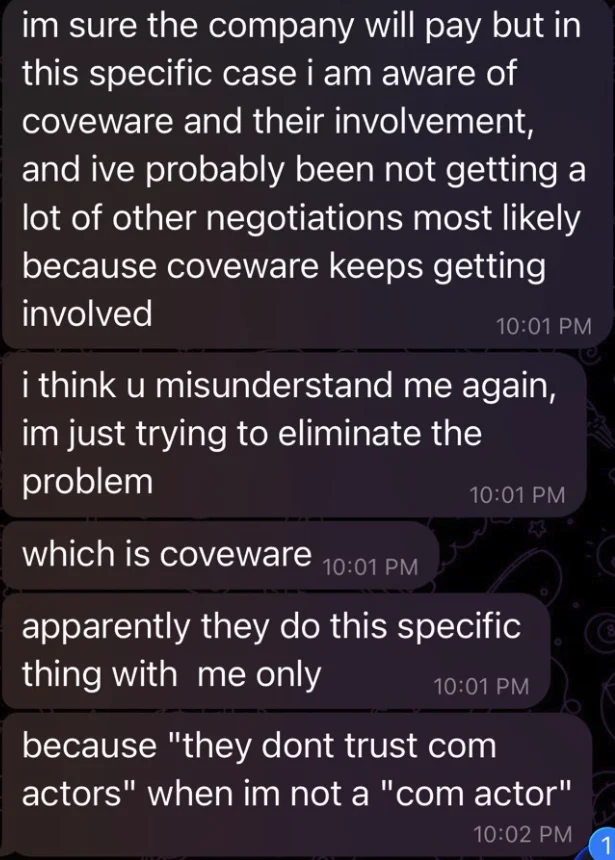
Leading incident response firms, including Coveware and Unit 221B, have long urged victims to refuse negotiations with ShinyHunters, warning that extortionists routinely retain stolen data regardless of payouts. This strict stance has made Coveware a prime target for the syndicate. Leaked Telegram chats from April and May 2026 show ShinyHunters leaders venting intense frustration, complaining that Coveware’s anti-ransom advice was tanking their payment rates and vowing to "eliminate the problem."

Federal prosecutors are increasingly targeting compromised negotiators. In July, ransomware negotiator Angelo Martino was sentenced to 70 months in prison for leaking client strategies to the Blackcat/ALPHV gang. Days before Dubrovsky’s arrest, the DOJ charged MonsterCloud CEO Zohar Pinhasi with wire fraud for secretly funneling $8 million to hackers behind his clients’ backs while billing them $19 million for supposed remediation.
Implications for National Security and the Future of Incident Response
The intersection of state-sponsored espionage, cybercrime syndicates, and corporate remediation has created a regulatory and operational crisis.
The hack of fbijobs.gov demonstrates that no organization—not even the premier domestic law enforcement agency—is immune to supply-chain and credential-based incursions. More critically, the alleged complicity of individuals within Western consulting and negotiation firms suggests that a segment of the cybersecurity industry has been co-opted from within, transforming trusted advisors into double agents for extortion cartels.
As the Department of Justice and the FBI press forward with their sealed indictments and ongoing trials, the cybersecurity sector faces a reckoning. The erosion of trust between victims, insurers, and remediation firms demands stringent regulatory oversight, mandatory transparency regarding ransom fee structures, and a hardline industry consensus: negotiating with extortionists must no longer be allowed to operate in the shadows.